
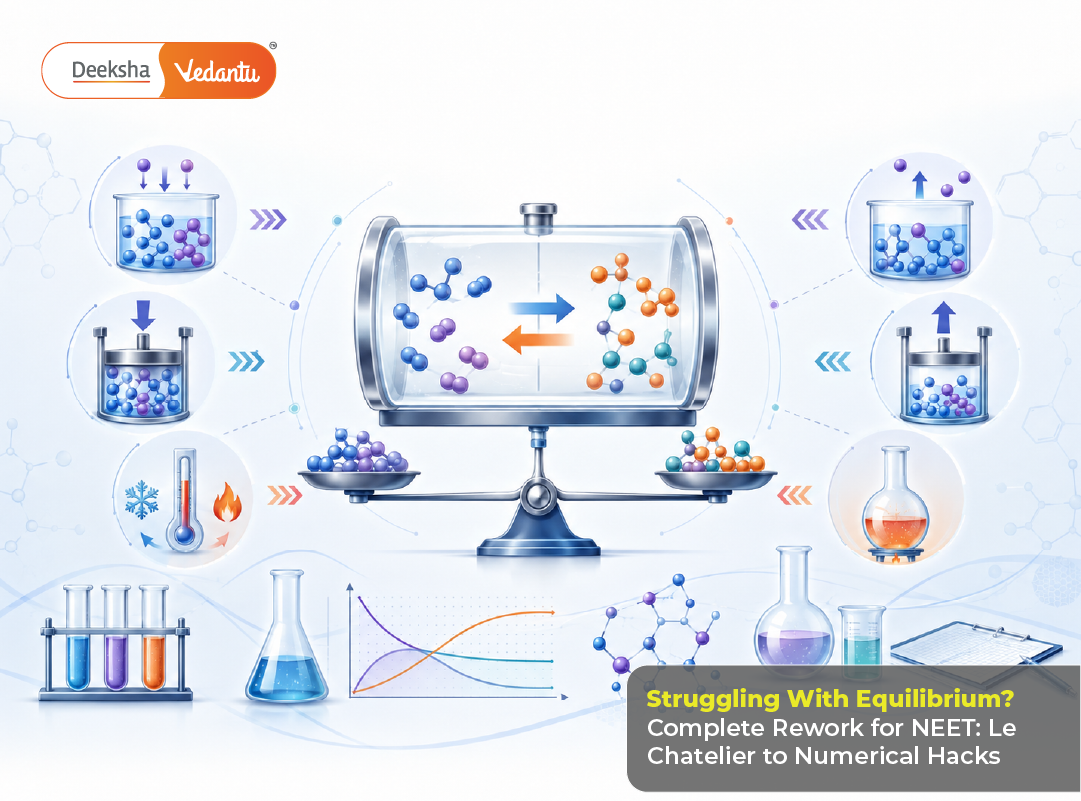


Equilibrium is the chapter where NEET Chemistry students often hit a wall – not because the concepts are individually hard, but because the chapter demands switching between qualitative reasoning (Le Chatelier’s principle) and precise numerical manipulation (Kc, Kp, pH, Ka, Kb) within the same paper. This rework walks through both halves systematically, with the shortcuts that actually save time under exam pressure.
Why Equilibrium Deserves a Dedicated Rework
NEET typically draws 3–5 questions from equilibrium, split fairly evenly between chemical equilibrium (gas-phase reactions, Le Chatelier’s principle) and ionic equilibrium (acids, bases, pH, buffers, solubility product). Students who treat these as one chapter often blur formulas that belong to different sub-topics. The cleanest fix is to rebuild the chapter as two connected tracks rather than one undifferentiated block.
Track 1: Chemical Equilibrium – The Dynamic Balance
A reaction reaches dynamic equilibrium when the rate of the forward reaction equals the rate of the reverse reaction, and concentrations of reactants and products stop changing – not because the reaction has stopped, but because both directions proceed at equal rates. The conceptual distinction between a static and dynamic equilibrium is explored in more depth in the dynamic equilibrium chapter, which NEET occasionally tests through definition-based one-liners.
Homogeneous vs Heterogeneous Equilibria
Homogeneous equilibrium – all reactants and products are in the same phase (e.g., N₂ + 3H₂ ⇌ 2NH₃, all gases). The full equilibrium constant expression includes every species.
Heterogeneous equilibrium – reactants and products exist in different phases (e.g., CaCO₃(s) ⇌ CaO(s) + CO₂(g)). Pure solids and liquids are excluded from the equilibrium constant expression, since their “concentration” is essentially constant.
NEET frequently tests this exclusion rule directly – given a heterogeneous reaction, write the correct Kc or Kp expression, omitting solid and liquid terms. A full set of worked examples distinguishing these two categories is available in the heterogeneous equilibria chapter.
The Equilibrium Constant: Kc and Kp
For a general reaction aA + bB ⇌ cC + dD:
Kc = [C]^c[D]^d / [A]^a[B]^b
Relationship between Kp and Kc:
Kp = Kc(RT)^Δn
where Δn = (moles of gaseous products) – (moles of gaseous reactants)
This Δn-based relationship is one of NEET’s most reliable numerical questions – get the sign of Δn wrong, and the entire answer inverts. Numerical hack: if Δn = 0 (equal moles of gas on both sides), Kp = Kc directly – a quick check worth doing first before any calculation.
Le Chatelier’s Principle: The Qualitative Engine
Le Chatelier’s Principle states that when a system at equilibrium is subjected to a change in concentration, pressure, volume, or temperature, the equilibrium shifts to counteract that change.
| Stress Applied | Equilibrium Shift |
| Increase concentration of reactant | Shifts forward (toward products) |
| Increase concentration of product | Shifts backward (toward reactants) |
| Increase pressure (decrease volume) | Shifts toward side with fewer gas moles |
| Increase temperature | Shifts toward endothermic direction |
| Add inert gas at constant volume | No effect on equilibrium position |
| Add catalyst | No shift; only speeds up reaching equilibrium |
NEET trap to remember: A catalyst never shifts equilibrium position – it only reduces the time taken to reach equilibrium by lowering activation energy for both forward and reverse reactions equally. This is one of the most repeated single-line NEET questions in the entire chapter. The full set of factors and their derivations is detailed in the factors affecting equilibria chapter.
Applying Le Chatelier’s to a Specific Reaction
For the Haber process: N₂(g) + 3H₂(g) ⇌ 2NH�3(g) + heat
Since the forward reaction has fewer gas moles (2 vs 4) and is exothermic, NEET-style reasoning predicts: increasing pressure favours forward reaction (NH₃ formation); increasing temperature favours the reverse reaction (since forward is exothermic) – meaning industrial NH₃ production uses moderate temperature, not high temperature, despite the kinetic benefit of higher temperatures. This nuance – balancing yield against rate – is a favourite NEET conceptual question. More worked reasoning chains like this are available in the applications of equilibrium constants chapter.
Track 2: Ionic Equilibrium – Acids, Bases, and pH
Ionic equilibrium governs the dissociation behaviour of acids, bases, and salts in solution – and is where most of NEET’s numerical-heavy equilibrium questions live.
pH and the Ion Product of Water
pH = –log[H⁺], pOH = –log[OH⁻], and at 25°C: pH + pOH = 14
Kw = [H⁺][OH⁻] = 10⁻¹⁴ at 25°C
Numerical hack: For strong acids/bases, dissociation is complete, so [H⁺] or [OH⁻] equals the given concentration directly – no equilibrium calculation needed. This shortcut alone resolves a large fraction of NEET’s “fastest” pH questions.
Weak Acids and Bases: Ka, Kb, and the Approximation Trick
For a weak acid HA ⇌ H⁺ + A⁻:
Ka = [H⁺][A⁻]/[HA], and [H⁺] = √(Ka × C) (when α is small, using the approximation 1–α ≈ 1)
This square-root shortcut is the single biggest numerical time-saver in this chapter – instead of solving a full quadratic, NEET problems involving weak acid dissociation almost always permit this approximation when Ka is small relative to concentration.
Relationship between Ka, Kb, and Kw: Ka × Kb = Kw (for a conjugate acid-base pair)
A complete treatment of ionic dissociation patterns, including degree of dissociation (α) and Ostwald’s dilution law, is available in the ionic equilibrium chapter.
Buffer Solutions: The Henderson-Hasselbalch Shortcut
A buffer resists changes in pH upon addition of small amounts of acid or base, typically made from a weak acid and its conjugate base (or weak base and its conjugate acid).
pH = pKa + log([salt]/[acid])
Numerical hack: When [salt] = [acid] in a buffer, the log term becomes zero, so pH = pKa directly – a fast check NEET numericals often rely on. The full derivation and buffer capacity concepts are detailed in the buffer solutions chapter.
Solubility Equilibria: Ksp Shortcuts
For a sparingly soluble salt AxBy ⇌ xA + yB:
Ksp = [A]^x[B]^y
Numerical hack: For a salt like AgCl (1:1 ratio), if solubility is ‘s’, Ksp = s². For a salt like Ag₂CO₃ (2:1 ratio), Ksp = (2s)²(s) = 4s³. Recognising the stoichiometric pattern immediately, rather than rederiving it each time, saves significant time. NEET also tests the common ion effect – adding a common ion decreases the solubility of a sparingly soluble salt, a direct consequence of Le Chatelier’s principle applied to ionic equilibrium. Full worked numericals on this are available in the solubility equilibria chapter.
Solved NEET-Style Numerical: Weak Acid pH
Find the pH of a 0.01 M solution of acetic acid (Ka = 1.8 × 10⁻⁵).
[H⁺] = √(Ka × C) = √(1.8 × 10⁻⁵ × 0.01) = √(1.8 × 10⁻⁷) ≈ 4.24 × 10⁻⁴ M
pH = –log(4.24 × 10⁻⁴) ≈ 3.37
Practice Questions Styled After NEET
Q1. A catalyst added to a reaction at equilibrium:
(a) Shifts equilibrium forward (b) Shifts equilibrium backward (c) Has no effect on equilibrium position (d) Increases Kc)
Answer: (c)
Q2. For the reaction N₂ + 3H₂ ⇌ 2NH₃, the value of Δn for the Kp-Kc relationship is:
(a) +2 (b) –2 (c) +4 (d) 0)
Answer: (b) – (2 – 4 = –2)
Q3. If [salt] = [acid] in a buffer solution, then:
(a) pH = 7 (b) pH = pKa (c) pH = pKb (d) pH = 0)
Answer: (b)
Q4. The solubility product of AgCl is s². This is because the dissociation produces:
(a) Two different ions in 1:1 ratio (b) Three ions (c) Equal moles of Ag and Cl in 2:1 ratio (d) No ions)
Answer: (a)
Why a Two-Track Approach Works Better Under Time Pressure
Equilibrium becomes manageable the moment you stop treating it as one undifferentiated chapter and start recognising which track a question belongs to – chemical equilibrium questions test direction and constants (Kc, Kp, Le Chatelier), while ionic equilibrium questions test concentration math (pH, Ka, Ksp). This same track-separation instinct is useful elsewhere in Chemistry too – distinguishing when a question needs Gibbs energy and equilibrium reasoning versus straightforward Kc substitution often determines how quickly a thermodynamics-flavoured equilibrium question gets solved.
For repeaters, equilibrium is frequently a chapter where the first attempt left gaps not in concept understanding but in numerical speed – knowing the formula but spending too long deriving rather than recognising the shortcut. Deeksha’s NEET repeater course specifically drills these numerical shortcuts as a separate skill from concept revision, since exam-day performance in chapters like this depends as much on speed as on accuracy.








Get Social