
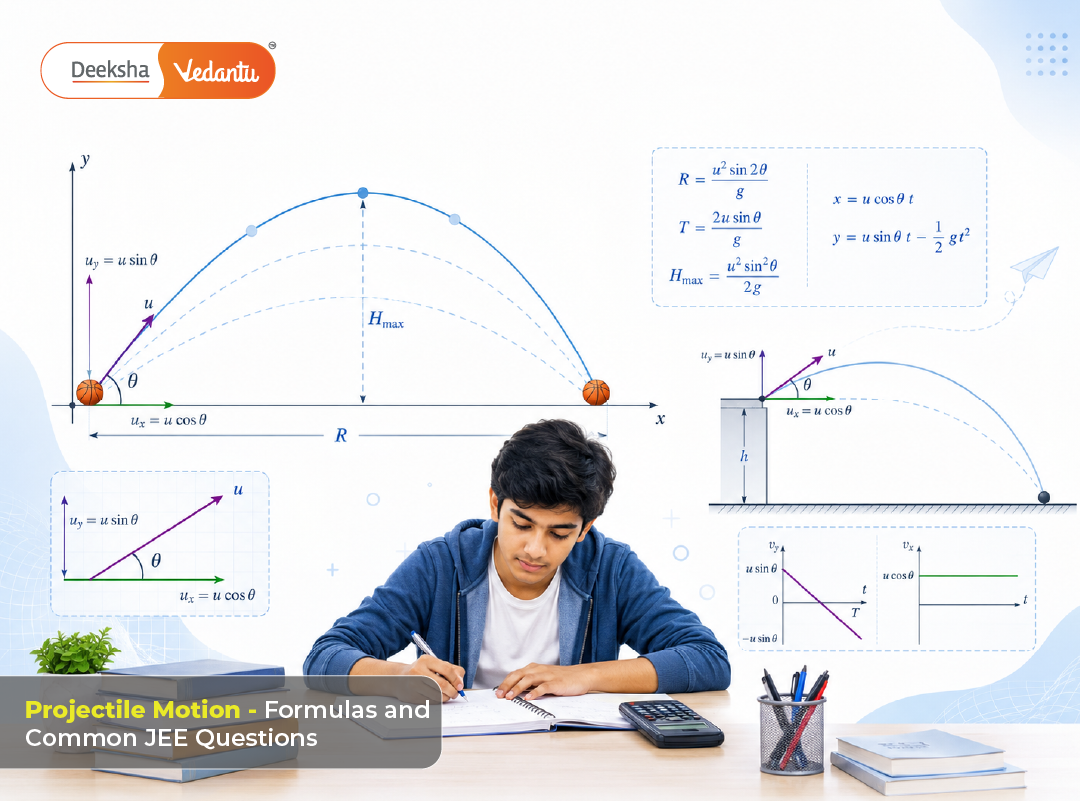


Projectile Motion is really just two independent motions happening at the same time – constant velocity horizontally, and constant acceleration (gravity) vertically – and almost every JEE question in this chapter is testing whether you can keep those two motions separate in your head without accidentally mixing them together. Here’s the complete formula set, followed by the five question types JEE returns to most often, each solved in full.
The Core Formula Set
For a projectile launched with initial speed u at angle θ above the horizontal:
- Time of flight: T = 2u sinθ / g
- Maximum height: H = u² sin²θ / 2g
- Horizontal range: R = u² sin2θ / g
- Velocity components at any time t: vₓ = u cosθ (constant), vy = u sinθ – gt
- Equation of trajectory: y = x tanθ – gx² / (2u²cos²θ)
The one relationship worth internalizing before anything else: horizontal motion has zero acceleration (vₓ never changes), while vertical motion is just free fall dressed up with an initial upward push. Every formula above is built from applying ordinary straight-line kinematics separately to each direction – nothing here is a new kind of physics, just two familiar equations running in parallel.
Common Question Type 1: Finding Range, Height, and Time Together
Question: A ball is projected at 20 m/s at an angle of 30° above the horizontal. Find its time of flight, maximum height, and range. (Take g = 10 m/s²)
Solution:
T = 2(20)sin30° / 10 = 2(20)(0.5)/10 = 2 s
H = (20)²sin²30° / 2(10) = 400(0.25)/20 = 5 m
R = (20)²sin60° / 10 = 400(0.866)/10 = 34.64 m
This is the most direct application of the formula set, and it’s exactly why memorizing these three formulas cold – rather than re-deriving them from scratch each time – matters for speed on exam day. The full derivation of each formula, including why sin2θ specifically shows up in the range equation, is worked through on the projectile motion page.
Common Question Type 2: The Angle-Pair Trap
Question: At what two angles of projection will a projectile have the same horizontal range, for the same initial speed?
Solution: Since R = u²sin2θ/g, and sin(2θ) = sin(180° – 2θ), any two angles θ₁ and θ₂ satisfying θ₁ + θ₂ = 90° will produce identical range.
For example, a projectile launched at 30° and one launched at 60° (same speed) will land at exactly the same distance – even though one is a low, flat trajectory and the other is a steep, high one.
This is one of JEE’s favorite conceptual traps precisely because it feels counterintuitive – students assume a steeper angle should always travel further or shorter, when in fact it’s the complementary-angle pair, not the individual angle, that determines matching range. Worth noting: maximum height and time of flight are not equal for this angle pair, only range is – a distinction JEE occasionally tests by asking which quantities match and which don’t.
Common Question Type 3: Maximum Range and the 45° Result
Question: Prove that a projectile achieves maximum range when launched at 45°, and find that maximum range for u = 30 m/s.
Solution: Since R = u²sin2θ/g, R is maximized when sin2θ = 1, which occurs when 2θ = 90°, or θ = 45°.
At this angle: R(max) = u²/g = (30)²/10 = 90 m
This result is worth remembering as a standalone fact, not just a derivation – JEE frequently asks for maximum range directly without walking through the full proof, expecting you to recall R(max) = u²/g on sight. It’s also worth knowing this result only holds on level ground with no air resistance; questions involving launches from a height or into a headwind require the full trajectory equation instead, covered in more depth on the motion in a plane overview.
Common Question Type 4: Velocity at a Given Point in Flight
Question: A projectile is launched at 25 m/s at 37° (sin37° = 0.6, cos37° = 0.8). Find its speed and direction at t = 1 s. (g = 10 m/s²)
Solution:
vₓ = u cosθ = 25(0.8) = 20 m/s (stays constant throughout flight)
vy = u sinθ – gt = 25(0.6) – 10(1) = 15 – 10 = 5 m/s
Resultant speed: v = √(vₓ² + vy²) = √(400 + 25) = √425 ≈ 20.6 m/s
Direction: tan(angle) = vy/vₓ = 5/20 = 0.25, so angle ≈ 14° above horizontal
The critical habit here is treating vₓ and vy as two completely separate calculations that only get combined at the very last step – students who try to track a single “velocity” throughout the flight, rather than its two components independently, consistently make errors on this exact question type. This component-based thinking is exactly what’s built up systematically in the vector addition, analytical method unit, which underlies every projectile motion calculation involving direction.
Common Question Type 5: Projectile Launched From a Height (Oblique Case)
Question: A ball is thrown horizontally at 15 m/s from the top of a 20 m tall tower. Find the time to reach the ground and the horizontal distance traveled. (g = 10 m/s²)
Solution: Since the ball is thrown horizontally, the initial vertical velocity is zero, and the vertical motion is pure free fall from height 20 m.
Using h = ½gt²: 20 = ½(10)t² → t² = 4 → t = 2 s
Horizontal distance: x = u × t = 15 × 2 = 30 m
This variation – launching from a height rather than from level ground – breaks the standard time-of-flight and range formulas entirely, since those were derived assuming the projectile lands at the same height it launched from. JEE deliberately tests this variant to catch students who’ve memorized formulas without understanding where they actually came from; the moment launch height and landing height differ, you’re back to solving the vertical motion directly with basic kinematics, not the shortcut formulas from the top of this article.
The Five Question Types at a Glance
| Question Type | What It Tests |
| Direct formula application | Speed of recall for T, H, R |
| Complementary angle pairs | Understanding sin2θ = sin(180°-2θ) |
| Maximum range at 45° | Recognizing R(max) = u²/g as a standalone fact |
| Velocity at a given time | Keeping vₓ and vy genuinely independent |
| Launch from a height | Knowing when standard formulas stop applying |
Where This Fits Into Your Broader Mechanics Preparation
Projectile motion is really a specific case of the more general motion in a plane with constant acceleration framework – understanding that broader context makes it much easier to recognize when a question is quietly asking you to deviate from the standard T, H, R formulas, as in the height-launch case above. For circular motion problems that sometimes appear alongside projectile questions in the same JEE section, the uniform circular motion page is a useful parallel reference.
Testing this formula fluency against real conditions through JEE Main previous year question papers will show you exactly how often each of these five question types actually appears, and for a broader map of where projectile motion sits within your full Physics syllabus, this breakdown of physics in JEE formula sheets, concepts, and quick revisions is a useful companion reference. Deeksha’s JEE coaching programs are structured to build exactly this kind of component-based thinking before formulas are introduced, which is what makes variations like the height-launch case feel intuitive rather than confusing.
Frequently Asked Questions
Why does horizontal velocity stay constant throughout a projectile’s flight?
Because gravity acts only vertically – there’s no horizontal force acting on the projectile once it’s launched (ignoring air resistance), so horizontal velocity has nothing to change it.
Do the standard time of flight and range formulas work if a projectile is launched from a height?
No – those formulas assume the projectile lands at the same height it was launched from. If launch and landing heights differ, you need to solve the vertical motion directly using basic kinematics equations instead.
Is 45° always the angle of maximum range, even with air resistance?
The 45° result assumes no air resistance. In real-world conditions with significant drag, the optimal angle for maximum range is actually slightly less than 45°, though JEE’s idealized questions don’t typically account for this.
Projectile motion stops being confusing the moment you stop treating it as one complicated motion and start treating it as two simple ones happening side by side. Keep vₓ and vy separate in your head at every step, and the five question types above – however JEE dresses them up – reduce to the same handful of formulas applied correctly.











Get Social