
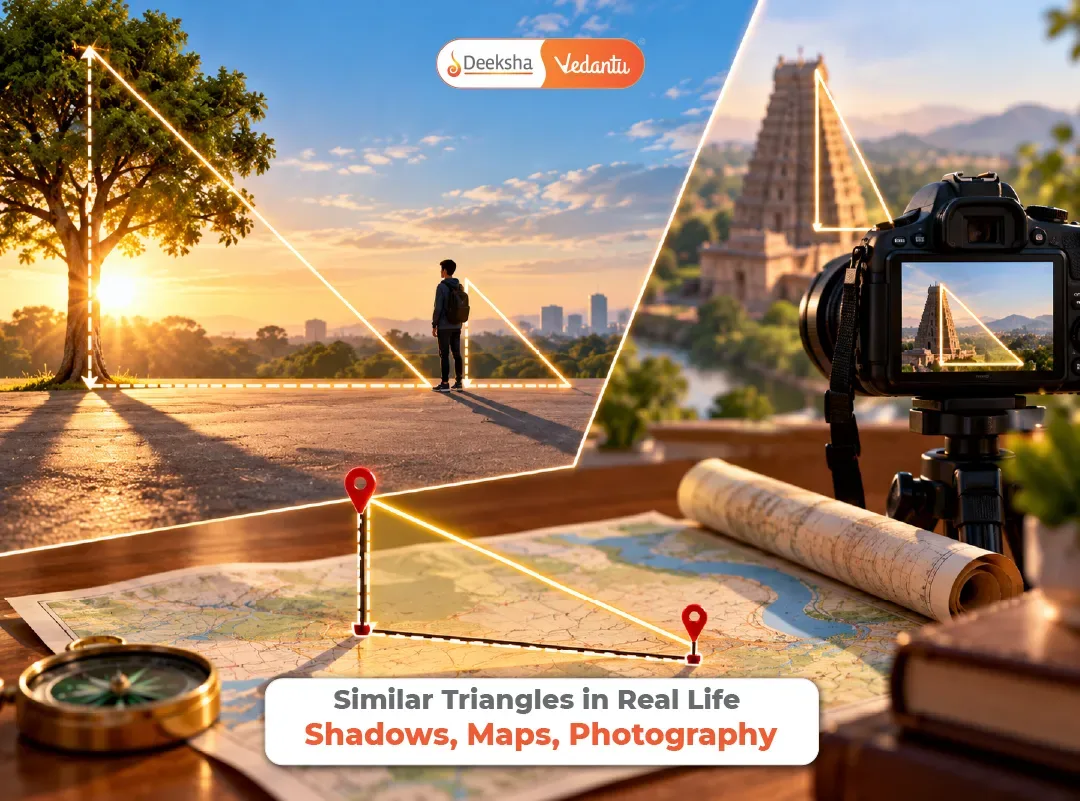


You cannot climb a tower with a measuring tape, and you cannot walk across a map, but you can still find the tower’s height and the real distance between two towns. The trick in both cases is the same: a small shape that has exactly the same form as a large one, so that measurements on the small one tell you about the large one. In geometry, that relationship is called similarity, and triangles are where it is easiest to prove.
This guide begins with what makes triangles similar, then applies the idea to shadows, maps, photographs, pinhole cameras and even solar eclipses, and ends with the mistakes that cost marks. For the theory, see these notes on the similarity of triangles and the criteria for similarity. The key theorem behind many of the proofs is explained in the basic proportionality theorem and its common proof mistakes.
What Makes Two Triangles Similar
Two triangles are similar if they have the same shape, even if they are different in size. That means two things are true at once: their corresponding angles are equal, and their corresponding sides are in the same ratio. The ratio is called the scale factor.
You do not need to check everything. Any one of these three criteria is enough.
| Criterion | What to check |
| AA (angle-angle) | Two angles of one triangle equal two angles of the other |
| SSS (side-side-side) | All three pairs of corresponding sides are in the same ratio |
| SAS (side-angle-side) | Two pairs of sides are in the same ratio, and the angle between them is equal |
AA is the one used most in real life, because it is easy to confirm. If two angles match, the third must match too, since the angles of a triangle add to 180°.
Shadows: Measuring What You Cannot Reach
At a given moment, the Sun’s rays reach everything at the same angle. A vertical pole and a vertical tree therefore make the same angle with the ground rays, and each stands at 90° to the ground. Two equal angles mean the triangles formed with their shadows are similar by AA.
Example. A 1.5 m tall person casts a shadow 2 m long. At the same moment, a tree casts a shadow 14 m long. How tall is the tree?
Because the triangles are similar, height ÷ shadow is the same for both:
Tree height ÷ 14 = 1.5 ÷ 2, so tree height = 1.5 × 14 ÷ 2 = 10.5 m.
The same method gives the height of a flagpole, a building or a hill, as long as you measure the two shadows at the same time of day and on level ground.
Maps and Scale Models
A map is a similar copy of a region. A scale of 1 : 50,000 means that 1 cm on the map stands for 50,000 cm, which is 500 m, on the ground. Every length on the map is the real length divided by 50,000, so a triangle of three towns drawn on the map is similar to the real triangle formed by the towns.
Example. Two towns are 6 cm apart on a map of scale 1 : 50,000. The real distance is 6 × 50,000 = 3,00,000 cm = 3 km.
The same idea applies to the scale model of a building, a toy car or an architect’s plan. The side ratio is the scale, and every length follows it.
Areas Follow the Square of the Scale
Here is the most important surprise in the chapter. If two triangles are similar with scale factor k, then their areas are in the ratio k².
Theorem. The ratio of the areas of two similar triangles is equal to the square of the ratio of their corresponding sides.
Example. Triangles ABC and DEF are similar, with AB : DE = 3 : 5. The area of ABC is 54 cm². Find the area of DEF.
Area ratio = (3/5)² = 9/25. So area of DEF = 54 × 25/9 = 150 cm².
This explains why a map with a scale of 1 : 50,000 shows areas shrunk by 1 : 2,500,000,000, not 1 : 50,000. When a length doubles, the area quadruples.
Photography and Enlargement
A photograph is a similar copy of a scene, and an enlargement is a similar copy of the photograph. If a 4 × 6 inch print is enlarged to 8 × 12 inches, every length doubles, so the scale factor is 2, and the area becomes 2² = 4 times as large. The picture does not distort, because the sides stay in proportion.
The same reasoning explains why stretching a photo to fit a different shape of frame distorts it: if the width and the height are scaled by different factors, the shapes are no longer similar.
The Pinhole Camera
The simplest camera is a box with a tiny hole. Light from each point of a scene passes through the hole and forms an upside-down image on the back wall. The object, the hole and the image form two similar triangles, so
image height ÷ object height = image distance ÷ object distance
Example. A tree 12 m tall stands 24 m from a pinhole camera, and the back of the box is 6 cm from the hole. How tall is the image?
Image height = 12 × 0.06 ÷ 24 = 0.03 m, which is 3 cm.
Why a Solar Eclipse Looks So Perfect
The Sun is about 400 times wider than the Moon, and about 400 times farther away. The two triangles formed by your eye and each disc are therefore nearly similar, so the two discs appear almost exactly the same size in the sky. That is why the Moon can just cover the Sun in a total solar eclipse. It is a coincidence, but a similar-triangles one.
Setting Up the Proportion Correctly
The most frequent mistake is matching the wrong sides. The safe method is to write the similarity with the vertices in matching order: if triangle ABC ~ triangle PQR, then A corresponds to P, B to Q and C to R, so AB/PQ = BC/QR = CA/RP. Always read the correspondence from the order of the letters.
Slips That Cost Marks
- Matching sides that do not correspond, for example pairing the longest side of one with the shortest of the other.
- Using the side ratio as the area ratio, instead of its square.
- Writing the similarity with the vertices in the wrong order.
- Using shadows measured at different times of the day.
- Assuming triangles are similar without stating the criterion (AA, SSS or SAS).
- Mixing units between the two triangles.
To see the same ideas used to build figures, see the guide to constructions, with step-by-step diagrams, and for heights found with angles, the guide on heights and distances and common diagram mistakes.
Triangles in Your Syllabus
Triangles is a chapter of the Class 10 Maths book in both the CBSE and the Karnataka SSLC textbooks. Published deleted-syllabus lists show that CBSE has trimmed some theorem proofs in this chapter, so check which proofs your own board expects. Practise with the chapter MCQs and the important questions. Similarity returns in Class 11 and 12 in trigonometry, coordinate geometry and vectors, which matter for JEE Main and KCET.
Frequently Asked Questions
Q1. What are similar triangles?
Triangles with equal corresponding angles and corresponding sides in the same ratio. They have the same shape but not necessarily the same size.
Q2. How do shadows help find heights?
At the same moment, an object and its shadow form a triangle similar to the triangle formed by a known object and its shadow, so the ratio of height to shadow is the same for both.
Q3. What is the relationship between the areas of similar triangles?
The ratio of their areas equals the square of the ratio of their corresponding sides.
Q4. Which criterion of similarity is used most often?
AA, because it only requires two equal angles, and the third is then automatically equal.
Q5. How does a map scale relate to similar triangles?
A map is a similar copy of the land, so triangles drawn between places on the map are similar to the real triangles, and every real length is the map length multiplied by the scale.
Same Shape, Different Size
Similar triangles let a short measurement stand in for a long one. Learn to spot the equal angles, set up the ratio with the vertices in order, and remember that areas follow the square. That is the whole chapter in three habits.





Get Social