
Every year, Class 10 parents ask the same question in November: what is in the syllabus, and what has been removed? The answer matters because the CBSE Class 10 board exams begin on 16 February 2027, and a student who studies a deleted topic loses time that a live chapter needed.
This guide sets out the CBSE Class 10 syllabus 2026-27 in plain terms. It lists the CBSE Class 10 deleted syllabus 2027 for Maths and Science, gives the chapter list for each subject, explains the marks pattern and shows how to turn the list into a revision plan. If you want to see how the changes were introduced, our breakdown of CBSE Class 10 syllabus changes subject-wise is a useful companion.
Where to Find the Official Syllabus
CBSE publishes the prescribed syllabus for each subject on its academic website, cbseacademic.nic.in, under the Curriculum 2026-27 section for Classes 9 and 10. CBSE does not issue a separate “deleted syllabus” list. Each subject document shows what is prescribed, and anything that is not listed is outside the exam.
Treat the subject PDF as the final word for your child’s subject combination. The lists below follow the prescribed content and are meant to help you plan, not to replace the PDF. For a school-level summary, our pages on the CBSE Class 10 Maths syllabus and the CBSE Class 10 Science syllabus give the chapter details.
CBSE Class 10 Exam Pattern for 2027 at a Glance
The first board exam for Class 10 runs from 16 February to 9 March 2027, and an optional second exam follows in May. Our guide to CBSE Class 10 two board exams in 2027 explains who can sit it.
In Maths and Science, each subject carries 80 marks for theory and 20 marks for internal assessment. The theory paper has a mix of objective, short-answer, long-answer and case-based questions, and the board has been raising the share of competency-based questions. So, learning concepts well matters more than memorising answers.
CBSE Class 10 Maths Syllabus 2026-27: Chapter List
The Class 10 Maths syllabus has 14 chapters:
- Real Numbers
- Polynomials
- Pair of Linear Equations in Two Variables
- Quadratic Equations
- Arithmetic Progressions
- Triangles
- Coordinate Geometry
- Introduction to Trigonometry
- Some Applications of Trigonometry
- Circles
- Areas Related to Circles
- Surface Areas and Volumes
- Statistics
- Probability
Constructions, which older textbooks carried as a chapter, is no longer part of the syllabus. A student using an older book or old notes should skip it.
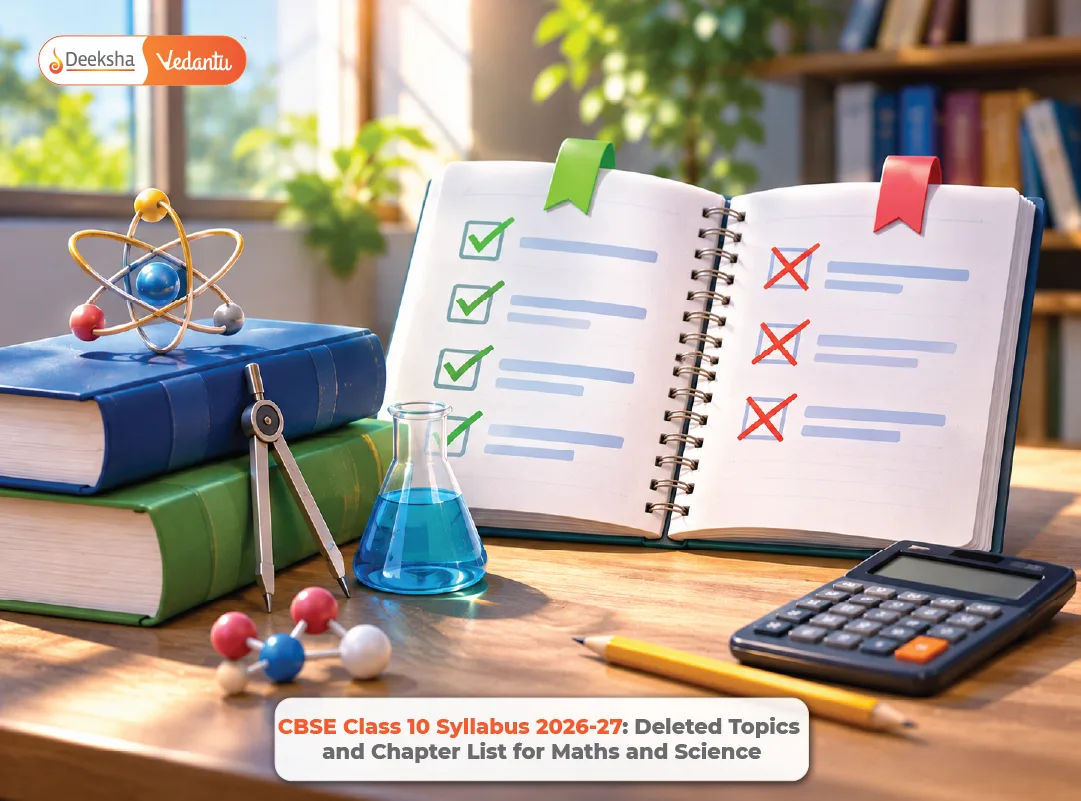
Class 10 Maths Deleted Topics 2026-27
These are the Maths topics that students should not spend time on:
- Constructions: the whole chapter is removed.
- Real Numbers: Euclid’s division lemma is removed. The Fundamental Theorem of Arithmetic and the irrationality of numbers such as √2, √3 and √5 stay.
- Polynomials: the division algorithm is removed.
- Pair of Linear Equations: the cross-multiplication method is removed. Students use the graphical, substitution and elimination methods.
- Triangles: the proof of the Basic Proportionality Theorem stays, and other similarity results are used without proof.
A student with an old workbook should mark these sections before starting revision, so that practice time goes to chapters that will appear.
How to Study the Live Maths Chapters
Maths rewards steady practice, so the plan should be built around problem types.
Algebra. Polynomials, linear equations, quadratic equations and arithmetic progressions form the largest block of the paper. Practise word problems, because they carry the most marks and need translating a story into an equation.
Geometry and Trigonometry. Triangles and Circles depend on theorems, so learn the statements and practise using them. For trigonometry, memorise the standard ratios and then solve heights and distances problems with a diagram each time.
Mensuration and Statistics. Keep a one-page formula sheet for areas and volumes, and practise reading data tables for mean, median and mode.
Our page of CBSE Class 10 Maths previous year papers helps you see how questions are framed.
CBSE Class 10 Science Syllabus 2026-27: Chapter List
The Class 10 Science syllabus has 13 chapters across Chemistry, Biology and Physics:
- Chemical Reactions and Equations
- Acids, Bases and Salts
- Metals and Non-Metals
- Carbon and Its Compounds
- Life Processes
- Control and Coordination
- How Do Organisms Reproduce?
- Heredity
- Light: Reflection and Refraction
- The Human Eye and the Colourful World
- Electricity
- Magnetic Effects of Electric Current
- Our Environment
The three subjects are balanced, so a student cannot afford to neglect one branch. Chemistry, Biology and Physics each carry a similar share of the theory marks.
Class 10 Science Deleted Topics 2026-27
The changes in Science are larger than in Maths:
- Periodic Classification of Elements: the chapter is removed from the theory syllabus.
- Sources of Energy: the chapter is not in the syllabus.
- Sustainable Management of Natural Resources: the chapter is not in the syllabus.
- Heredity and Evolution: heredity stays and is now a chapter on its own. The evolution portion is removed.
- Magnetic Effects of Electric Current: the electric motor, electromagnetic induction and the generator are removed.
- The Human Eye: the explanation of why the sun looks a different colour at sunrise and sunset is removed.
A student who uses an old reference book will find these chapters in it. They are not part of the exam, so skip them.
How to Study the Live Science Chapters
Science needs a different approach for each branch.
Chemistry. Practise balancing equations until it is automatic. Learn the reactions of acids, bases, metals and carbon compounds as families, not as isolated facts.
Biology. Use labelled diagrams for life processes, control and coordination, and reproduction. Diagram questions are easy marks when you practise them.
Physics. Light and Electricity involve numericals. Learn the formulas, write the units and practise sign conventions for mirrors and lenses. For a quick review, our Class 10 Science quick revision guide for CBSE boards is a good place to start.
Turn the Syllabus Into a Revision Plan
A syllabus list helps only when it becomes a calendar. With about three months to the first exam, a simple plan works:
- Mark the live chapters. Cross out the deleted topics in every book and notebook.
- Rank chapters by confidence. Mark each chapter strong, medium or weak.
- Give weak chapters the first slots. Study them in short daily sessions.
- Add weekly tests. One timed paper a week shows what is working.
- Keep the last two weeks for full papers. Practise the pattern, the timing and the case-based questions.
Our guide to how to create a Class 10 study timetable for 2026 boards can be adapted for the 2027 batch.
Why the Syllabus Matters for PU Admission
The syllabus is the base of the Class 10 result, and the result is the base of a good PU admission. A student who finishes the live chapters well can aim for strong marks, and strong marks widen the choice of colleges. Our guide on when to apply to PU colleges shows how the board dates and the admission calendar fit together.
The deleted portions also have a bearing on Class 11. Topics removed from Class 10 may return in a more advanced form in Class 11 and 12 Physics and Chemistry, so a student aiming for JEE or NEET should still read them lightly for general understanding, after the board exam preparation is secure. An integrated programme builds this bridge into its Class 11 plan.
Common Mistakes to Avoid
- Using old notes without checking. Notes from earlier years carry deleted chapters.
- Studying only what was removed last year. Use the current subject PDF.
- Skipping the case-based questions. They are a regular part of the paper.
- Ignoring Heredity because evolution is gone. Heredity is still examined.
- Leaving internal assessment to the last week. The 20 marks come from work done during the year.
Frequently Asked Questions
Q1. Where can I download the CBSE Class 10 syllabus 2026-27?
CBSE publishes it on cbseacademic.nic.in under Curriculum 2026-27, in the Secondary section for Classes 9 and 10.
Q2. What is the CBSE Class 10 deleted syllabus 2027 for Maths?
Constructions is removed, along with Euclid’s division lemma, the polynomial division algorithm and the cross-multiplication method.
Q3. What are the deleted chapters in Class 10 Science 2026-27?
Periodic Classification of Elements, Sources of Energy and Sustainable Management of Natural Resources are removed, and the evolution portion of Heredity and Evolution is removed.
Q4. How many marks are the theory papers in Maths and Science?
Each subject carries 80 marks for theory and 20 marks for internal assessment.
Q5. Is the syllabus the same for the second board exam?
Yes. The second exam follows the same prescribed syllabus as the first.
Conclusion
The CBSE Class 10 syllabus 2026-27 is clear once you separate what is live from what is removed. Maths has 14 chapters with Constructions gone, and Science has 13 chapters with three chapters and several sub-topics removed. Mark the deleted portions, build a revision plan around the live chapters, and use the official subject PDF as your final check. A student who studies the right chapters in the right order walks into the exam on 16 February with confidence.






Get Social