
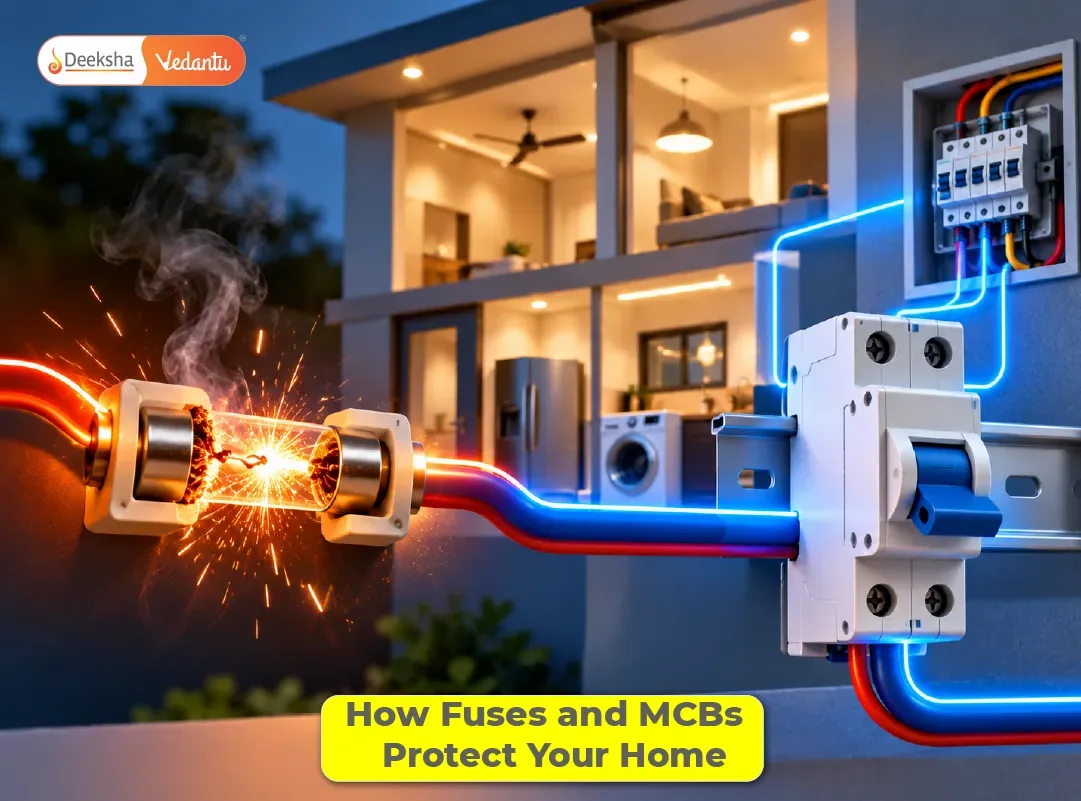


Nobody notices a fuse until it saves them. When a heater, a mixer and a charger are all plugged into one overloaded socket, something has to give. The question is whether it is a thin piece of wire designed to give way, or the wiring inside your walls.
This guide explains what goes wrong in a home circuit, how a fuse and an MCB each respond, and how they differ. It then covers earthing, a few practice questions, and where all this sits in your Class 8, Class 10 and Class 12 syllabus.
When a Home Circuit Goes Wrong
A home circuit is built for a normal current. Two kinds of faults push that current far above normal, and both are dangerous because of the heating effect: the heat produced in a wire is proportional to the square of the current (H = I²Rt).
| Overloading | Short circuit | |
| What happens | Too many appliances draw current from the same circuit | The live and neutral wires touch directly, or insulation fails, so current bypasses the appliance |
| Why the current rises | The total power drawn is far more than the circuit can safely carry | The resistance of the path becomes almost zero, so the current becomes very large |
| Typical cause | A heater, geyser and iron plugged into one extension board | Damaged insulation, a loose wire touching another, a faulty appliance |
| Danger | Wires overheat and may start a fire | A sudden, very large current can melt wires and cause sparks or fire |
In both cases, the wires must be cut off from the supply quickly. That is exactly the job of a fuse or an MCB. For the wider picture of how a house is wired, see domestic electric circuits.
The Fuse: A Weak Link on Purpose
How a fuse works
A fuse is a short piece of wire made of a metal or alloy with a low melting point, connected in series with the appliance or circuit it protects. Normally the current is small and the fuse wire stays cool. When the current exceeds a safe limit, the heating effect, H = I²Rt, raises the wire’s temperature until it melts. The circuit breaks, and the current stops before the household wiring can overheat.
The fuse is sacrificed so the wiring does not have to be. It is the weakest link by design.
Choosing a fuse rating
The rating tells you the largest current the fuse can carry without melting. It must be slightly above the normal working current.
Example: a 1.5 kW heater runs on 220 V. Its current is I = P/V = 1500/220 ≈ 6.8 A. A 5 A fuse would blow the moment the heater is switched on, so a 10 A fuse is a sensible choice. A much higher rating, such as 30 A, would let a dangerous current flow before it melted, which defeats its purpose.
Rules that keep a fuse useful
- Always connect the fuse in the live wire, so the appliance is cut off from the live supply when it blows.
- Never replace a blown fuse with a thicker wire or a piece of ordinary copper wire. That removes the protection.
- Find out why it blew before replacing it.
To see why heat and current are linked, read about the heating effect of electric current and the formula for electric power.
The MCB: A Switch That Trips and Resets
A miniature circuit breaker (MCB) does the same job as a fuse but without destroying itself. When the current becomes too large, it switches off automatically, and you restore the supply by flipping the switch back after the fault is fixed.
Many Class 10 notes explain the MCB through the magnetic effect of current: an excessive current strengthens an electromagnet, which pulls a lever and breaks the circuit. In practice, many MCBs combine two responses, a heat-sensitive strip for slow overloads and an electromagnet for sudden short circuits. Check which explanation your textbook expects, and write that one in the exam.
Fuse versus MCB
| Feature | Fuse | MCB |
| Working idea | Heating effect melts the wire | Typically heat and magnetic response trip a switch |
| After a fault | Wire is destroyed and must be replaced | Switch is reset by hand |
| Reuse | Single use | Reusable |
| Convenience | Needs a new wire and care to fit | Quick to restore |
| Common place | Older wiring and small appliances | Modern distribution boards in homes |
Both are placed in series in the live wire, and both exist to break the circuit before a fault turns into a fire. For another application of the magnetic effect, read this comparison of electric motor vs generator.
Earth Wire, Safe Habits and Exam Slips
Why the earth wire matters
A fuse or MCB protects the wiring, but it does not protect a person from an electric shock. For that, appliances with a metal body, such as a geyser, an iron or a refrigerator, are connected to the earth wire through the third pin of the plug. If a live wire accidentally touches the metal body, the current takes the low-resistance path to the earth instead of through the person who touches the appliance, and the large current also blows the fuse or trips the MCB.
Five habits worth teaching at home
- Do not plug several high-power appliances into one socket.
- Replace damaged cables and plugs immediately.
- Keep switches, sockets and the distribution board away from water.
- Never touch an appliance with wet hands.
- Use the right fuse or MCB rating, never a substitute.
Five questions to check yourself
- Why is a fuse wire made of a metal with a low melting point? Answer: so that it melts quickly when the current exceeds the safe limit.
- In which wire should a fuse be connected? Answer: the live wire.
- A 2 kW geyser runs on 220 V. What is its current? Answer: I = 2000/220 ≈ 9.1 A, so a 5 A fuse is unsuitable.
- What is the difference between overloading and a short circuit? Answer: overloading is too many appliances drawing current from one circuit, while a short circuit is a direct path of almost zero resistance between live and neutral.
- Name two advantages of an MCB over a fuse. Answer: it can be reset and reused, and it is quicker to restore after a fault.
Mistakes that cost marks
- Saying that a fuse is connected in parallel. It is connected in series.
- Writing that the earth wire carries current normally. It carries current only during a fault.
- Mixing up overloading and short circuit.
- Forgetting to state the rating of the fuse in numerical problems.
For a broader read on safe use of electricity, see electricity in daily life, from circuits to safety.
Where Fuses Show Up in Your Syllabus
| Stage | What you study |
| Class 8 (NCERT Science, Curiosity, Chapter 4: Electricity: Magnetic and Heating Effects) | The heating effect of current, nichrome in heaters, and the fuse as a safety device |
| Class 10 (NCERT Science, Chapter 11: Electricity) | Heating effect of current and Joule’s law, H = I²Rt, with applications such as the electric fuse |
| Class 10 (NCERT Science, Chapter 12: Magnetic Effects of Electric Current) | Domestic electric circuits, overloading, short circuit, the fuse, the earth wire and, in many notes, the MCB |
| Class 12 / II PUC | Electrical energy and power, and Joule heating, as part of current electricity |
The fuse and MCB themselves are board-level topics. For entrance exams, the underlying ideas matter: the NEET UG 2026 syllabus lists electrical energy and power under Current Electricity, and the same heating-effect formulas appear in JEE Main and KCET problems. For JEE Advanced and for later exam years, check the latest official syllabus. State Board and ICSE textbooks cover the same ideas under their own chapter titles.
If resistance and power numericals are where you slip, try this guide to solving resistance numericals step by step.
A five-minute activity for parents
Open your home’s distribution board with your child, and look at the labels on each MCB. Ask which room each one serves, and what happens if two heavy appliances run together. It turns a Class 10 chapter into something real, and it builds the habit of asking “what could go wrong?” that good science needs. Deeksha Vedantu’s Foundation Program for Grades 8, 9 and 10 builds concepts in Science and Mathematics early, so that chapters like this one feel familiar when board exams arrive.
Frequently Asked Questions
Q1. What is an electric fuse and how does it work?
An electric fuse is a short wire of low melting point connected in series in the live wire. When the current exceeds the safe limit, the heating effect melts the wire, which breaks the circuit and protects the appliances and wiring.
Q2. What is the difference between overloading and a short circuit?
Overloading happens when too many appliances draw current from the same circuit. A short circuit happens when live and neutral wires touch, or insulation fails, so a very large current flows through a path of almost zero resistance.
Q3. What is the difference between a fuse and an MCB?
A fuse melts and must be replaced after it breaks the circuit. An MCB switches off automatically and can be reset and reused once the fault is fixed.
Q4. Why is a fuse connected in the live wire?
Because when the fuse blows, it disconnects the appliance from the live supply. If it were in the neutral wire, the appliance would stay connected to the live wire even after the fuse had blown.
Q5. Are fuses and MCBs important for NEET, JEE and KCET?
The devices themselves are board-level topics. The heating effect of current, electrical energy and power behind them appear in the NEET UG 2026, JEE Main and KCET syllabi. Always check the latest official syllabus for your exam year.
A Small Wire That Does a Big Job
A fuse looks like the least impressive part of a house, and it is one of the most important. It turns a physics idea, the heating effect of current, into a safety device that fails on purpose so that your home does not. Once you can explain overloading, short circuit, the live wire, the earth wire and the MCB in plain language, the whole domestic circuit chapter falls into place.










Get Social