
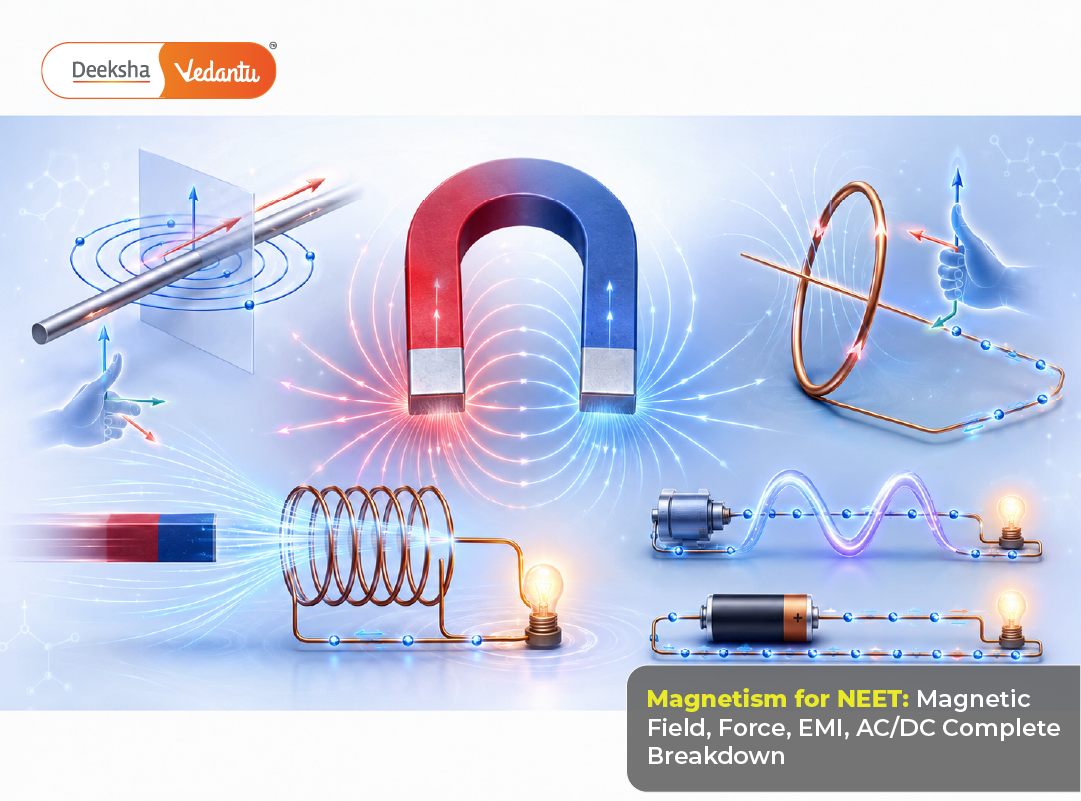


Magnetism is one of the longer chapters NEET draws from, spanning moving charges, magnetic fields, induction, and alternating current. The challenge isn’t the individual formulas – it’s that each sub-topic has its own right-hand or left-hand rule, and mixing them up costs marks on questions that are otherwise straightforward. This guide sequences the chapter the way NEET actually builds on it: field first, force next, induction after that, and AC/DC behaviour last.
Magnetic Field: Where It Comes From
A magnet has a magnetic field around it, represented by field lines that emerge from the north pole and terminate at the south pole. But NEET’s real interest is in magnetic fields produced by moving charges and currents, not permanent magnets alone – this is the foundation of electromagnetism.
Biot-Savart Law gives the magnetic field due to a small current element:
dB = (μ₀/4π) × (I dl sinθ)/r²
This is rarely tested as a direct numerical in NEET but underlies every derived formula that follows.
Field Due to a Straight Current-Carrying Conductor
B = (μ₀I)/(2πr)
The field forms concentric circles around the wire, and its direction is found using the right-hand thumb rule – point the thumb in the direction of current flow, and the curled fingers show the field direction. A clear visual breakdown of this rule alongside field-line patterns is available in the dedicated magnetic field and field lines chapter, useful if the directional logic still feels unintuitive.
Field at the Centre of a Circular Loop
B = (μ₀I)/(2R)
Field Due to a Solenoid
B = μ₀nI (inside, away from the ends)
A solenoid behaves like a bar magnet, with the field strength dependent on the number of turns per unit length (n) and current (I) – a relationship NEET tests through direct substitution numericals. The complete derivation, including edge effects, is covered in the broader magnetic field due to a current-carrying conductor chapter.
Force: What the Magnetic Field Does to Moving Charges
Once a magnetic field exists, it exerts a force on any moving charge or current within it.
Force on a moving charge: F = qvB sinθ (Lorentz force, magnetic component)
The direction is given by Fleming’s left-hand rule – forefinger points along the field, middle finger along the current (or velocity for a positive charge), and the thumb gives the force direction. This is distinct from the right-hand rule used for field direction, and NEET frequently tests whether students confuse the two. A side-by-side comparison of both rules and when to apply each is laid out in the Fleming’s left-hand and right-hand rule chapter.
Force on a current-carrying conductor in a magnetic field: F = BIL sinθ
When the conductor is perpendicular to the field (θ = 90°), this simplifies to F = BIL, the most common NEET numerical form. The complete derivation and worked examples are detailed in the force on a current-carrying conductor chapter.
Force between two parallel current-carrying conductors:
F/L = (μ₀I₁I₂)/(2πd)
Like currents attract; unlike currents repel – the opposite of the rule for like and unlike charges, a contrast NEET has used as a trap question.
Solved NEET-Style Numerical: Force on a Conductor
A 0.5 m long conductor carrying 4 A current is placed perpendicular to a magnetic field of 0.2 T. Find the force on it.
F = BIL = 0.2 × 4 × 0.5 = 0.4 N
Electromagnetic Induction: Generating Current from Changing Fields
While the previous section covered how currents create fields and forces, EMI covers the reverse – how a changing magnetic field induces a current.
Faraday’s First Law: Whenever magnetic flux linked with a circuit changes, an EMF is induced.
Faraday’s Second Law (quantitative):
ε = –N(dΦ/dt)
The negative sign reflects Lenz’s Law – the induced current always opposes the change in flux that produced it, a direct consequence of energy conservation. The full reasoning behind this sign convention, along with flux calculation examples, is explained in the Faraday’s law chapter.
NEET frequently tests Lenz’s Law conceptually: a magnet falling through a conducting ring experiences a retarding force, because the induced current opposes the magnet’s motion (opposing the increasing flux as it approaches, then opposing the decreasing flux as it leaves).
Motional EMF
When a conducting rod moves with velocity v in a magnetic field B, perpendicular to both:
ε = BvL
This is a frequently tested numerical pattern – a rod sliding on rails within a magnetic field, asked to find the induced EMF or current.
AC and DC: Two Different Current Behaviours
Once EMF is induced, it can take two forms depending on how the source is constructed.
Direct Current (DC) flows in one direction only, with constant magnitude (in an ideal source).
Alternating Current (AC) periodically reverses direction, typically following a sinusoidal pattern: I = I₀sin(ωt)
| Feature | AC | DC |
| Direction | Reverses periodically | Constant |
| Source example | Generators (mains supply) | Batteries, cells |
| Measured value | RMS value | Direct/peak value |
| Transformable | Yes (via transformers) | No |
A detailed comparison table covering transmission efficiency and practical applications is available in the difference between AC and DC chapter, which NEET sometimes references in conceptual “why is AC used for long-distance transmission” questions.
RMS value of AC: Irms = I₀/√2, Vrms = V₀/√2
NEET almost always specifies whether a given current value is peak or RMS – misreading this is one of the most common avoidable errors in AC numericals.
Transformers: Applying EMI Practically
A transformer changes AC voltage using the principle of mutual induction between two coils wound on a common core.
Transformer equation: Vs/Vp = Ns/Np = Ip/Is
A step-up transformer has more secondary turns than primary (increases voltage, decreases current); a step-down transformer does the reverse. The complete working principle, including why transformers don’t work with DC, is covered in the transformer chapter – a useful read since NEET occasionally asks why a transformer requires AC specifically (a changing flux is required for induction, and DC produces no flux change once steady).
Solved NEET-Style Numerical: Transformer Ratio
A transformer has 200 turns in the primary and 1000 turns in the secondary. If the primary voltage is 220 V, find the secondary voltage.
Vs/Vp = Ns/Np
Vs = Vp × (Ns/Np) = 220 × (1000/200) = 1100 V
This is a step-up transformer, since Vs > Vp.
Practice Questions Styled After NEET
Q1. The magnetic field inside a long solenoid is given by:
(a) μ₀I/2πr (b) μ₀nI (c) μ₀I/2R (d) μ₀I/4πr²)
Answer: (b)
Q2. Two parallel wires carrying current in the same direction will:
(a) Repel each other (b) Attract each other (c) Show no force (d) Rotate)
Answer: (b)
Q3. Lenz’s law is a consequence of:
(a) Newton’s third law (b) Conservation of energy (c) Conservation of charge (d) Coulomb’s law)
Answer: (b)
Q4. A transformer works on the principle of:
(a) Self-induction (b) Mutual induction (c) Electromagnetic force (d) Lorentz force)
Answer: (b)
Q5. The RMS value of an AC current with peak value 10 A is:
(a) 10 A (b) 7.07 A (c) 5 A (d) 14.14 A)
Answer: (b) – Irms = I₀/√2 = 10/1.414 ≈ 7.07 A
Why Sequencing This Chapter Matters
Magnetism questions in NEET rarely test a formula in isolation – they test whether you can trace the chain correctly: current creates a field, the field exerts force on other currents or moving charges, a changing field induces new current, and that induced current can be AC or DC depending on the source. Treating each rule (right-hand thumb rule, Fleming’s left-hand rule, Lenz’s law direction) as part of this single causal chain, rather than as four unrelated mnemonics, is what prevents the sign and direction errors that quietly cost marks.
For students revisiting Physics in a second NEET attempt, magnetism is often where conceptual confidence is highest but accuracy is lowest – familiarity with the formulas doesn’t always translate into correctly applying the right rule under time pressure. Deeksha’s NEET repeater course addresses this directly through rule-specific drilling, ensuring students aren’t just recalling formulas but applying the correct directional logic instantly when a question demands it.








Get Social