
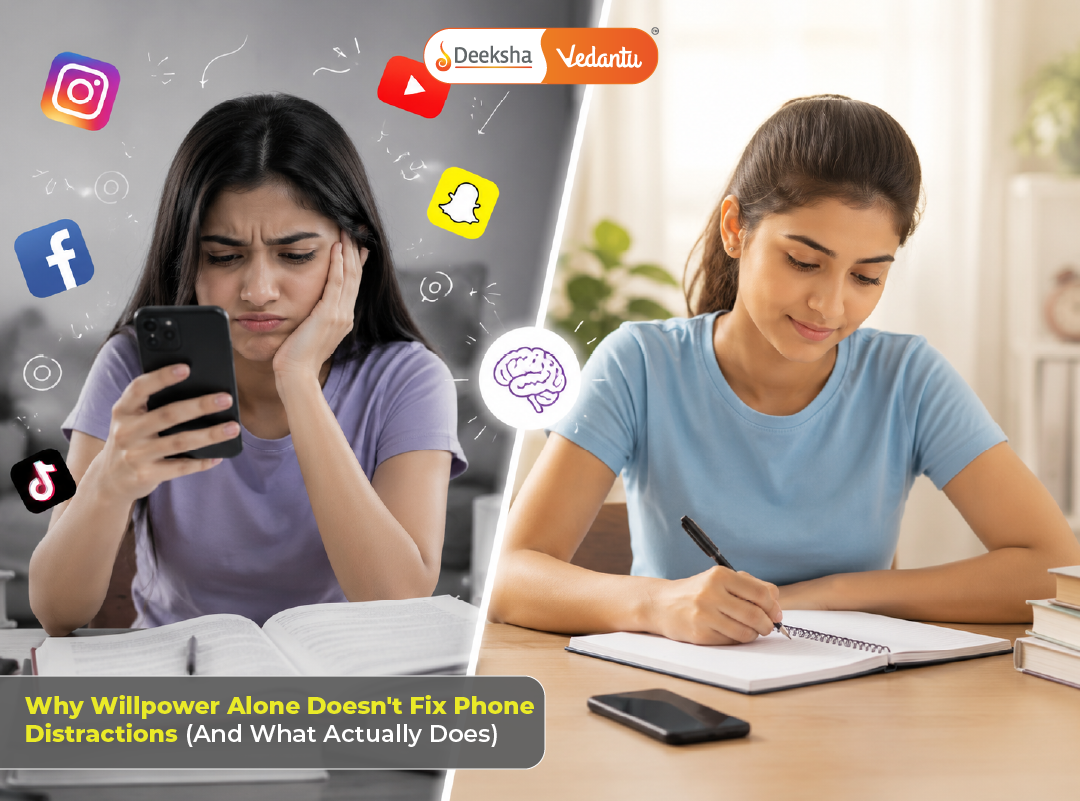
Every student has tried the same fix at least once: “I’ll just have more discipline this time.” Phone face-down, or in another room, or on silent – and yet somehow, three chapters into a study session, it’s back in hand. This isn’t a character flaw. It’s a fundamentally mismatched strategy, and understanding why willpower keeps losing this particular fight is the first step toward a fix that actually holds.
Why “Just Don’t Check Your Phone” Was Never Going to Work
Willpower operates like a muscle that fatigues with use – every decision you make throughout a day, including small ones like whether to glance at a notification, draws from the same limited reserve. By the time you’ve sat down to study after a full day of school, coaching, and a dozen other minor decisions, your willpower reserve is already partially spent, and it keeps depleting further with every hour of focused work. Asking tired willpower to repeatedly resist a phone that’s sitting right there, buzzing with genuinely engineered appeal, is asking an already-weakened system to win a fight it’s structurally set up to lose.
This is precisely why the same student who successfully resists checking their phone for the first thirty minutes of a study session almost always cracks by hour two – not because their character weakened, but because willpower itself is a depleting resource, not a fixed trait you either have or don’t.
Fix Attempt 1: “I’ll Just Put It on Silent”
Why this fails: Silencing notifications removes the sound cue, but does nothing about the underlying behavior loop – the habit of periodically checking, driven by curiosity and the fear of missing something, rather than by an actual notification prompting you. Most compulsive phone-checking during study sessions isn’t even triggered by a buzz; it’s triggered by boredom, a difficult problem, or simply an idle moment, and a silenced phone is still sitting right there, still one glance away, still fully capable of answering that idle-moment urge.
Fix Attempt 2: “I’ll Just Tell Myself I Won’t Check It”
Why this fails: This is a pure willpower play, and it fails for the reason described above – it’s asking a depleting resource to hold a line indefinitely, with the phone itself providing zero actual resistance if that resolve slips even once. The commitment lives entirely in your head, and your head is exactly the thing getting tired.
Fix Attempt 3: “I’ll Use a Focus App That Blocks Notifications”
Why this partially fails: This is a genuine improvement over the first two attempts, since it removes some of the trigger. But most basic focus or “do not disturb” modes are trivially reversible – a single tap turns them off, and that single tap requires far less willpower to make than resisting a live, buzzing phone does. The fix reduces the temptation’s frequency, but doesn’t meaningfully increase the effort required to give in, which means it only holds up as long as your (still depleting) willpower reserve does.
The Actual Fix: Increase Friction, Not Willpower
Here’s the reframe that changes everything: instead of trying to strengthen your resolve to resist the phone, make giving in to that urge require more physical effort than it’s worth in the moment. This is a friction-based approach, and it works precisely because it doesn’t rely on willpower at all – it relies on simple physical inconvenience, which doesn’t fatigue the way mental resolve does.
Physical distance, not just silence. Leave the phone in a different room entirely, not just face-down on the same desk. The specific friction that matters is the number of physical steps between “I have an urge to check” and “I’m actually holding the phone” – every added step (standing up, walking to another room, physically picking it up) gives that initial urge time to fade on its own, since most such urges are genuinely fleeting if you don’t act on them within the first few seconds.
A locked box, not a silenced app. Small timer-locked boxes, designed originally for exactly this purpose, remove the phone from your control entirely for a set duration. This sounds extreme until you notice the actual mechanism: it doesn’t require you to resist anything, because resistance is no longer the variable – the phone is physically unavailable regardless of how strong or weak your willpower feels in that specific moment.
Batch your checking, don’t ban it. Total phone bans across a multi-hour study session tend to fail because they create exactly the kind of “forbidden fruit” tension that makes the eventual break even harder to resist. A more durable version: study in focused 45–50 minute blocks, with a genuinely permitted 5-minute phone-check window built into every break. This removes the psychological pressure of total denial, while still keeping the phone physically absent during every actual study block.
Make the phone boring on purpose. Turn off as many notification categories as your phone allows – not just silencing sound, but disabling the visual badges and lock-screen previews that make checking feel urgent or rewarding even without a sound. A phone that shows nothing interesting when glanced at gradually stops triggering the “just a quick check” impulse in the first place, since there’s nothing there to reward that impulse.
Why Friction Works Where Willpower Didn’t
| Willpower-Based Attempt | Why It Fails | Friction-Based Alternative | Why It Holds |
| Silence the phone | Trigger removed, behavior loop untouched | Physical distance (different room) | Removes the option entirely, no resistance needed |
| Mental resolve (“I won’t check it”) | Willpower depletes with use over a session | Locked timer box | Phone is unavailable regardless of resolve strength |
| Basic focus app, easily disabled | One tap undoes the entire fix | Batched, scheduled check windows | Removes forbidden-fruit pressure without total denial |
| Notifications only silenced | Visual badges still trigger idle-moment checks | Disable visual previews and badges too | Nothing rewarding to glance at, impulse fades naturally |
Building This Into a Realistic Study Routine
None of this requires eliminating your phone from your life – it requires recognizing that the moment of temptation is far easier to design around than to resist in the moment. This friction-first approach pairs naturally with structured time management more broadly; if session-length and break-timing feel like the missing piece alongside this, it’s worth reading through time management tips for board exams, which covers how to structure the study blocks this friction approach depends on.
If concentration issues persist even once phone-related friction is in place, it’s worth checking whether the root cause is genuinely digital distraction or something more foundational – this guide on tips to improve concentration covers additional angles worth ruling out. And for repeaters specifically, where unsupervised study time and phone access both tend to be higher than during regular school years, this piece on repeater psychology and managing pressure touches on some of the deeper motivational patterns that friction-based fixes work best alongside, not instead of.
Frequently Asked Questions
Is it realistic to expect a student to keep their phone in another room every single study session?
It’s more realistic than expecting willpower alone to hold up repeatedly – the physical inconvenience only needs to be slightly higher than the urge’s momentary pull, and most study sessions don’t require constant phone access for anything legitimate.
Do batched phone-check breaks actually reduce total usage, or just delay it?
In practice, they reduce total usage, since removing the forbidden-fruit tension of a total ban tends to lower the intensity of each check – students report shorter, less compulsive checking during scheduled breaks than during the “sneaky glance” checks a full ban tends to produce.
Should students disable their phone entirely during exams season, or is that too extreme?
Complete removal isn’t necessary or sustainable for most students – the friction-based methods above (distance, locked boxes, batched checking) tend to hold up better over weeks and months than an all-or-nothing ban, which often collapses the first time it’s genuinely tested.
Willpower was never really the right tool for this problem – it’s a resource that depletes exactly when you need it most, late in a long study session, tired from a full day already spent making smaller decisions. Friction doesn’t get tired. Build enough physical distance between the urge and the phone, and the fix holds long after resolve alone would have quietly given out.








Get Social