
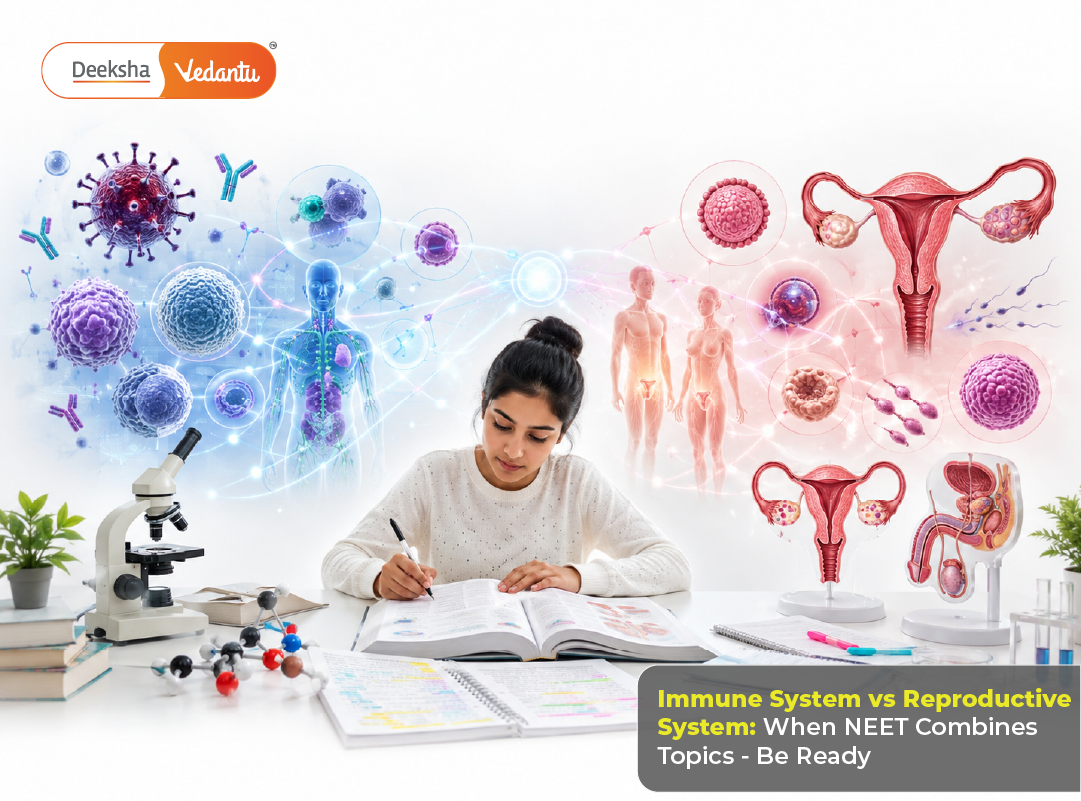


Most NEET aspirants study the immune system and the reproductive system as completely separate chapters, revised on different days, tested with different flashcards. That separation works fine for straightforward recall questions – but NEET increasingly constructs questions that sit at the intersection of the two, testing whether you understand how the immune system behaves differently during pregnancy, or why certain infections specifically threaten reproductive health. This guide treats both systems side by side, with particular attention to where NEET likes to combine them.
Why These Two Systems Get Paired in NEET Questions
The connection isn’t arbitrary. Pregnancy requires the maternal immune system to tolerate a genetically distinct fetus without rejecting it – a genuine immunological puzzle that NEET occasionally references conceptually. Several major diseases tested in human health and disease – the unit immunity belongs to – have direct reproductive consequences, from STDs to specific infections that cross the placental barrier. Once you see these threads, isolated revision of either chapter starts to feel incomplete.
The Immune System: Innate vs Acquired
NEET’s immunity questions are built around one core distinction: innate immunity is the body’s non-specific, immediately available defence (skin barriers, mucus, phagocytic cells, the inflammatory response), present from birth and not specific to any particular pathogen. Acquired (adaptive) immunity is pathogen-specific, develops after exposure, and improves with repeated exposure – the basis for how vaccines work.
The Two Arms of Acquired Immunity
Humoral immunity is mediated by B-lymphocytes, which produce antibodies (immunoglobulins) that circulate in blood and lymph, neutralising pathogens directly.
Cell-mediated immunity is mediated by T-lymphocytes, which destroy infected cells directly rather than relying on free-floating antibodies – critical against viruses hiding inside host cells, and against cancer cells.
| Antibody Class | Key Feature |
| IgG | Most abundant; crosses the placenta to protect the fetus |
| IgA | Found in secretions (saliva, milk, mucus); first-line mucosal defence |
| IgM | First antibody produced in a primary immune response |
| IgE | Mediates allergic reactions |
| IgD | Function less clearly defined; found on B-cell surfaces |
This IgG row is the single most important cross-topic fact in this entire article. IgG is the only antibody class that crosses the placenta, providing the newborn with passive immunity during the first few months of life before its own immune system matures. NEET has tested this directly, and it’s exactly the kind of fact that links immunity straight into reproductive physiology – a maternal immune product physically protecting the developing fetus.
Active vs Passive Immunity
Active immunity – the body produces its own antibodies, either through natural infection or vaccination. Develops slowly but provides long-lasting protection (immunological memory via memory B and T cells).
Passive immunity – ready-made antibodies are introduced into the body, either naturally (maternal IgG crossing the placenta, or IgA through breast milk) or artificially (antibody injections). Acts immediately but doesn’t last, since the body never produces its own memory cells.
NEET frequently asks you to classify a given scenario as active or passive – and “antibodies passed from mother to infant” is one of the most repeated examples, sitting squarely at the immunity-reproduction intersection.
The Reproductive System: Structure Built for a Specific Sequence
Human reproduction in NEET is organised around a precise sequence: gametogenesis, fertilisation, implantation, and pregnancy – each stage with its own structures and hormonal triggers.
Gametogenesis: Producing Sperm and Ova
Spermatogenesis occurs in seminiferous tubules of the testes, producing sperm through a continuous process from puberty onward. Oogenesis begins before birth, arrests partway, and resumes only at puberty under hormonal triggers – a fundamentally different timeline that NEET tests as a contrast question.
The Menstrual Cycle: Hormonal Sequencing
The menstrual cycle is divided into the menstrual, follicular, ovulatory, and luteal phases, governed by FSH, LH, estrogen, and progesterone in a tightly sequenced feedback loop. A surge in LH triggers ovulation around day 14 of a standard 28-day cycle – one of NEET’s most reliably tested numerical/conceptual facts in this entire unit.
Fertilisation and Implantation
Fertilisation typically occurs in the ampullary region of the fallopian tube. The resulting zygote undergoes cleavage divisions while travelling toward the uterus, implanting as a blastocyst roughly a week after fertilisation. This is where the immunological story becomes directly relevant.
Where the Two Systems Genuinely Intersect
Maternal-Fetal Immune Tolerance
A fetus carries paternal genetic material that is, immunologically speaking, “foreign” to the mother’s body. Under normal immune logic, this should trigger rejection – yet pregnancy proceeds successfully in the vast majority of cases. This apparent contradiction is resolved through specific immunological adaptations at the placental interface, a topic NEET sometimes references conceptually when testing whether students understand that immune tolerance during pregnancy is a genuine biological phenomenon, not an absence of immune activity.
Placental Transfer of Immunity
As established earlier, IgG crosses the placenta, meaning a newborn arrives with a temporary immune inheritance from its mother. This passive immunity fades over the first several months, which is precisely why early childhood vaccination schedules are timed the way they are – a connection NEET occasionally draws between immunology and developmental biology.
Reproductive Tract Infections and Immune Defence
The reproductive tract relies on its own localised innate immune defences – mucus barriers, local pH, resident immune cells – to prevent ascending infections. When these defences fail, infections can affect fertility or pregnancy outcomes, reinforcing why the reproductive system cannot be studied in complete isolation from immune function.
HIV and AIDS: The Direct Curriculum Overlap
HIV specifically targets helper T-lymphocytes (CD4+ cells), crippling cell-mediated immunity over time. Because HIV is also sexually transmitted, it sits simultaneously in the immunity syllabus and the reproductive health syllabus – making it one of NEET’s most natural combined-topic questions, testing both the virus’s immunological mechanism and its transmission route.
Practice Questions Styled After NEET
Q1. Which antibody class can cross the placental barrier?
(a) IgA (b) IgM (c) IgG (d) IgE)
Answer: (c)
Q2. Passive immunity acquired by a newborn through maternal antibodies is an example of:
(a) Active natural immunity (b) Passive natural immunity (c) Active artificial immunity (d) Passive artificial immunity)
Answer: (b)
Q3. HIV primarily infects and destroys:
(a) B-lymphocytes (b) Helper T-lymphocytes (c) Red blood cells (d) Platelets)
Answer: (b)
Q4. Fertilisation in humans normally occurs in the:
(a) Uterus (b) Cervix (c) Ampullary region of the fallopian tube (d) Ovary)
Answer: (c)
Q5. The surge of which hormone triggers ovulation?
(a) FSH (b) Progesterone (c) LH (d) Estrogen only)
Answer: (c)
Building the Combined-Topic Instinct
NEET’s harder questions increasingly reward students who can connect chapters rather than recall them in isolation – and immunity-reproduction overlaps are a clear example of this trend. The same combined-thinking habit applies elsewhere too: understanding accumulation of variation during reproduction connects reproductive biology to genetics, while the broader principles of sexual reproduction and the contrast with modes of reproduction used by single organisms build the foundational vocabulary that makes Class 12’s human reproduction unit easier to absorb. Similarly, the hormonal sequencing logic in the menstrual cycle echoes the feedback-loop reasoning used throughout sexual reproduction in flowering plants, where a parallel hormonal and structural sequence governs a different but analogous biological process.
For repeaters specifically, this kind of cross-chapter linkage is exactly what separates a strong second attempt from a repeat of the first – not more content coverage, but a deeper structural understanding of how NEET’s Biology section actually tests connected reasoning. Deeksha’s NEET repeater course deliberately builds these cross-topic links into revision sessions, since recognising a combined question pattern in the exam hall is a skill that needs practice well before exam day, not something to discover mid-test.











Get Social