
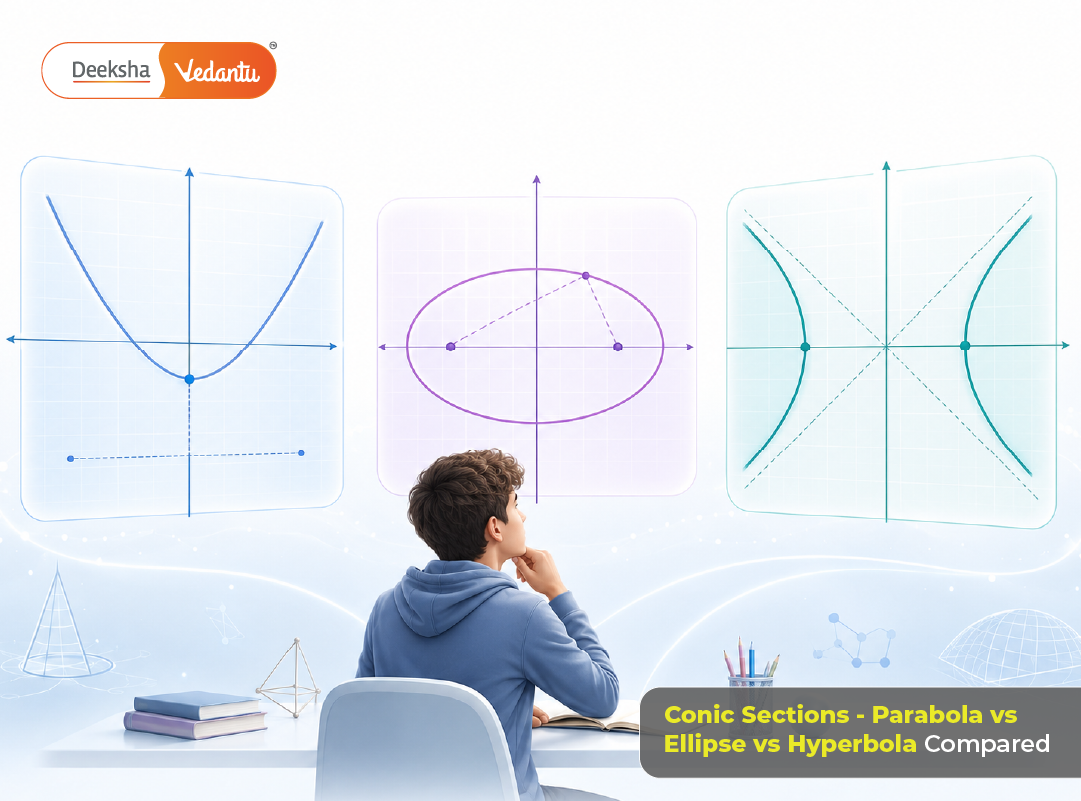


Most students learn parabola, ellipse, and hyperbola as three unrelated chapters, memorizing three separate sets of formulas that happen to look vaguely similar. That’s the hard way to learn conics. There’s actually one number – eccentricity, denoted e – that smoothly turns one curve into the next as it changes value. Understand that single dial, and you’re not memorizing three chapters anymore. You’re understanding one idea from four different angles.
The Setup: One Definition, One Dial
Every conic section shares the same underlying definition: it’s the locus of a point whose distance from a fixed point (the focus) has a constant ratio to its distance from a fixed line (the directrix). That constant ratio is eccentricity, e.
distance from focus / distance from directrix = e
Nothing else in this chapter changes. Only the value of e does. Turn that one dial from 0 upward, and you move through every conic JEE will ever ask you about.
e = 0: The Circle (The Starting Point)
At e = 0, the curve becomes perfectly symmetric around a single center point, with every point on the curve equidistant from that center. This is the circle – technically a conic, though it rarely gets grouped with the “big three” in JEE discussions. Its standard equation, x² + y² = r², is the simplest member of the entire family, and it’s worth remembering as the e = 0 anchor point before the dial starts moving.
0 < e < 1: The Ellipse Appears
As soon as e climbs above 0 but stays below 1, the curve stretches out of its perfect circularity and becomes an ellipse – a closed curve with two foci instead of one center.
Standard equation: x²/a² + y²/b² = 1 (for a > b)
Eccentricity formula: e = √(1 – b²/a²)
Key property: For any point on the ellipse, the sum of distances to the two foci is constant, equal to 2a.
Notice what’s happening on the dial: the closer it gets to 0, the rounder the ellipse looks (closer to a circle). The closer e gets to 1, the more stretched and elongated it becomes – visibly straining toward whatever comes next on the dial.
e = 1: The Tipping Point – Parabola
Right at e = 1, something structural changes. The curve stops closing in on itself entirely and opens up infinitely in one direction. This is the parabola – and it’s the only one of the four conics with just one focus and one directrix, no pair.
Standard equation: y² = 4ax
Key property: Every point on the parabola is exactly equidistant from the focus and the directrix – which is just the defining ratio (distance from focus ÷ distance from directrix = e) evaluated at exactly e = 1.
This is the cleanest possible illustration of why the eccentricity dial matters: at e = 1, the “sum of distances to two foci” property of the ellipse literally cannot apply anymore, because there’s only one focus left. The curve has to open up to satisfy the same distance ratio with only one anchor point instead of two.
e > 1: The Hyperbola – The Dial Keeps Turning
Push e past 1, and the curve doesn’t just open up – it splits into two separate branches entirely.
Standard equation: x²/a² – y²/b² = 1
Eccentricity formula: e = √(1 + b²/a²)
Key property: For any point on the hyperbola, the difference of distances to the two foci is constant, equal to 2a – the mirror image of the ellipse’s sum rule.
Notice the beautiful symmetry here: ellipse uses a sum, hyperbola uses a difference. Both formulas even look structurally similar (e = √(1 ∓ b²/a²)), differing only by that one sign – which is exactly the dial we’ve been turning the entire time.
The Dial, Summarized
| Eccentricity (e) | Curve | Defining Distance Property |
| e = 0 | Circle | Constant distance from one center |
| 0 < e < 1 | Ellipse | Sum of distances to 2 foci = constant |
| e = 1 | Parabola | Distance to focus = distance to directrix |
| e > 1 | Hyperbola | Difference of distances to 2 foci = constant |
Telling Them Apart From the General Equation
In JEE, conics are rarely handed to you in clean standard form – they usually appear as a general second-degree equation: Ax² + Bxy + Cy² + Dx + Ey + F = 0. The fast diagnostic here uses the discriminant, B² – 4AC:
- B² – 4AC < 0 and A = C (with B = 0): Circle
- B² – 4AC < 0, A ≠ C: Ellipse
- B² – 4AC = 0: Parabola
- B² – 4AC > 0: Hyperbola
This single test is often faster than trying to force the equation into standard form first, especially under JEE Main’s time pressure – recognize the discriminant sign, and you already know which curve’s formula sheet to reach for.
Standard Equation Quick Reference
| Conic | Standard Equation | Foci | Directrix |
| Circle | x² + y² = r² | Single center | None |
| Ellipse | x²/a² + y²/b² = 1 | (±ae, 0) | x = ±a/e |
| Parabola | y² = 4ax | (a, 0) | x = -a |
| Hyperbola | x²/a² – y²/b² = 1 | (±ae, 0) | x = ±a/e |
Notice the ellipse and hyperbola share the exact same focus and directrix formulas – the only thing distinguishing them is whether e sits below or above 1, reinforcing once again that these aren’t separate rules, just different settings of the same dial.
Where This Fits Into Your JEE Maths Preparation
Once this unified view feels solid, it’s worth going deeper into each individual curve through the Class 11 Mathematics Ellipse, Parabola, and Hyperbola pages, along with the Circle page for the e = 0 anchor point. The broader Conic Sections overview and sections of a cone page are also useful for understanding where these curves geometrically come from in the first place – literally slicing a cone at different angles, which is where the entire family gets its name.
This chapter also connects directly back into coordinate geometry fundamentals – the distance between two points, equation of a line, and coordinates of a point pages are worth revisiting if the focus-directrix distance calculations in this chapter feel shaky, since conics are really just coordinate geometry applied to a slightly more elaborate locus. For broader context on where this topic sits in your overall syllabus, this checklist of math concepts every JEE aspirant should master is a useful reference point.
To convert this conceptual clarity into exam-ready speed, this guide on how to score 180 in JEE Maths with smart practice is a solid next step, and practicing directly with JEE Main previous year question papers will show you exactly how often JEE tests the eccentricity-based diagnostic versus the standard-equation approach. Tracking your progress through the best mock test series for JEE Mains with ranking logic will confirm whether this unified mental model is actually translating into faster, more confident attempts on test day.
For structured, concept-first guidance that connects ideas like this across chapters rather than teaching each one in isolation, Deeksha’s JEE coaching programs are built around exactly this kind of unified understanding.
Frequently Asked Questions
Is it worth memorizing the eccentricity formula for each conic separately, or is the unified view enough?
Both matter – the unified view (e = 0, 0<e<1, e=1, e>1) helps you instantly identify which conic you’re dealing with, but you’ll still need each specific formula (e = √(1-b²/a²) for ellipse, e = √(1+b²/a²) for hyperbola) to solve numerical problems.
Why does a parabola only have one focus while an ellipse and hyperbola have two?
It comes directly from the eccentricity dial – at e = 1, the curve sits at the exact transition point between the ellipse’s “two foci, sum of distances” structure and the hyperbola’s “two foci, difference of distances” structure, and a single focus is what allows the distance ratio to still equal exactly 1.
Is the discriminant test (B² – 4AC) reliable for every JEE question, or are there exceptions?
It’s reliable for identifying the general type of conic from a second-degree equation, but always double-check by attempting to reduce the equation to standard form when time allows, since degenerate cases (like a pair of straight lines) can occasionally satisfy the same discriminant conditions.
Parabola, ellipse, and hyperbola were never three separate chapters to memorize – they’re one continuous idea, revealed by turning a single dial called eccentricity from 0 to beyond 1. Once that dial clicks into place mentally, the formulas for each curve stop feeling like isolated facts and start feeling like natural consequences of wherever e happens to be sitting.










Get Social