
A geometry proof is the one question in Class 10 Maths where you can know the idea and still lose most of the marks. The examiner is not only checking whether you reached the conclusion. They are checking whether each line follows from the one before it, and whether you gave the reason. Students who understand the theorem but write it as a paragraph of prose often score less than students who write a plain, ordered proof.
This guide gives you a fixed method for geometry proofs in Class 10, then applies it to the proofs that come up most often in the chapters on triangles and circles. If you want the theory first, our notes on similarity of triangles and the circles chapter are the best place to start.
The Five Parts of a Board-Style Proof
Every proof you write should have the same skeleton, in the same order. Examiners are used to it, and marks are awarded against it.
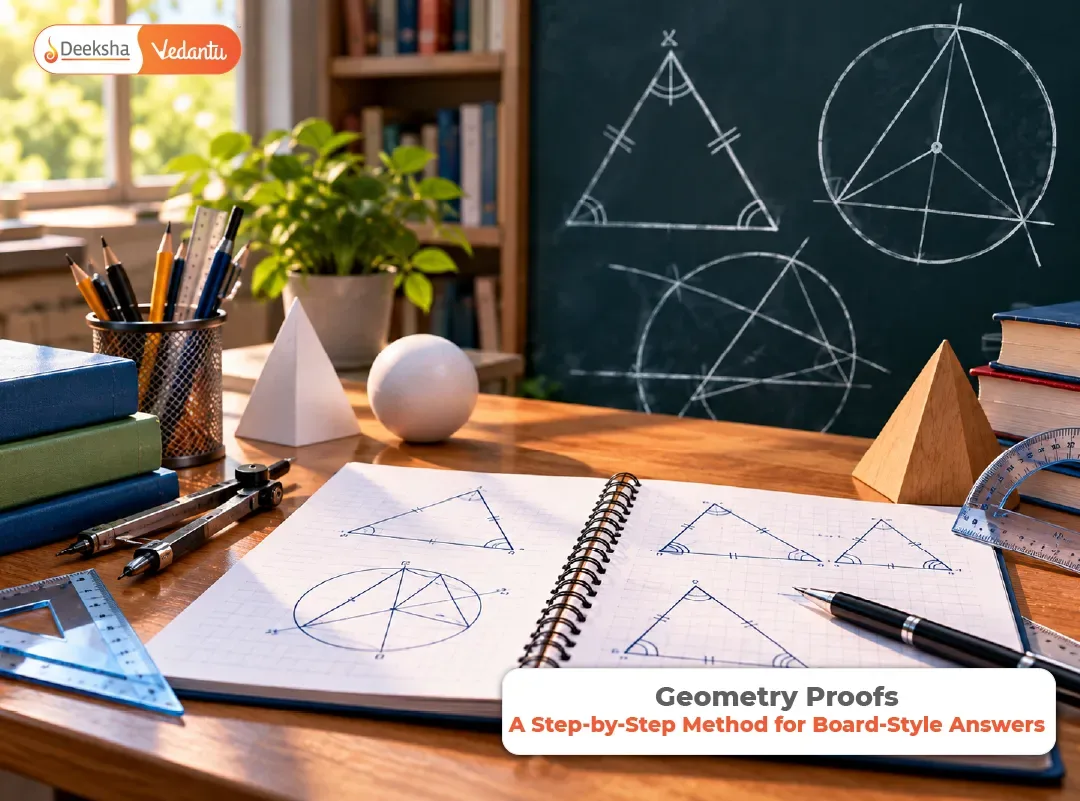
- Figure. Draw a neat diagram and mark the given information on it, using equal-side ticks and angle arcs.
- Given. Write what is known, in terms of the letters on your figure.
- To prove. Write exactly what you must show.
- Construction. If you add a line, say so, and say how: “Join BE and CD” or “Draw DM perpendicular to AC”.
- Proof. Number the steps, and put the reason beside each one in brackets.
The reasons carry real weight. A line such as “angle ADE = angle ABC (corresponding angles)” earns a mark that the bare statement “angle ADE = angle ABC” does not. Finish with the conclusion in the words of the question, and write “Hence proved”.
The biggest habit change is to treat the figure as part of the answer, not a rough sketch. Many marks are lost simply because a student cannot see which angle is which. A clear figure also shows you which construction is needed, which is often the hardest step to spot.
Applying the Method to the Basic Proportionality Theorem
This is the standard first proof of the triangles chapter, and it shows the method clearly. The theorem says that if a line is drawn parallel to one side of a triangle to meet the other two sides at distinct points, it divides those sides in the same ratio.
Given: In triangle ABC, DE is parallel to BC, with D on AB and E on AC.
To prove: AD/DB = AE/EC.
Construction: Join BE and CD. Draw EN perpendicular to AB and DM perpendicular to AC.
Proof:
- Area of triangle ADE = ½ × AD × EN, and area of triangle BDE = ½ × DB × EN (area = ½ × base × height, with the same height EN). So ar(ADE)/ar(BDE) = AD/DB.
- In the same way, ar(ADE)/ar(DEC) = ½ × AE × DM / ½ × EC × DM = AE/EC.
- Triangles BDE and DEC stand on the same base DE and lie between the same parallels DE and BC, so ar(BDE) = ar(DEC).
- From steps 1, 2 and 3, AD/DB = AE/EC.
Hence proved. The proof has one idea, comparing areas, and one construction. A student who knows both can write it in two minutes. For the full explanation and the converse, see our guide to the Basic Proportionality Theorem, and for the slips that cost marks, read common proof mistakes in the Basic Proportionality Theorem.
Similar Triangles: Choosing the Criterion
Most similarity proofs are short once you pick the right criterion. The three you need are AA, SAS and SSS. Match the criterion to what you are given, and say its name in the reason.
Here is a short example. In triangle ABC, a line DE parallel to BC meets AB at D and AC at E. Prove that triangle ADE is similar to triangle ABC.
- Angle A is common to both triangles.
- Angle ADE = angle ABC (corresponding angles, since DE is parallel to BC).
- So triangle ADE ~ triangle ABC (AA criterion).
Three lines, each with a reason. When a question gives you only sides, check the ratios and use SSS. When it gives you two sides and the angle between them, use SAS. The criteria for similarity of triangles page lists all three with figures.
One point trips up many students. When you write similar triangles, the order of the letters matters. Write triangle ADE ~ triangle ABC so that A corresponds to A, D to B and E to C. If the letters are in the wrong order, the ratios you write next will be wrong, even though your idea was correct.
Circles: Two Proofs That Appear Again and Again
The circles chapter has two standard theorems, and both are asked as proofs. Learn them in the order below, because the second uses the first.
Theorem 1: The tangent at any point of a circle is perpendicular to the radius through the point of contact.
Given: A circle with centre O, and a tangent XY touching the circle at P.
To prove: OP is perpendicular to XY.
Construction: Take any point Q on XY other than P, and join OQ.
Proof:
- Q lies outside the circle (a tangent touches the circle at only one point), so OQ is greater than the radius OP.
- This is true for every point Q on XY other than P, so OP is the shortest distance from O to the line XY.
- The shortest distance from a point to a line is the perpendicular, so OP is perpendicular to XY.
Hence proved.
Theorem 2: The lengths of the two tangents drawn from an external point to a circle are equal.
Given: A circle with centre O, a point P outside it, and tangents PA and PB touching the circle at A and B.
To prove: PA = PB.
Construction: Join OA, OB and OP.
Proof:
- OA is perpendicular to PA, and OB is perpendicular to PB (the tangent is perpendicular to the radius at the point of contact).
- In the right triangles OAP and OBP, OA = OB (radii of the same circle), OP is common, and angle OAP = angle OBP = 90°.
- So triangle OAP is congruent to triangle OBP (RHS criterion).
- Therefore PA = PB (corresponding parts of congruent triangles).
Hence proved. The second proof is a good example of why you should always name the congruence criterion and the reason “corresponding parts of congruent triangles”. Each one is a separate mark. Our page on tangent to a circle has the figures, and the article on common proof mistakes in circle tangent properties covers the wording errors worth avoiding.
Why Marks Go Missing in Otherwise Correct Proofs
Students usually lose marks in geometry proofs for a small set of reasons, and almost all of them are fixable.
- No reason beside the step. The step is right, but the reason is missing.
- Assuming what you must prove. If your proof uses the conclusion as a step, it proves nothing.
- Wrong order of letters. Congruent and similar triangles must have corresponding vertices in the same order.
- Using a theorem in the wrong direction. The Basic Proportionality Theorem and its converse are different statements.
- Construction without a statement. Adding a line to the figure without writing it in the proof can cost the construction mark.
- Skipping the figure or drawing it too small. If you cannot see the angles, you cannot reason about them.
For more practice at board level, the important questions for Class 10 maths, chapter 6 triangles page has a good set of proof questions.
A Short Routine for Learning Proofs, Not Memorising Them
Learning a proof by heart works until the question changes slightly. Learning the structure works every time. Try this routine for each theorem.
- Day 1. Read the proof once, then close the book and write the Given, To prove and Construction from memory.
- Day 2. Write the full proof with reasons, without looking. Compare, and mark the missing reasons in a different colour.
- Day 3. Solve two riders based on the theorem. A rider is a question that uses the theorem as a tool rather than asking you to prove it.
- Day 5. Redo the proof from scratch. If you can write it in under three minutes with all reasons, move on.
Both CBSE and Karnataka SSLC ask geometry proofs, so practise the standard theorems in full. For extra question banks, the Class 10 circles notes with theorems and the triangles MCQs are good to work through after the proofs.
Frequently Asked Questions
Q1. Do I Need to Learn Every Proof in the Textbook?
Learn the theorems the syllabus lists as provable, because those are the ones set as full proofs. For the rest, understand the idea so you can use them in riders. Previous-year papers show which theorems are set most often.
Q2. How Much Should I Write for Each Step?
One short statement and one reason in brackets. Long sentences waste time without adding marks. A numbered list with brief reasons is the clearest format.
Q3. What If I Cannot See the Construction?
Look at what the conclusion compares. If it compares areas, join points to make triangles with a common base or height. If it compares lengths of tangents, join the centre to the points of contact. Practising the standard constructions makes them easier to spot.
Q4. Is It Okay to Skip the Figure If I Am Short of Time?
It is better not to. The figure often carries a mark, and it makes the proof easier to write. A quick neat figure takes about a minute and usually saves more than that.
Q5. How Can I Improve at Geometry Proofs for Class 10 Quickly?
Write each proof in full, with reasons, at least twice with a gap between attempts. Then solve riders that use the theorem. Most students improve fastest by writing and comparing, not by rereading.
Conclusion: Write Proofs the Way Examiners Read Them
A good proof is short, ordered and explained. Draw the figure, write the given and the aim, state any construction, give each step a reason and close with the conclusion. Do that for the Basic Proportionality Theorem, the similarity criteria and the two tangent theorems, and you will have covered most of what is asked. Practise the structure, not just the content, and the marks follow.









Get Social