
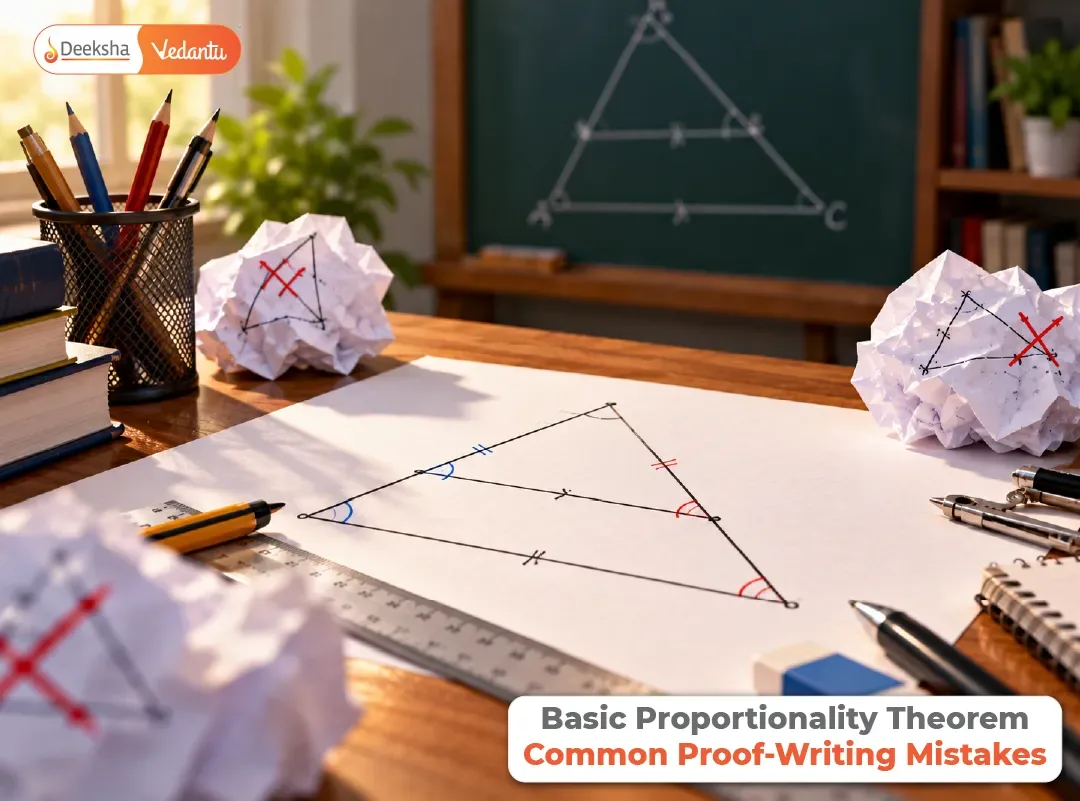


The basic proportionality theorem is the one theorem in Class 10 geometry that students are expected to prove from scratch, and the proof is short. Yet it is also one where full marks are hard to earn, because a proof is graded on its structure and its reasons, and not only on whether the ending is right. A student can know exactly why the theorem is true and still lose half the marks by writing the argument in the wrong way.
This guide states the theorem and its converse, gives a complete model proof with the reason beside every step, works two numerical examples, and then lists the proof-writing mistakes with the fix for each. For the wider chapter, see these notes on the similarity of triangles and the criteria for similarity. The theorem is also the engine behind dividing a line in a ratio in constructions, and it leads directly into similar triangles in real life.
The Theorem and Its Converse
Basic Proportionality Theorem (Thales’ theorem). If a line is drawn parallel to one side of a triangle, intersecting the other two sides in distinct points, then it divides those two sides in the same ratio.
In triangle ABC, if DE ∥ BC, with D on AB and E on AC, then
AD/DB = AE/EC
Converse. If a line divides two sides of a triangle in the same ratio, then it is parallel to the third side.
The theorem moves from “parallel” to “proportional”, and the converse moves from “proportional” to “parallel”. Mixing the two up is a classic source of mistakes.
A Model Proof, Line by Line
A complete proof has five parts: Given, To prove, Construction, Proof, and a conclusion. Here is the standard one.
Given: In triangle ABC, DE ∥ BC, where D lies on AB and E lies on AC.
To prove: AD/DB = AE/EC.
Construction: Join BE and CD. Draw DM ⊥ AC and EN ⊥ AB.
Proof:
| Step | Reason |
| ar(△ADE) = ½ × AD × EN | Area of a triangle = ½ × base × height, with base AD and height EN |
| ar(△BDE) = ½ × DB × EN | Base DB and the same height EN |
| So ar(ADE)/ar(BDE) = AD/DB … (i) | Divide the two, and ½ × EN cancels |
| ar(△ADE) = ½ × AE × DM | Base AE and height DM |
| ar(△CDE) = ½ × EC × DM | Base EC and the same height DM |
| So ar(ADE)/ar(CDE) = AE/EC … (ii) | Divide the two, and ½ × DM cancels |
| ar(△BDE) = ar(△CDE) … (iii) | They lie on the same base DE and between the same parallels DE and BC |
| From (i), (ii) and (iii), AD/DB = AE/EC | The right sides of (i) and (ii) are equal because the denominators are equal |
Conclusion: Hence AD/DB = AE/EC. Proved.
The step that carries the weight is (iii). Triangles on the same base and between the same parallels have equal areas, which is where the parallel condition enters the proof. If a proof never uses that fact, it cannot be right.
The Converse, by Contradiction
Given: In triangle ABC, a line DE with D on AB and E on AC such that AD/DB = AE/EC.
To prove: DE ∥ BC.
Proof: Suppose DE is not parallel to BC. Then draw a line DE′ through D that is parallel to BC, meeting AC at E′. By the theorem, AD/DB = AE′/E′C. But AD/DB = AE/EC is given. So AE′/E′C = AE/EC. Adding 1 to both sides gives AC/E′C = AC/EC, so E′C = EC. This means E′ and E are the same point, which contradicts our assumption. Hence DE ∥ BC.
Two Numerical Examples
Example one. In triangle ABC, DE ∥ BC. If AD = 4 cm, DB = 6 cm and AE = 3 cm, find EC.
By the theorem, AD/DB = AE/EC, so 4/6 = 3/EC, which gives EC = 3 × 6/4 = 4.5 cm.
Example two. In triangle ABC, DE ∥ BC, with AD = x, DB = x − 2, AE = x + 2 and EC = x − 1. Find x.
x/(x − 2) = (x + 2)/(x − 1). Cross-multiplying: x(x − 1) = (x + 2)(x − 2), so x² − x = x² − 4, giving x = 4.
Check. AD = 4, DB = 2, AE = 6, EC = 3. AD/DB = 2 and AE/EC = 2. ✓
Using the converse. A student is asked whether DE ∥ BC when AD = 3 cm, DB = 9 cm, AE = 2 cm and EC = 6 cm. AD/DB = 3/9 = 1/3 and AE/EC = 2/6 = 1/3. The ratios are equal, so by the converse, DE ∥ BC.
Ten Proof-Writing Mistakes
| Mistake | What it looks like | The fix |
| No Given or To prove | Starting the proof at once | State both, with the figure labelled |
| No figure, or an unlabelled one | An incomplete diagram | Draw a neat triangle and mark the parallel lines and the points |
| Leaving out the construction | Using BE and CD without saying they are drawn | Write the construction line explicitly |
| Writing a step without a reason | A column of equations | Put a reason next to every step |
| Wrong reason for equal areas | Saying “same base” only | Say “same base and between the same parallels” |
| Assuming what is to be proved | Writing AD/DB = AE/EC early | Prove it at the end, and not at the start |
| Circular reasoning | Using similar triangles to prove the theorem | The similarity criteria are proved using this theorem, so you cannot use them here |
| Confusing the theorem with its converse | Starting from the ratio when the question gives parallel lines | Check which one is the “given” |
| Writing the wrong ratio | AD/AB = AE/EC | Compare AD/DB with AE/EC, or AD/AB with AE/AC |
| No conclusion | The proof just stops | Close with “Hence proved” and the result |
The circular reasoning mistake deserves a second look. In the textbook order, the basic proportionality theorem comes first, and it is then used to prove the AA criterion of similarity. If you use “the triangles are similar” to prove the theorem, you are using a result that depends on it.
A Template for Any Geometry Proof
The same structure serves for most proofs in the chapter and in the chapters on circles.
- Figure: neat, labelled, with all the given information marked.
- Given: what the question tells you.
- To prove: the statement you must reach.
- Construction: any extra lines, named.
- Proof: one step per line, with a reason.
- Conclusion: the result, written in the form of the “to prove”.
For another proof where the same habits apply, read the common proof mistakes about tangents to a circle.
The Theorem in Your Syllabus
The basic proportionality theorem belongs to Triangles, a chapter of the Class 10 Maths book in both the CBSE and the Karnataka SSLC textbooks. Published deleted-syllabus lists show that CBSE has trimmed some theorem proofs in this chapter, so check which proofs your own board expects you to write out. Practise with the chapter MCQs and the important questions. The theorem returns as a tool in Class 11 coordinate geometry and vectors, which matter for JEE Main and KCET.
Frequently Asked Questions
Q1. What is the basic proportionality theorem?
If a line parallel to one side of a triangle meets the other two sides in distinct points, it divides those sides in the same ratio.
Q2. What is the converse of the theorem?
If a line divides two sides of a triangle in the same ratio, then it is parallel to the third side.
Q3. Why do triangles BDE and CDE have equal areas in the proof?
Because they lie on the same base DE and between the same parallel lines DE and BC.
Q4. Can I use similar triangles to prove the theorem?
No. In the textbook sequence, the theorem is used to prove the similarity criteria, so using similarity to prove it would be circular reasoning.
Q5. How should I lay out a proof in the exam?
Draw a labelled figure, then write Given, To prove, Construction, Proof with a reason for each step, and finish with a conclusion.
A Proof Is a Conversation With the Examiner
The examiner cannot read your mind, so every step must say what you are doing and why. Write the structure, give the reasons, and finish with the conclusion, and a short theorem becomes a reliable source of full marks.









Get Social