
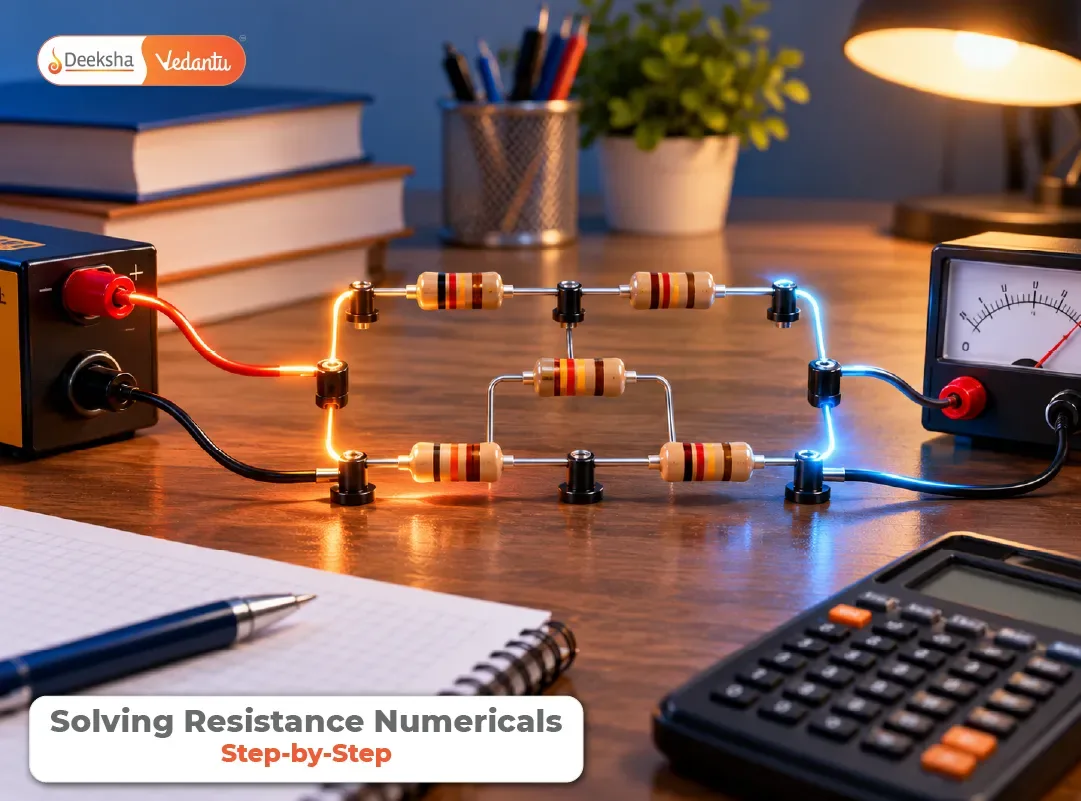


Most resistance numericals are not hard. They are long, and long problems fail at the first wrong turn: the wrong formula, a missed conversion, or a combination that was never really series or parallel. A fixed routine removes that risk, because every step has one job.
This guide gives you a four-step frame for resistance problems, then climbs five solved numericals from a simple Ohm’s law question to a mixed network with power. Each one is checked, so you can see what a clean answer looks like.
A Four-Step Frame That Fits Every Problem
The routine
- Given and find. List every value with its unit, converted to SI, and write what you must find.
- Sketch and cue. Draw the circuit. Look at the wording of the question to decide which relation applies.
- Formula, then numbers. Write the formula first, then substitute. Never substitute into a formula you have not written.
- Check and state. Test the answer for sense, then write it with its unit.
Let the wording pick the formula
| If the question says | Think |
| A wire of a given length, area or material | R = ρL/A, with A = πd²/4 if the diameter is given |
| Resistors joined end to end, or “the same current” | Series: R = R₁ + R₂ + R₃ |
| Resistors joined across the same two points, or “the same voltage” | Parallel: 1/R = 1/R₁ + 1/R₂ + 1/R₃ |
| Voltage across, or current through, one resistor | V = IR for that resistor alone |
| Power, heat or energy | P = VI = I²R = V²/R, and H = I²Rt |
If any step here feels shaky, a quick read of Ohm’s law and the factors on which resistance depends is a good refresher.
Five Numericals, From Easy to Exam-Hard
Easy: Ohm’s law
A resistor draws 0.5 A from a 6 V battery. Find its resistance, and the current if the battery voltage is raised to 9 V.
- Plan: R = V/I, and the resistance stays the same.
- Solve: R = 6/0.5 = 12 Ω. At 9 V, I = 9/12 = 0.75 A.
Next: Resistivity of a wire
A copper wire is 2 m long and has a cross-sectional area of 0.5 mm². Taking ρ = 1.6 × 10⁻⁸ Ω m, find its resistance.
- Convert: A = 0.5 mm² = 0.5 × 10⁻⁶ m².
- Solve: R = ρL/A = (1.6 × 10⁻⁸ × 2) / (0.5 × 10⁻⁶) = 0.064 Ω.
- Check: a short copper wire should have a very small resistance, and it does.
Series connection
Resistors of 2 Ω, 3 Ω and 5 Ω are connected in series across 20 V. Find the current and the voltage across each resistor.
- Solve: R = 2 + 3 + 5 = 10 Ω, so I = 20/10 = 2 A through all three.
- Voltages: 2 × 2 = 4 V, 2 × 3 = 6 V, and 2 × 5 = 10 V.
- Check: 4 + 6 + 10 = 20 V, which equals the supply.
Parallel connection
Resistors of 6 Ω and 3 Ω are connected in parallel across 12 V. Find the equivalent resistance, the total current and each branch current.
- Solve: 1/R = 1/6 + 1/3 = 1/2, so R = 2 Ω. Total current I = 12/2 = 6 A.
- Branches: 12/6 = 2 A and 12/3 = 4 A.
- Check: 2 + 4 = 6 A, and 2 Ω is smaller than both resistors.
Exam-hard: A mixed network with power
A 4 Ω resistor is in series with a parallel pair of 6 Ω and 3 Ω, all connected to a 12 V supply. Find the total current, the voltage across the pair, the current in each branch of the pair, and the total power.
- Reduce the pair: 6 Ω and 3 Ω in parallel give 2 Ω.
- Total resistance: 4 + 2 = 6 Ω, so I = 12/6 = 2 A.
- Voltage across the pair: 2 × 2 = 4 V.
- Branch currents: 4/6 ≈ 0.67 A and 4/3 ≈ 1.33 A, which add up to 2 A.
- Power: P = VI = 12 × 2 = 24 W.
- Check: the 4 Ω resistor uses I²R = 4 × 4 = 16 W, and the pair uses 4 × 2 = 8 W. Together they make 24 W.
For more problems in the same style, see these top 10 electricity numericals with solutions and how resistances of a system of resistors combine.
Check Your Answer in Ten Seconds
Four quick tests
| Test | What it catches |
| Series resistance must be larger than the largest resistor, and parallel resistance must be smaller than the smallest | A missed inversion, or the wrong combination |
| Voltage drops in series must add up to the supply voltage | Mixed-up resistors or a wrong current |
| Branch currents in parallel must add up to the total current | Arithmetic slips and swapped branches |
| Power calculated two ways, VI and I²R, must agree | A wrong formula or a missed square |
For speed in the exam hall, there is more in this guide on how to solve circuit problems fast in board exams.
Five questions to practise
- A bulb filament has a resistance of 484 Ω on a 220 V supply. Find the current. Answer: I = 220/484 ≈ 0.45 A.
- Two 10 Ω resistors are connected in parallel across a 10 V battery. Find the equivalent resistance and the total current. Answer: 5 Ω and 2 A.
- A 20 Ω and a 30 Ω resistor in series carry 0.2 A. Find the supply voltage. Answer: R = 50 Ω, so V = 0.2 × 50 = 10 V.
- Two wires of the same material and length have areas A and 2A. If the first has a resistance of 8 Ω, what is the second’s? Answer: resistance is inversely proportional to area, so 4 Ω.
- A 12 Ω resistor is in series with two 12 Ω resistors connected in parallel. Find the total resistance. Answer: 12 + 6 = 18 Ω.
Where These Numericals Live
Resistance numericals fill the Class 10 chapter on Electricity (Chapter 11 in the CBSE book and Chapter 12 in the Karnataka SSLC textbook), and in Class 12 they grow, inside Current Electricity (Chapter 3), into internal resistance and Kirchhoff’s laws. KCET tests them as quick MCQs from the II PUC syllabus. NEET UG 2026 (Unit 12) and JEE Main list Ohm’s law, resistivity, resistor combinations, electrical energy and power, internal resistance, Kirchhoff’s laws and bridge circuits. Published lists show the potentiometer and the colour code for carbon resistors among topics removed from recent NEET and JEE Main syllabi, so check the latest official syllabus before you study them.
And once a power question appears, remember the safety side of it too: see how fuses and MCBs protect your home.
Frequently Asked Questions
Q1. How do I solve a resistance numerical step by step?
List the given values in SI units, sketch the circuit, choose the formula from the wording of the question, write the formula before substituting, and check the answer for sense before stating it with its unit.
Q2. When do I use series and when parallel for resistors?
Use the series formula when resistors share the same current and are joined end to end, so R = R₁ + R₂ + R₃. Use the parallel formula when they share the same voltage across the same two points, so 1/R = 1/R₁ + 1/R₂ + 1/R₃.
Q3. How do I find the resistance of a wire?
Use R = ρL/A, where ρ is the resistivity of the material, L is the length and A is the cross-sectional area. Convert the area to m² before substituting, and use A = πd²/4 if the diameter is given.
Q4. How can I check whether my answer is correct?
Check that series resistance is larger than the largest resistor, parallel resistance is smaller than the smallest, voltage drops add up to the supply, branch currents add up to the total, and power calculated as VI and as I²R agree.
Q5. Why does a longer wire have more resistance?
Electrons collide with the atoms of the wire along the whole length of their path, so a longer wire means more collisions and a greater opposition to the current. That is why R = ρL/A is proportional to the length, and inversely proportional to the cross-sectional area.
Long Problems Become Short Steps
A resistance numerical is only a handful of small decisions: which formula, which unit, which combination, and does the answer make sense. Make each decision on purpose, in the same order every time, and the long problem stops feeling long.










Get Social