
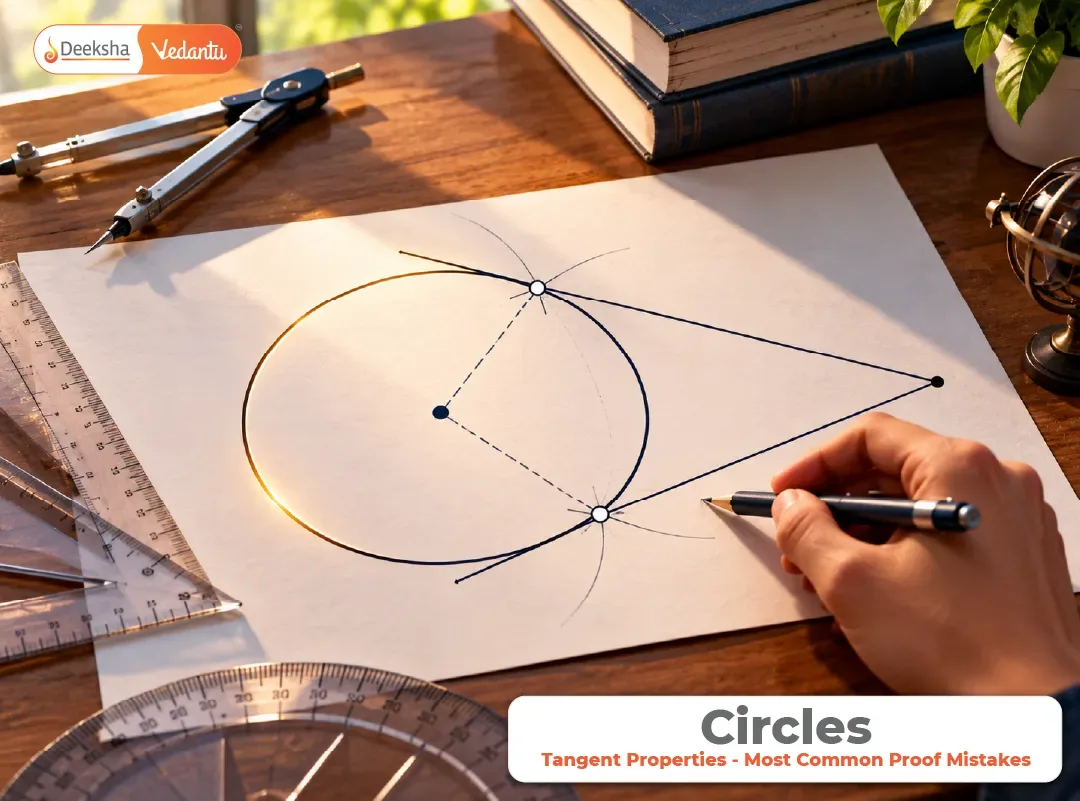


Tangent proofs look short, and that is exactly why they fail. A student who can state both theorems from memory can still lose half the marks on a three-line proof because one reason is missing, one triangle is named in the wrong order, or the proof quietly assumes the very thing it was asked to show. This article goes through the mistakes that show up again and again in Class 10 answer sheets, explains why each one costs marks, and shows what the corrected line looks like.
If you want the theory first, the page on the tangent to a circle and the full chapter notes with theorems and questions cover the basics. Here we assume you know the statements and concentrate on how they are used.
The Two Theorems Every Tangent Proof Rests On
Almost everything in the chapter comes from two results.
Theorem 1. The tangent at any point of a circle is perpendicular to the radius through the point of contact.
Theorem 2. The lengths of the two tangents drawn from an external point to a circle are equal.
A third group of facts follows from these and is used in numericals: the angle between the two tangents and the angle subtended at the centre by the points of contact add up to 180 degrees; the line joining the centre to the external point bisects the angle between the tangents; and that same line is the perpendicular bisector of the chord of contact.
Notice the order. Theorem 2 is proved using Theorem 1. So the first mistake is a structural one: using Theorem 2 as if it were free, without ever being sure Theorem 1 is available to you in the proof you are writing. Whenever a question says “prove that the tangents are equal”, Theorem 1 is the reason you will quote for the right angles.
Mistakes in Proving That the Tangent Is Perpendicular to the Radius
The standard proof is by contradiction, and this is where most of the damage happens, because the logic has a fixed shape and students skip parts of it.
Assuming the perpendicularity you are asked to prove
The most common wrong start is “Since OP is the radius and PT is the tangent, OP is perpendicular to PT.” That is the statement of the theorem, not a step towards it. An examiner reads that line as a circular argument and awards nothing for it. The proof must begin from the definition of a tangent: a line that meets the circle at exactly one point, so every other point on it lies outside the circle.
Leaving out why the other point lies outside the circle
The correct proof takes a point Q on the tangent, other than the point of contact P, and joins OQ. The key sentence is that Q must lie outside the circle, because if it lay inside, the line would cut the circle at two points and would be a secant, not a tangent. Students often write “OQ is greater than OP” with no reason. The reason is the whole proof. Without it, the comparison is only a claim.
Stopping at “OP is shortest” without the final step
OQ is greater than OP for every Q other than P, so OP is the shortest distance from O to the line. The shortest distance from a point to a line is the perpendicular. Many answers stop at the first half of that sentence. Both halves are needed: shortest, and therefore perpendicular.
Writing the proof by contradiction without the assumption line
If you choose the other common proof, where you suppose OP is not perpendicular and then draw a different perpendicular, you must write the supposition explicitly: “Suppose OP is not perpendicular to the tangent.” Then you must close the loop: “This contradicts the fact that OP is the shortest, so our supposition is wrong.” A proof that never says what it supposes, or never says where the contradiction arises, reads as unfinished.
Mistakes in the Equal-Tangents Proof
The proof of Theorem 2 is a congruence proof with four lines of working. Because it is so short, each line carries marks, and each is a place to slip.
Let PA and PB be tangents from an external point P to a circle with centre O, touching at A and B. Join OA, OB and OP.
Not joining the radii, or not saying why the angles are right angles
Students write “in triangles OAP and OBP” and move on, without ever drawing OA and OB. Then the angles at A and B are used as 90 degrees with no justification. The reason is Theorem 1: the radius is perpendicular to the tangent at the point of contact. Write it every time, in words: “angle OAP = angle OBP = 90 degrees, as a tangent is perpendicular to the radius at the point of contact.”
Choosing the wrong congruence rule
The two triangles have a right angle each, equal radii and a shared hypotenuse OP. That is RHS (right angle, hypotenuse, side). A large share of answers write SAS or SSS, and neither is justified, because the angle between the equal sides is not known. RHS is the rule, and it should be named.
Mismatched vertex order and a missing final reason
If you write triangle OAP is congruent to triangle OPB, the correspondence is wrong, and the line PA = PB will not follow from it. Keep the order consistent: triangle OAP is congruent to triangle OBP. Then conclude with the reason, “by CPCT”, before writing PA = PB. Missing CPCT is one of the simplest ways to lose a mark on a proof that is otherwise correct.
A clean version reads: OA = OB (radii); angle OAP = angle OBP = 90 degrees (Theorem 1); OP = OP (common); so triangle OAP is congruent to triangle OBP by RHS; therefore PA = PB by CPCT.
Mistakes in Numerical Problems on Tangents
The theorems are used far more often in numericals than in proofs, and the errors there are of a different kind.
Adding instead of subtracting in the tangent-length formula
Triangle OAP is right angled at A, with OP as the hypotenuse. So OP squared equals OA squared plus AP squared, which gives tangent length AP = square root of (OP squared minus r squared). A surprising number of answers write OP squared plus r squared. The check is simple: the tangent length must always be smaller than OP, because the hypotenuse is the longest side. If your answer is larger than the distance from the centre, you added when you should have subtracted.
Treating the angle between the tangents as if it equals the angle at the centre
In quadrilateral OAPB the angles at A and B are each 90 degrees, so angle AOB plus angle APB equals 180 degrees. Students sometimes assume the two angles are equal, or that one is half the other. Neither is true in general. If the angle between the tangents is 70 degrees, the angle at the centre is 110 degrees, and OP bisects each of them, giving 35 degrees and 55 degrees in the two halves.
Another frequent slip is forgetting that OP bisects the angle between tangents, and then trying to find angle OPA by a longer route when it is simply half of angle APB.
Mistakes With Circumscribed Quadrilaterals and Parallel Tangents
The next group of proofs are applications of Theorem 2 and are where students most often forget to name things.
Quadrilateral sides add up in opposite pairs
When a quadrilateral ABCD is drawn around a circle so that every side touches it, the claim is AB + CD = AD + BC. The proof needs the points of contact to be named, say P on AB, Q on BC, R on CD and S on DA. By Theorem 2, AP = AS, BP = BQ, CR = CQ and DR = DS, since each pair are tangents from the same corner. Add them: AB + CD = AP + BP + CR + DR, and AD + BC = AS + DS + BQ + CQ, and these are equal. Students who do not label P, Q, R and S end up with nothing to write the equal pairs against. The cleanest habit is to mark the four points on the diagram before writing a word.
A useful follow-on, which is also asked in its own right: if a parallelogram is circumscribed about a circle, it must be a rhombus. Opposite sides of a parallelogram are equal, so AB + CD = AD + BC becomes 2AB = 2BC, which gives AB = BC. A parallelogram with two adjacent sides equal is a rhombus.
Tangents at the ends of a diameter
The tangents at the two ends of a diameter are parallel. The reason has two parts: each tangent is perpendicular to the diameter (Theorem 1), and two lines perpendicular to the same line are parallel, since the co-interior or corresponding angles are 90 degrees each. Answers that say only “because it is a diameter” miss both reasons.
Drawing problems that make the proof harder
A tangent drawn so that it visibly cuts the circle, or a figure drawn very small, creates real mistakes. Students then read angles from the picture rather than from the reasoning. Draw a clear circle, mark the centre, and make the tangent touch at exactly one point. A good diagram is not decoration here; it is half the proof.
Worked Examples With the Arithmetic Checked
Example 1. A point P is 13 cm from the centre of a circle of radius 5 cm. Find the length of the tangent from P.
Tangent length = square root of (13 squared minus 5 squared) = square root of (169 minus 25) = square root of 144 = 12 cm. Check: 12 is less than 13, as it must be, and 5, 12, 13 is a Pythagorean triple.
Example 2. The angle between two tangents from an external point P to a circle with centre O is 70 degrees. Find angle POA, where A is a point of contact.
Angle AOB = 180 minus 70 = 110 degrees. OP bisects it, so angle POA = 55 degrees. Check using the triangle: angle OPA = 35 degrees (half of 70), and 35 + 55 + 90 = 180.
Example 3. Two concentric circles have radii 5 cm and 3 cm. Find the length of the chord of the larger circle that touches the smaller circle.
The radius of the smaller circle to the point of contact is perpendicular to the chord, so it bisects it. Half the chord = square root of (5 squared minus 3 squared) = square root of 16 = 4 cm. The chord is 8 cm.
Example 4. A circle is inscribed in a triangle ABC right angled at B, with AB = 6 cm and BC = 8 cm. Find its radius.
AC = 10 cm. The two tangents from B are equal to the radius, because the figure formed at B with the centre and the two points of contact is a square. Using equal tangents from A and C, AB + BC − AC = 2r, so r = (6 + 8 − 10) / 2 = 2 cm.
For more practice at board level, the important questions for Class 10 Maths Chapter 10 and the circles MCQs are useful to run after you have read the mistakes above.
A Short Checklist to Run Before You Write the Final Line
- Is the figure clear, with the centre marked and the contact points named?
- Have you joined the radii to the points of contact?
- Is every right angle justified by Theorem 1, in words?
- Is the congruence rule named, and is the vertex order consistent?
- Does the answer end with CPCT or the stated result, not just a number?
- For numericals, is the tangent length smaller than the distance from the centre?
- Do the angles in your working add up to the totals you expect, such as 180 degrees in a triangle or a straight line?
This takes thirty seconds and catches most of the errors above.
Where This Chapter Sits in Your Board Syllabus
Circles is Chapter 10 in the CBSE Class 10 Maths book, and the CBSE chapter 10 notes follow that numbering. In the Karnataka SSLC textbook the chapter sits under a different number and the way the theorems are presented can differ, so use the numbering in your own textbook. Which theorems you are expected to prove, and which you may only use, can also vary between boards and between years. Please confirm with your own board’s current syllabus and sample papers before you decide what to memorise word for word.
The chapter connects forward to areas of sector and segment of a circle, where the same radius and angle language returns, and to the coordinate and trigonometry chapters, where right-angled triangles do the heavy lifting.
Frequently Asked Questions
Q1. Why is the tangent perpendicular to the radius?
Because the radius to the point of contact is the shortest distance from the centre to the tangent line. Every other point on the tangent lies outside the circle, so it is farther from the centre than the radius is. The shortest distance from a point to a line is the perpendicular, so the radius is perpendicular to the tangent.
Q2. Which congruence rule is used to prove that tangents from a point are equal?
RHS. The two triangles each have a right angle at the point of contact, the radii are equal, and the line joining the centre to the external point is common. The final equality then follows by CPCT.
Q3. How many tangents can be drawn from a point to a circle?
Two from a point outside the circle, one from a point on the circle, and none from a point inside it. This is a common one-mark question, and the reasoning behind it is the same as the reasoning behind the theorems.
Q4. What is the relation between the angle between two tangents and the angle at the centre?
They are supplementary. In the quadrilateral formed by the centre, the two points of contact and the external point, the two angles at the points of contact are 90 degrees each, so the other two angles sum to 180 degrees.
Q5. How can I stop losing marks on tangent proofs?
Name every point on the figure, write the reason for every right angle, name the congruence rule, keep the vertex order consistent, and finish with CPCT or the required result. Most lost marks come from missing reasons, not from wrong ideas.
Conclusion: Proofs Are Won in the Reasons
Tangent proofs are short enough that every line matters. The ideas are rarely the problem; the missing reason, the wrong rule or the assumed result is. Work through the mistakes above once, rewrite two proofs in the clean form shown, and the chapter becomes one of the more reliable scoring areas in the paper.








Get Social