
A diagram question looks like a gift. You know the structure, you have seen it a dozen times, and there is no long paragraph to write. Yet diagrams are where many students quietly lose marks, because a half-remembered label, a missing arrow or a messy outline is easy to penalise. The students who score well on them are not more artistic. They have simply practised the same set of drawings until the hand moves on its own.
This guide lists the important diagrams for Class 10 Science by branch, notes what each one is really testing, and ends with a short revision method you can follow in a week. Treat this as the pool to practise from. If you want a broader look at how marks are given, our article on how examiners actually grade science diagrams is a good companion.
Biology Diagrams That Keep Coming Back
Biology produces many of the labelled-diagram questions, and most of them are diagrams of systems or processes. Practise these until you can draw each with all labels in about three minutes.
- The human heart. Four chambers, the major vessels and the direction of blood flow. Label the right and left atria and ventricles, the vena cava, aorta, pulmonary artery and pulmonary vein. Our heart diagram walkthrough shows how to keep the left and right sides straight.
- The alimentary canal. Mouth to anus, with the liver, gall bladder and pancreas shown as associated glands. Examiners check order and the glands’ positions.
- The excretory system and the nephron. Kidneys, ureters, bladder and urethra, plus the glomerulus, Bowman’s capsule and tubule. See the excretory system labelling guide for the common labelling slips.
- The respiratory system. Nasal passage, trachea, bronchi, lungs and alveoli.
- The neuron and the reflex arc. A neuron has dendrites, cell body, nucleus, axon and nerve endings. A reflex arc runs receptor, sensory neuron, spinal cord, motor neuron and effector, and the order is what earns the marks. The article on reflex actions with everyday examples makes the sequence easy to remember.
- Reproduction. Binary fission in Amoeba, budding in Hydra, the longitudinal section of a flower, pollen tube growth, and the male and female human reproductive systems.
- Heredity. A cross-chart for a monohybrid cross is a diagram too. Draw the parent generation, the gametes and the F1 and F2 generations in a tidy grid.
There is also a page that gathers the most-asked drawings in one place, our guide to most commonly asked diagrams in life processes, which is useful for narrowing your list.
Physics Diagrams: Rays, Circuits and Field Lines
Physics diagrams are about rules more than labels. Each has a convention that, once learned, makes the drawing correct almost automatically.
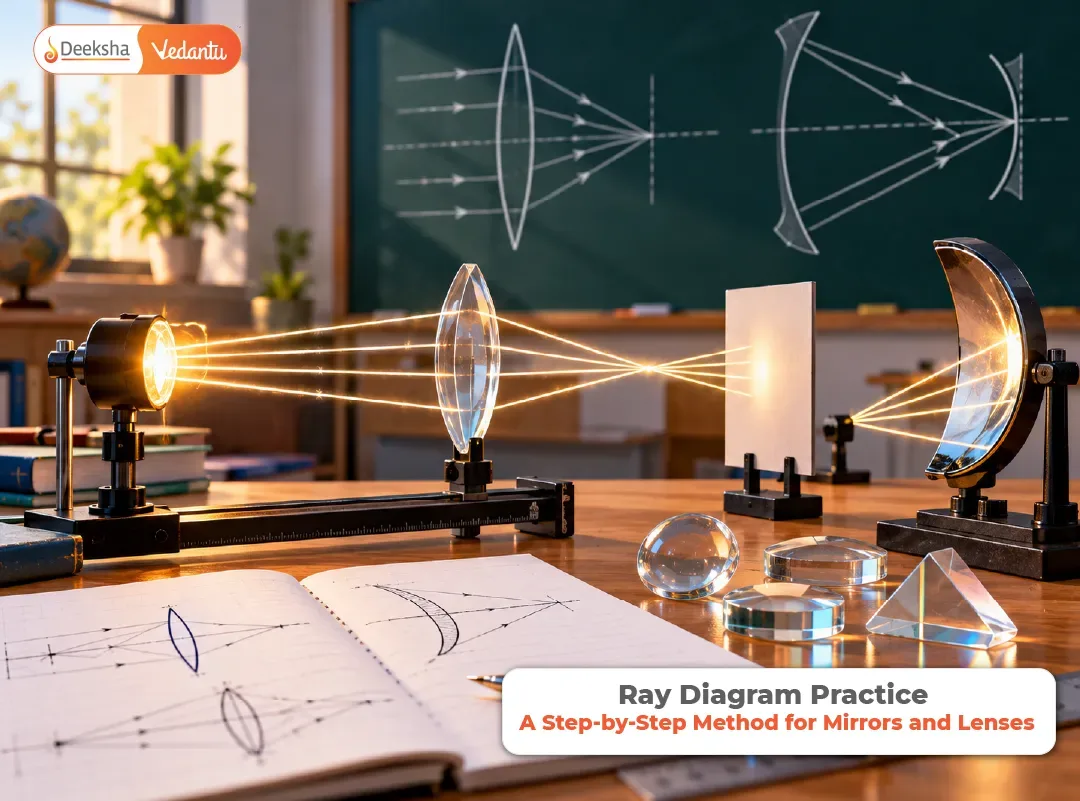
- Ray diagrams for mirrors and lenses. The standard rays, the arrows, the dotted lines for virtual rays, and the position and nature of the image. Our article on ray diagram mistakes in mirrors and lenses covers the slips that cost marks.
- Refraction through a rectangular glass slab and a prism. For the slab, the emergent ray is parallel to the incident ray and shifted sideways. For the prism, the white light splits into its colours, VIBGYOR, with violet bent the most.
- The human eye. Cornea, iris, pupil, lens, ciliary muscles, retina and optic nerve. For defects of vision, draw the uncorrected case and then the corrected case: a concave lens for myopia and a convex lens for hypermetropia. See how to label the human eye diagram for full marks for a neat labelling routine.
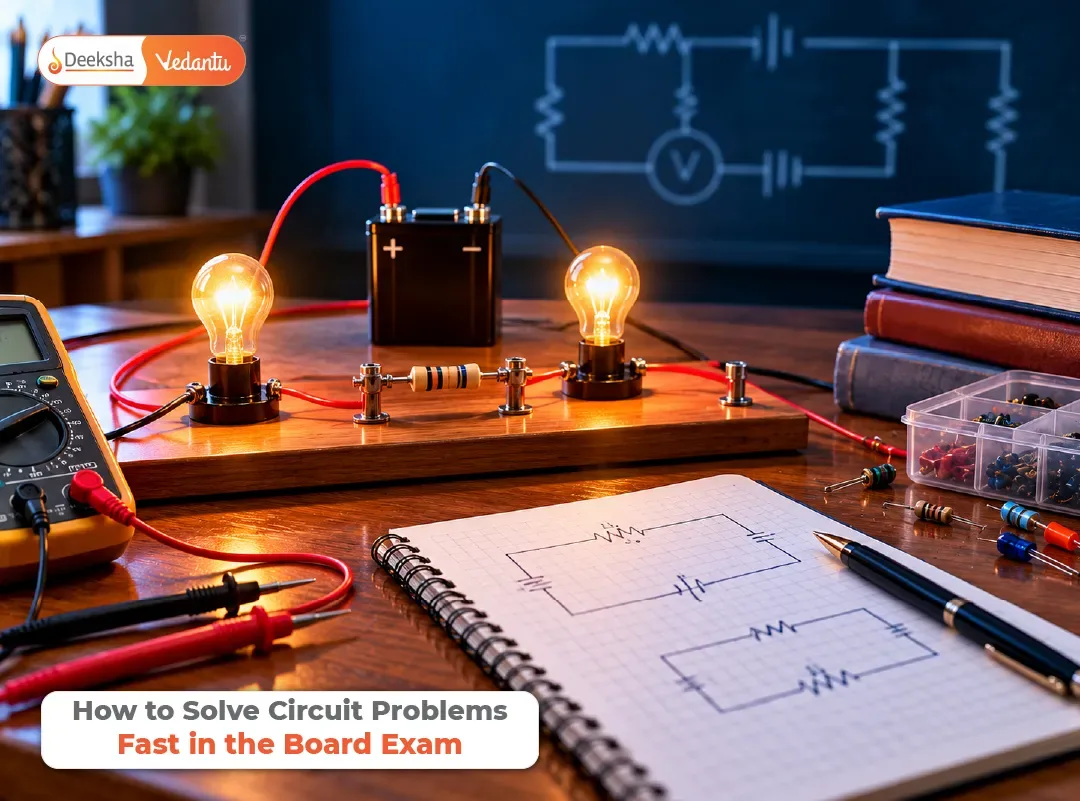
- Circuit diagrams. Use the standard symbols for a cell, battery, plug key, resistor, rheostat, ammeter and voltmeter. The ammeter goes in series and the voltmeter in parallel. Our guide to circuit diagrams lists the symbols.
- Magnetic field lines. Lines leave the north pole and enter the south pole outside a bar magnet, form closed loops and never cross. Draw them for a bar magnet, a straight conductor and a solenoid.
- The electric motor, the generator and the domestic circuit. In the motor, the split-ring commutator and brushes are the details to get right. The generator uses slip rings. In the domestic circuit, the fuse sits on the live wire.
Most lost marks in physics diagrams come from missing arrows and wrong symbols, not from misunderstanding the concept. Both are fixed by repetition. If you want the mirror and lens drawings built up step by step, our light chapter ray diagram guide covers every case.
Chemistry: Setups, Structures and Soap Micelles
Chemistry has fewer diagrams, which makes each one more valuable to revise. The important diagrams in Class 10 Science for chemistry fall into three groups.
- Experimental setups. The electrolysis of water, where hydrogen collects at the cathode in twice the volume of oxygen at the anode, and the decomposition reactions from the first chapter, such as heating lead nitrate and watching the brown fumes of nitrogen dioxide. Label the apparatus, the gases and the observation.
- Electron dot structures. Draw them for common molecules such as H₂O, CH₄, N₂ and C₂H₄. Show every shared pair, and for nitrogen show the triple bond. The details are in the carbon and its compounds diagram guide.
- Structures and the micelle. Structural isomers of butane and the diagram of a soap micelle, with hydrophobic tails pointing inwards towards the oil and hydrophilic heads facing the water.
For the reactions side, the chemical reactions and equations notes are the best place to check the setups before you draw them.
The Draw, Cover, Compare Loop
Reading a diagram is not the same as being able to draw it. Many students look at a heart diagram, feel they know it, and then draw it wrongly in the exam. The loop below turns recognition into recall, and it takes about ten minutes per diagram.
- Study the diagram for one minute, noting the labels and their positions.
- Cover it and draw it from memory on plain paper, with a ruler for straight lines.
- Label everything you can without looking.
- Uncover the original and compare. Mark each error in a different colour.
- Redraw it a day later, and again three days later, correcting only the parts you got wrong.
The delay between attempts matters. Drawing the same diagram twice in a row tests short-term memory. Drawing it again after a gap tests whether it has actually stuck. A realistic weekly plan looks like this:
| Day | Focus | Diagrams |
|---|---|---|
1 | Biology: transport and excretion | Heart, nephron, excretory system |
2 | Biology: digestion, respiration, nervous system | Alimentary canal, respiratory system, neuron, reflex arc |
3 | Biology: reproduction and heredity | Amoeba, flower section, human reproductive systems, cross chart |
4 | Physics: light | Mirror and lens ray diagrams, slab, prism |
5 | Physics: eye, electricity and magnetism | Eye, defects, circuits, field lines, motor, generator |
6 | Chemistry | Setups, electron dot structures, micelle |
7 | Mixed test | Pick any eight diagrams at random and draw them in 30 minutes |
If a week is too short, stretch each row into two days. What matters is that every diagram gets drawn at least twice, with a gap between the attempts. The article on how to score good marks in Class 10 science has more on balancing diagrams with the rest of your preparation.
What Examiners Reward in a Drawn Answer
A diagram is marked on a few simple things, and they are the same across most questions.
- Correct structure. The parts are in the right positions and proportions.
- Complete and correct labels. Every part the question names is labelled, spelled correctly, and joined to its part with a straight line that does not cross another line.
- Neat, honest drawing. A clear pencil outline matters more than artistic skill. Draw large enough for labels to fit.
- Directions and conventions. Arrows on rays and on blood flow, dotted lines for virtual rays, standard symbols in circuits.
- A heading. Write the name of the diagram under it.
For longer questions, a diagram placed beside a short written explanation often earns more than the explanation alone.
Frequently Asked Questions
Q1. Which Are the Most Important Diagrams in Class 10 Science?
The human heart, nephron, alimentary canal, neuron and reflex arc, reproduction diagrams, mirror and lens ray diagrams, the human eye, circuit diagrams, magnetic field lines, and the electrolysis and decomposition setups are the ones worth practising first. Previous-year papers will help you narrow the list further.
Q2. How Many Diagrams Should I Revise Each Day?
Three to five is a comfortable load if you draw each from memory and then compare. If you try to revise ten a day, you will end up looking at them, not drawing them, which gives less benefit.
Q3. Do I Need to Be Good at Drawing to Score Full Marks?
No. Examiners mark structure, labels and neatness, not artistic skill. A simple, clear outline in pencil with straight label lines is enough. Practice matters more than talent.
Q4. Should I Use Coloured Pencils in the Exam?
A clean pencil diagram with clear labels is enough, and colour is unnecessary. Use colour in practice to mark your errors, not in the final answer.
Q5. How Can I Remember Long Label Lists?
Group labels by position, such as top to bottom or left to right, and say them in that order each time you draw. For flow diagrams, such as the reflex arc, remember the path as a sentence. Repeating the drawing after a gap works better than repeating the list.
Conclusion: Make Diagrams Your Easiest Marks
Diagrams reward repetition more than any other kind of question in Science. Pick the pool above, practise each drawing from memory, compare, and redraw after a gap. Keep your labels in a fixed order, remember the conventions for arrows and dotted lines, and write a heading under every drawing. Within a couple of weeks, the diagrams you once feared become the questions you finish first.











Get Social