
Most students open the syllabus, see five units and a list of chapters, and treat every chapter as equal. They are not. The way the 80 theory marks are split across units decides where an hour of revision earns the most, and it also tells you which chapters you can safely keep for the last week. This guide walks through the CBSE Class 10 Science marking scheme 2026, unit by unit, and explains what the numbers mean for your study plan.
The unit marks below follow the CBSE curriculum for Class 10 Science. If you want the full list of topics first, our CBSE Class 10 Science syllabus page has it.
How the 100 Marks Are Divided
Class 10 Science is a 100-mark subject: 80 marks for the written paper and 20 for internal assessment. The written paper is three hours long. Internal assessment is made up of periodic assessment (5 marks for the average of the best two periodic tests and 5 marks for other assessment methods such as quizzes, oral tests or projects), subject enrichment through practical work (5 marks) and a portfolio (5 marks).
The point most students miss is that the 20 internal marks are the easiest 20 marks in the subject. They depend on regular work, not on one exam day. If you want to see how those marks interact with the final result, read our note on internal assessment versus board exams in Class 10.
The Five Units and What Each Carries
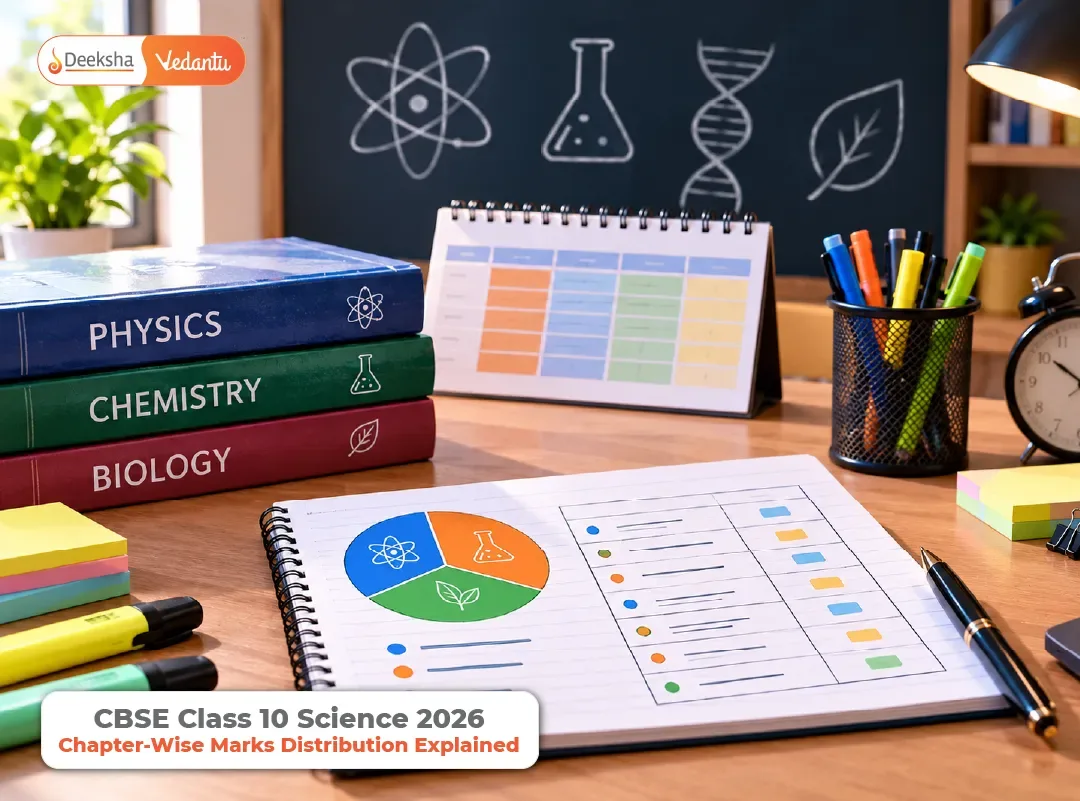
According to the CBSE curriculum, the 80 theory marks are distributed as follows:
| Unit | Marks |
|---|---|
Chemical Substances: Nature and Behaviour | 25 |
World of Living | 25 |
Natural Phenomena | 12 |
Effects of Current | 13 |
Natural Resources | 5 |
Total | 80 |
Two units, Chemical Substances and World of Living, together carry 50 of the 80 marks. That is more than 60 per cent of the written paper. Physics is split across Natural Phenomena and Effects of Current and adds up to 25 marks, the same as the chemistry unit. Natural Resources, which holds the environment chapter, is the smallest unit at 5 marks.
Chemical Substances: Where the Largest Block of Marks Sits
This unit covers chemical reactions and equations, acids, bases and salts, metals and non-metals, and carbon and its compounds. With 25 marks, it can swing your total more than any other unit. The questions here mix equations, observations, definitions and a few short numericals, so steady practice matters more than reading.
Start with reactions and equations, because balancing and identifying reaction types is used again in acids, metals and carbon compounds. Then keep a one-page sheet of reaction types, colours and observations. Our carbon and its compounds chapter page and the important chemical reactions for CBSE boards 2026 are useful for that revision.
World of Living: Biology in the Paper
The 25 marks of this unit come from life processes, control and coordination, how organisms reproduce, and heredity. These chapters reward clear, structured writing: a labelled diagram, a flow of steps and the correct terms. Life processes is the longest chapter in the unit, so give it extra time. Our life processes chapter page covers the whole chapter, and our guide on labelling the important science diagrams helps with the diagrams that biology questions ask for.
Because biology answers are descriptive, they are also the easiest place to lose marks through missing keywords. Learn the textbook terms exactly, and practise writing each process in four or five clean lines.
Natural Phenomena and Effects of Current: 25 Marks of Physics
Natural Phenomena (12 marks) covers light, meaning reflection and refraction, and the human eye and the colourful world. Effects of Current (13 marks) covers electricity and the magnetic effects of electric current. Together, physics gives you the same weight as the whole chemistry unit, and it is the part where numericals and ray diagrams decide the marks.
Electricity is the chapter where a student who practises can score close to full marks, because the formulas are few and the method is fixed. Our electricity chapter page and light reflection and refraction notes cover both halves of the physics paper.
Natural Resources: Only 5 Marks, but Not Zero Effort
The environment chapter carries 5 marks. It is mostly theory, with food chains, the ozone layer and waste management, so it is quick to prepare. Treat it as a quick final-week topic, not a chapter to skip. Five marks can be the difference between two grade bands, so do not leave it for the last night. Read the chapter once from the textbook, make a short list of the key terms (biodegradable and non-biodegradable waste, trophic levels, the ten per cent law, ozone depletion), and revisit it twice before the exam. The chapter also carries diagram-style questions such as food chains and food webs, which are quick to practise. Our environment chapter page is a convenient reference.
What the Paper Tests, Not Just Where the Marks Are
The curriculum states that competency-based weightage is split as 50 per cent for demonstrating knowledge and understanding, 30 per cent for applying knowledge or concepts, and 20 per cent for formulating, analysing, evaluating and creating. It also notes that an internal choice of about 33 per cent is provided. The paper uses very short answer and objective questions, assertion-reasoning, short and long answers, and case or source-based questions.
In practice, this means half the paper can be answered by someone who knows the textbook well, while the remaining half needs you to use what you know in a new situation. Memorising lines helps with the first half only. For the second half, practise questions you have not seen before. Our sample papers for Class 10 Science are a good place to find them, and the guide on how to write a 5-mark answer in CBSE Science shows how to structure the longer answers.
Turning the Marks Distribution Into a Study Plan
A marks table is useful only if it changes what you do. Here is a simple way to use it.
- Give time in proportion to marks. If chemistry and biology carry 25 marks each, they should take roughly half your total revision time between them.
- Split by chapter, not just by unit. A 25-mark unit with four chapters is roughly six marks per chapter on average, so no chapter should be left unprepared.
- Secure the smaller units early. Natural Resources and Effects of Current are short and scoring, so finish them first and build confidence.
- Keep physics numericals for daily practice. Ten minutes a day on electricity and light numericals pays off more than a long session once a week.
- Use our chapter ranking as a cross-check. The most important chapters in Class 10 Science for CBSE boards 2026 goes deeper on which chapters repay the effort.
The unit marks are fixed, but how they are distributed across individual questions changes from paper to paper, so treat chapter averages as a guide, not a prediction. A practical check is to revise a unit, then attempt a full paper from our important questions for Class 10 Science and mark how many of your lost marks fall in each unit. If most of them come from one unit, that is where the next week of revision should go. Repeat this every two weeks, and your plan will keep adjusting to what you actually find difficult rather than what you assume. Students who do this usually stop feeling that the syllabus is endless, because every unit has a mark target and a finish line.
If You Are Studying Under the Karnataka SSLC Board
The figures in this article are for CBSE. The Karnataka SSLC board follows its own syllabus, paper pattern and marks distribution. If you are an SSLC student, our SSLC question paper structure guide is a starting point for that board.
Frequently Asked Questions
Q1. How Many Marks Is the CBSE Class 10 Science Theory Paper?
The written paper is 80 marks, and internal assessment is 20 marks, which makes 100 in total. The written paper is three hours long.
Q2. Which Unit Has the Most Marks in Class 10 Science?
Chemical Substances: Nature and Behaviour and World of Living carry 25 marks each, so they are the two largest units. Together they make up 50 of the 80 theory marks.
Q3. How Many Marks Do Physics Chapters Carry?
Natural Phenomena carries 12 marks and Effects of Current carries 13, so physics adds up to 25 marks.
Q4. Is the Marks Distribution the Same for 2026-27 as for 2025-26?
Yes. The unit marks for 2026-27 are the same as for 2025-26: 25, 25, 12, 13 and 5.
Q5. Why Do Some Websites Show Different Marks for Each Unit?
Some sites copy figures from older sessions or make errors when summarising. The CBSE curriculum document is the reference to follow.
Conclusion: Let the Marks Decide Your Revision Order
The CBSE Class 10 Science marking scheme 2026 is simple once you see it: 25 marks for Chemical Substances, 25 for World of Living, 12 for Natural Phenomena, 13 for Effects of Current and 5 for Natural Resources, plus 20 internal marks. Spend your time where the marks are, keep the small units for quick wins, and practise the application questions that make up the rest of the paper.






Get Social