
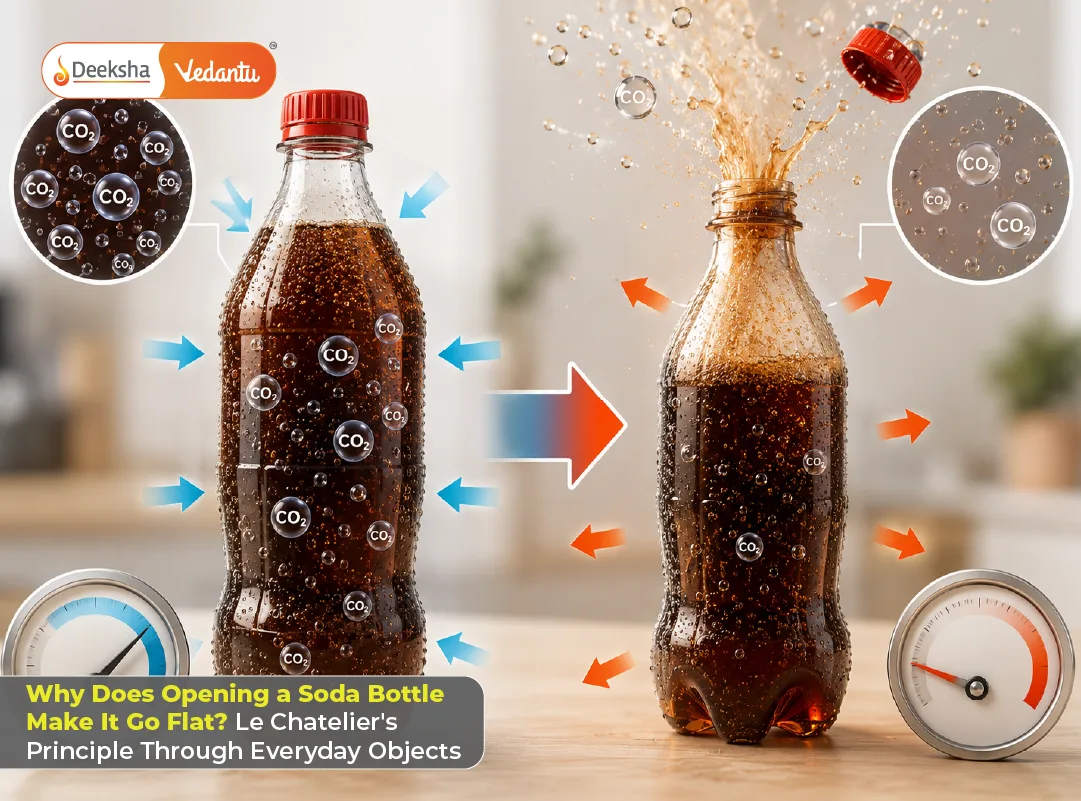


Crack open a fresh bottle of soda, and you hear that satisfying hiss – then within a few hours, even with the cap back on, the drink has gone noticeably flatter than it was. Nothing chemically dramatic happened. No reaction was deliberately triggered. And yet something inside that bottle clearly shifted, and shifted specifically because you disturbed it. This is Le Chatelier’s Principle happening in your kitchen, and once you’ve felt it through a few ordinary objects, the formal chemistry version stops feeling like an abstract rule.
The Bottle That Was Quietly at Equilibrium the Whole Time
Before you ever opened it, that sealed soda bottle wasn’t just sitting there doing nothing – it was in a genuine chemical equilibrium, just one you couldn’t see or hear. Dissolved carbon dioxide in the liquid was constantly converting to gaseous CO₂ escaping into the small headspace at the top of the bottle, while at the same time, gaseous CO₂ from that same headspace was constantly redissolving back into the liquid. Both processes were happening simultaneously, at equal rates, which is exactly what equilibrium means – not that nothing is happening, but that two opposing changes are perfectly balancing each other out.
CO₂(dissolved) ⇌ CO₂(gas)
The instant you twist the cap open, you break that balance in one specific way: you let the built-up gaseous CO₂ escape into the much larger volume of the surrounding room, instead of staying trapped in that small headspace. The system has lost product from one side of the equilibrium. According to Le Chatelier’s Principle, when you disturb an equilibrium, the system shifts in whatever direction relieves that disturbance – so more dissolved CO₂ starts converting into gas, trying to replenish what just escaped. That’s the hiss you hear, and it’s also exactly why the drink keeps losing fizz gradually afterward, even with the cap back on: you permanently changed the amount of gas available to re-establish balance, so the new equilibrium simply has less dissolved CO₂ than the original sealed bottle did.
The Pressure Cooker Whistle Is the Same Idea, Running in Reverse
A pressure cooker works by trapping steam inside a sealed vessel, letting pressure build up far beyond what an open pot could ever reach. Water inside a sealed cooker exists in its own equilibrium between liquid and vapor – and here’s the part that feels backward at first: increasing the pressure on that system doesn’t stop water from evaporating, it changes the temperature at which the whole liquid-vapor equilibrium settles.
Under this trapped, high-pressure environment, water can reach far higher temperatures than 100°C before it boils, since boiling itself is really just the point where liquid and vapor can coexist in equilibrium at the surrounding pressure. This is the entire reason pressure cookers dramatically speed up cooking – the system, disturbed by rising pressure, shifts its equilibrium point to a higher temperature, and that hotter environment is what actually cooks the food faster, not the pressure directly.
Why Rice Takes Forever to Cook on a Mountain
Flip the pressure cooker scenario around entirely, and you get high-altitude cooking. At high elevation, atmospheric pressure is genuinely lower than at sea level – and this shifts the same liquid-vapor equilibrium in the opposite direction, causing water to boil at a noticeably lower temperature, sometimes as low as 90°C on a tall enough mountain.
This is precisely why experienced trekkers know rice and lentils take much longer to properly cook at altitude: the equilibrium between liquid water and water vapor has shifted toward vapor at a lower temperature, and boiling water at 90°C simply carries less heat energy into your food per unit time than boiling water at 100°C does, even though it’s still visibly “boiling” the whole time. Nobody needs to explain equilibrium shifts to a mountain cook who’s learned to add extra time for this – they’ve just felt Le Chatelier’s Principle operating on their dinner, meal after meal.
Stating the Principle, Now That You’ve Felt It Three Times
Here’s the formal version, and notice it’s just naming what the soda bottle, the pressure cooker, and the mountain kitchen already showed you directly: if a system at equilibrium is subjected to a change in concentration, temperature, pressure, or volume, the system shifts in the direction that partially counteracts that change, establishing a new equilibrium.
The word “partially” matters more than it looks like it should. The system doesn’t fully undo the disturbance – it just shifts enough to find a new balance point. The soda bottle doesn’t restore its original fizz level once opened; it settles at a new, lower equilibrium. Pressure cooker water doesn’t boil at exactly 100°C despite the added pressure; it settles at a new, higher boiling equilibrium. This partial-shift behavior is the actual mechanism, not just a footnote.
The Industrial Version: Why the Haber Process Uses High Pressure
This same everyday logic scales directly into one of JEE’s most frequently tested equilibrium applications: the industrial synthesis of ammonia via the Haber process.
N₂(g) + 3H₂(g) ⇌ 2NH₃(g)
Notice the mole count on each side: 4 moles of gas on the left, 2 moles on the right. Applying the exact logic from the pressure cooker – a system responds to increased pressure by shifting toward whichever side occupies less volume – this equilibrium shifts toward the product side (fewer gas moles) when pressure increases, exactly why industrial ammonia production deliberately runs at very high pressure: it’s using Le Chatelier’s Principle on purpose, pushing the equilibrium toward more ammonia yield, using precisely the same physical logic that made your pressure cooker run hotter.
Reading Any Le Chatelier Question Like the Soda Bottle
| Disturbance | Everyday Version | System’s Response |
| Removing product | Opening the soda cap, letting CO₂ escape | Shifts to replace what’s lost (more CO₂ released from solution) |
| Increasing pressure | Sealing steam inside a pressure cooker | Shifts toward the side with fewer gas moles (higher boiling point) |
| Decreasing pressure | Lower atmospheric pressure at altitude | Shifts toward more vapor (lower boiling point) |
| Adding a reactant | More N₂ or H₂ pumped into a Haber process reactor | Shifts toward products, consuming the added reactant |
Every JEE Le Chatelier question, however it’s dressed up, is asking you to identify which of these categories of disturbance is happening, then predict which direction relieves it – the same two-step reasoning you just applied to a soda bottle and a pressure cooker.
Where This Fits Into Your Broader Equilibrium Preparation
The formal treatment of how disturbances shift equilibrium position, including the specific factor-by-factor breakdown JEE tests most often, is covered in full on the factors affecting equilibria page – worth reading now that you have the physical intuition to anchor each factor to. The underlying idea of a system existing in genuine balance, as the soda bottle was before you opened it, is developed further on the dynamic equilibrium page, and the mathematical relationship connecting concentrations at equilibrium is covered on the law of chemical equilibrium page.
For numerical problems that quantify exactly how far an equilibrium shifts – not just which direction – the applications of equilibrium constants page is the natural next step, and understanding why a system shifts the way it does thermodynamically, rather than just directionally, connects to the relation between K, Q, and Gibbs energy page. If you’re specifically preparing for NEET and want the numerical-heavy companion to this conceptual walkthrough, the existing guide on equilibrium – from Le Chatelier to numerical hacks picks up exactly where this intuition leaves off.
For structured guidance that builds this kind of physical, felt understanding before introducing formal equilibrium mathematics, Deeksha’s JEE coaching programs are designed around exactly this sequence – intuition first, formula second.
Frequently Asked Questions
Does the soda bottle ever return to its original fizz level if you reseal it quickly?
Not fully – some CO₂ has already permanently escaped into the room’s much larger volume, so the new equilibrium inside the bottle settles at a lower dissolved-CO₂ level than before, even once resealed.
Why does increasing pressure favor the side of a reaction with fewer gas moles?
Because that side occupies less volume for the same number of gas particles, and shifting toward it is the system’s way of partially relieving the increased pressure, exactly as Le Chatelier’s Principle predicts.
Is Le Chatelier’s Principle only about gases, or does it apply to reactions in solution too?
It applies broadly to any equilibrium – gaseous, aqueous, or otherwise – responding to changes in concentration, temperature, or pressure; the gas examples here are just especially easy to feel physically, since pressure and volume changes are so directly noticeable.
Le Chatelier’s Principle was never really a rule you needed a textbook to first encounter – you’d already felt it in a hissing soda bottle, a whistling pressure cooker, and slow-cooking rice on a mountain, long before anyone attached a name to what your senses had already noticed. Once you’ve felt the system push back against being disturbed, predicting which way any equilibrium will shift stops being memorization and starts being something closer to common sense.











Get Social