
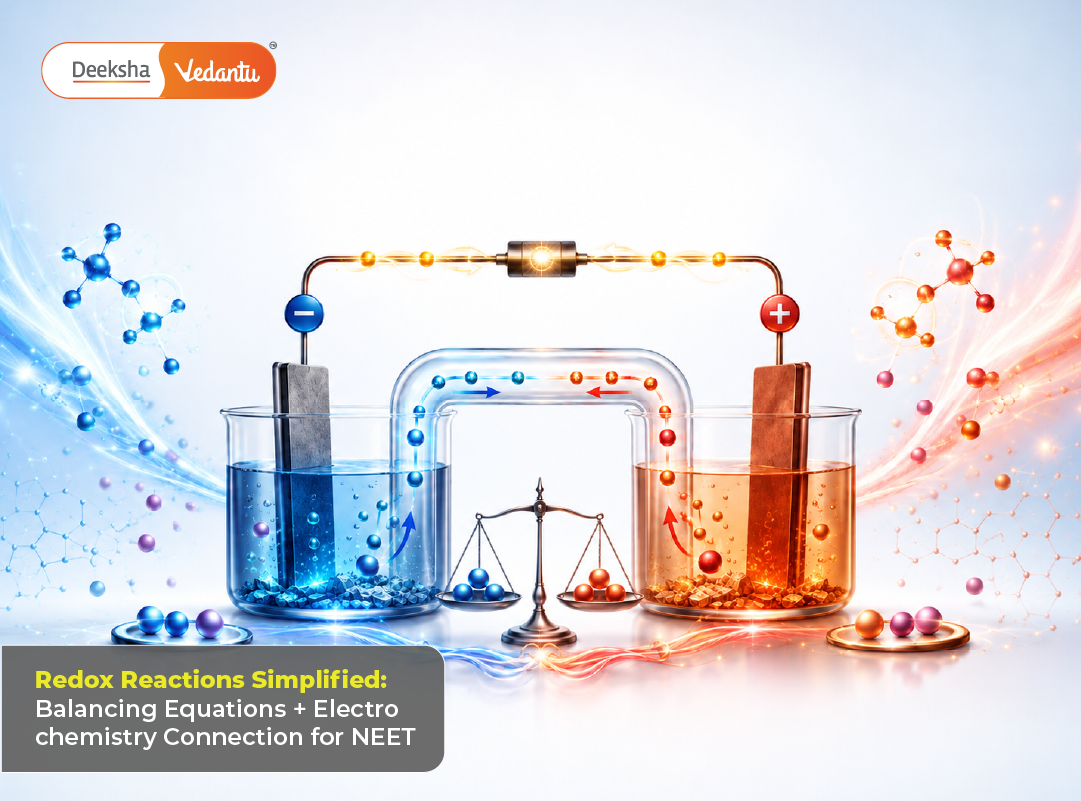


Redox reactions sit at an awkward junction in NEET Chemistry – students learn the rules in Class 11 as a standalone topic, then encounter the same logic again disguised inside electrochemistry, metallurgy, and even biological oxidation in Biology. The chapter rewards students who see oxidation and reduction not as two separate processes to memorise, but as two halves of a single electron-transfer event. This guide rebuilds that connection and walks through the balancing methods NEET actually expects.
Oxidation and Reduction: One Event, Two Names
Every redox reaction involves a transfer of electrons. Oxidation is loss of electrons (oxidation number increases); reduction is gain of electrons (oxidation number decreases). These always occur together – there is no oxidation without a corresponding reduction, which is why the reaction is called “redox” in the first place.
Oxidising agent – the species that gets reduced (it oxidises something else by taking its electrons)
Reducing agent – the species that gets oxidised (it reduces something else by giving up electrons)
NEET frequently tests this through a simple identification question: given a reaction, identify which species is the oxidising agent. The most common student error is reversing the two – assuming the species that “does the oxidising” is itself oxidised, when it’s actually the reverse.
Oxidation Number: The Bookkeeping Tool
Assigning oxidation numbers correctly is the foundation for everything that follows. The standard rules, in order of priority: free elements have oxidation number 0; monatomic ions equal their charge; oxygen is usually -2 (except in peroxides, -1); hydrogen is usually +1 (except with metals, -1); fluorine is always -1; and the sum of oxidation numbers in a neutral compound is 0 (or equals the ionic charge for a polyatomic ion).
A complete rule-by-rule breakdown, including tricky exceptions like oxygen in OF₂ (+2, since fluorine outranks oxygen) and peroxide structures, is detailed in the oxidation number chapter – worth revisiting whenever an unusual compound appears in a NEET question.
Two Theoretical Lenses NEET Expects You to Know
Classical (Electronic) Concept
The traditional, pre-electron-transfer view defined oxidation as addition of oxygen or removal of hydrogen, and reduction as the reverse. While outdated as a complete framework, NEET occasionally references this historical definition in conceptual one-liners. The historical progression of this definition is covered in the classical redox reactions chapter.
Electron Transfer Concept
The modern definition – oxidation as electron loss, reduction as electron gain – is the one NEET tests numerically. This framework is what makes balancing by the ion-electron method possible, since you’re literally tracking electrons moving from one species to another. The conceptual shift from the classical view to this electron-transfer model is laid out in the electron transfer redox chapter.
Two Methods for Balancing Redox Equations
NEET expects familiarity with both balancing methods, since different questions lend themselves to different approaches.
Oxidation Number Method
Step 1: Assign oxidation numbers to all atoms.
Step 2: Identify atoms undergoing a change in oxidation number.
Step 3: Calculate the total increase and decrease in oxidation number, and balance these by adjusting coefficients so total electrons lost equals total electrons gained.
Step 4: Balance the remaining atoms and charges, then balance oxygen and hydrogen (often by adding H₂O and H⁺ or OH⁻ depending on the medium).
Ion-Electron (Half-Reaction) Method
This method splits the overall reaction into two half-reactions – oxidation and reduction – balances each separately for atoms and charge, then adds them together so electrons cancel out completely.
Worked Example: Balance MnO₄⁻ + Fe²⁺ → Mn²⁺ + Fe³⁺ in acidic medium.
Reduction half: MnO₄⁻ + 8H⁺ + 5e⁻ → Mn²⁺ + 4H₂O
Oxidation half: Fe²⁺ → Fe³⁺ + e⁻
To balance electrons, multiply the oxidation half by 5:
5Fe²⁺ → 5Fe³⁺ + 5e⁻
Adding both halves and cancelling the 5 electrons:
MnO₄⁻ + 8H⁺ + 5Fe²⁺ → Mn²⁺ + 4H₂O + 5Fe³⁺
This worked logic – splitting, balancing separately, then combining – is the single most NEET-relevant skill in this entire chapter, since balancing questions in acidic or basic medium appear almost every year. A deeper dive into electrode-specific balancing nuances is available in the electrode processes in redox chapter.
Solved NEET-Style Numerical: Identifying the Change in Oxidation Number
In the reaction Cr₂O₇²⁻ → Cr³⁺, find the change in oxidation number of chromium.
In Cr₂O₇²⁻, let Cr = x. Using the rule that oxygen is -2 and the overall charge is -2:
2x + 7(-2) = -2
2x – 14 = -2
2x = 12
x = +6
Chromium goes from +6 to +3, a decrease of 3 – meaning chromium is reduced, and Cr₂O₇²⁻ acts as the oxidising agent. This +6 to +3 transition is one of NEET’s most frequently recurring redox numericals, often embedded inside a larger balancing question.
The Electrochemistry Connection: Redox in Action
Once you understand electron transfer, electrochemistry becomes simply redox reactions harnessed to produce or consume electrical energy – the same chemistry, applied physically.
In a galvanic (voltaic) cell, a spontaneous redox reaction generates electrical current – oxidation occurs at the anode, reduction at the cathode (remembered by the mnemonic “an ox, red cat”). Electrons flow from anode to cathode through the external circuit, while conventional current flows the opposite way.
In an electrolytic cell, an external electrical current is used to force a non-spontaneous redox reaction to occur – the reverse logic of a galvanic cell, used in processes like electroplating and the extraction of reactive metals.
Standard Electrode Potential (E°) ranks species by their tendency to be reduced. A more positive E° means a stronger oxidising agent (greater tendency to gain electrons); a more negative E° means a stronger reducing agent. This same ranking logic underlies the reactivity series used to predict whether a displacement reaction will occur between a metal and a metal salt solution.
Real-world redox application – corrosion: Rusting of iron is fundamentally an electrochemical redox process, where iron is oxidised at anodic regions of the metal surface and oxygen is reduced at cathodic regions, with moisture acting as the electrolyte connecting them. The complete mechanism and prevention methods are detailed in the corrosion chapter, which reframes a familiar everyday phenomenon entirely in redox terms.
Practice Questions Styled After NEET
Q1. In the reaction Zn + Cu²⁺ → Zn²⁺ + Cu, the oxidising agent is:
(a) Zn (b) Cu²⁺ (c) Zn²⁺ (d) Cu)
Answer: (b)
Q2. The oxidation number of sulphur in H₂SO₄ is:
(a) +4 (b) +6 (c) -2 (d) +2)
Answer: (b)
Q3. In a galvanic cell, oxidation occurs at the:
(a) Cathode (b) Anode (c) Both electrodes (d) Salt bridge)
Answer: (b)
Q4. A species with highly positive standard electrode potential is a:
(a) Strong reducing agent (b) Strong oxidising agent (c) Weak oxidising agent (d) Catalyst)
Answer: (b)
Treating Redox as One Continuous Idea, Not Three Chapters
Students often experience redox, oxidation number rules, and electrochemistry as three separate topics requiring three separate memorisation efforts. They’re not – they’re one electron-transfer principle, expressed first as bookkeeping (oxidation numbers), then as equation-balancing technique (half-reactions), and finally as a physical device (galvanic and electrolytic cells). Recognising this thread is what allows a NEET question about cell potential to be solved using the same electron-counting instinct developed while balancing equations. The same logic of tracking valence and charge states also resurfaces in periodicity of valence and oxidation states, reinforcing why certain elements show variable oxidation states in the first place.
For repeaters, this chapter is often deprioritised because it “feels done” – but balancing errors and electrode-identity mix-ups (anode vs cathode) are exactly the kind of small, repeatable mistakes that quietly cap a Chemistry score. Deeksha’s NEET repeater course treats redox and electrochemistry as a single connected unit during revision, ensuring the electron-transfer logic is drilled once and applied consistently across both halves of the topic.











Get Social