
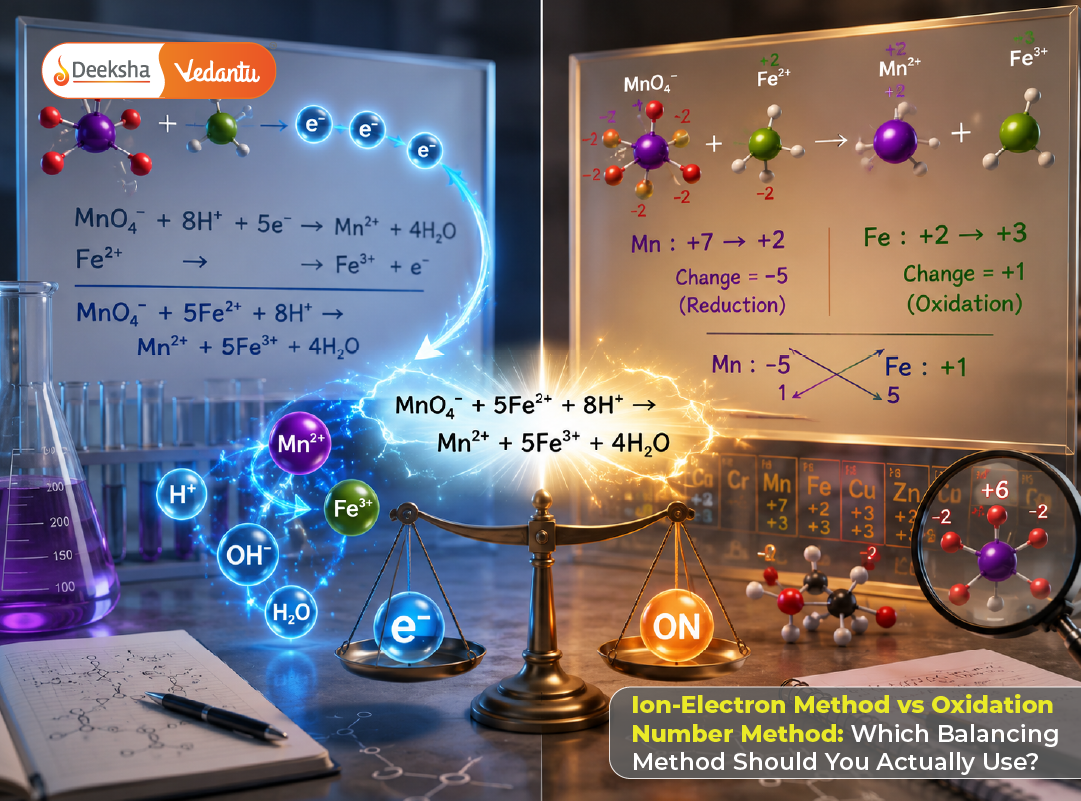


Most students pick one redox-balancing method early on, stick with it out of habit, and never actually test whether it’s the faster choice for the specific reaction in front of them. Both the Ion-Electron (half-reaction) method and the Oxidation Number method get you to the same correctly balanced equation – but they don’t get there at the same speed, and one of them handles a specific category of reaction the other genuinely struggles with. Here’s both methods run on the same two reactions, so the difference stops being theoretical.
Round 1: A Standard Acidic-Medium Reaction
The reaction: MnO₄⁻ + Fe²⁺ → Mn²⁺ + Fe³⁺ (in acidic medium)
This is JEE’s most classic redox scenario – permanganate oxidizing iron(II) to iron(III) while itself being reduced. Let’s balance it both ways.
Oxidation Number Method
Step 1: Assign oxidation numbers. Mn goes from +7 to +2 (a change of 5). Fe goes from +2 to +3 (a change of 1).
Step 2: Balance the electron loss and gain by cross-multiplying the change in oxidation number: since Mn changes by 5 and Fe changes by 1, you need 5 Fe²⁺ for every 1 MnO₄⁻.
MnO₄⁻ + 5Fe²⁺ → Mn²⁺ + 5Fe³⁺
Step 3: Balance charge and oxygen using H⁺ and H₂O, since we’re in acidic medium:
MnO₄⁻ + 5Fe²⁺ + 8H⁺ → Mn²⁺ + 5Fe³⁺ + 4H₂O
Total time: roughly three clean steps, and this is genuinely one of the fastest methods available for a simple, single-oxidant, single-reductant reaction like this one.
Ion-Electron Method
Step 1: Split into two half-reactions.
Reduction half: MnO₄⁻ → Mn²⁺
Oxidation half: Fe²⁺ → Fe³⁺
Step 2: Balance atoms other than O and H first (already balanced here), then balance oxygen using H₂O, then hydrogen using H⁺:
MnO₄⁻ + 8H⁺ → Mn²⁺ + 4H₂O
Step 3: Balance charge on each half using electrons:
MnO₄⁻ + 8H⁺ + 5e⁻ → Mn²⁺ + 4H₂O
Fe²⁺ → Fe³⁺ + e⁻
Step 4: Multiply the oxidation half by 5 to match electrons lost and gained, then add both halves together:
MnO₄⁻ + 5Fe²⁺ + 8H⁺ → Mn²⁺ + 5Fe³⁺ + 4H₂O
Verdict for Round 1: Same answer, but the Oxidation Number method got there in noticeably fewer written steps. For a straightforward reaction like this, with one oxidant and one reductant in a familiar medium, the Oxidation Number method is simply faster – this is exactly the category of question where reaching for the more elaborate half-reaction method is wasted time.
Round 2: Where the Oxidation Number Method Starts to Struggle
The reaction: Cl₂ + OH⁻ → Cl⁻ + ClO₃⁻ (disproportionation in basic medium)
This is a disproportionation reaction – the same element, chlorine, is simultaneously oxidized and reduced. This is exactly the category of reaction where the two methods stop being equally convenient.
Oxidation Number Method
Step 1: Assign oxidation numbers. Chlorine starts at 0 in Cl₂. In the products, one chlorine ends up at −1 (Cl⁻) and another ends up at +5 (ClO₃⁻).
Here’s where it gets genuinely awkward: you’re tracking the same starting atom splitting into two different oxidation states in two different product species, using only a single overall oxidation number change per formula unit. The bookkeeping requires carefully tracking that for every 6 Cl₂ molecules, 1 gets oxidized to ClO₃⁻ (losing 5 electrons per Cl atom, or 10 total since ClO₃⁻ has one Cl) and 5 get reduced to Cl⁻ (gaining 1 electron each, 10 total) – a ratio that isn’t at all obvious just from looking at the oxidation number change on paper. Getting this wrong is one of the most common JEE Advanced errors in this entire chapter.
Step 2: After correctly working out that ratio, you eventually reach:
3Cl₂ + 6OH⁻ → 5Cl⁻ + ClO₃⁻ + 3H₂O
Getting there via the Oxidation Number method alone, without separating the two “identities” chlorine is taking on, is genuinely error-prone – most students who attempt disproportionation this way either mismatch the ratio or lose track of which chlorine atoms are doing what.
Ion-Electron Method
Step 1: Split into two half-reactions – treating the same starting species, Cl₂, as feeding into two entirely separate processes:
Reduction half: Cl₂ → Cl⁻ (chlorine gaining electrons)
Oxidation half: Cl₂ → ClO₃⁻ (chlorine losing electrons)
Step 2: Balance each half independently, in basic medium:
Reduction: Cl₂ + 2e⁻ → 2Cl⁻
Oxidation: Cl₂ + 6H₂O → 2ClO₃⁻ + 12H⁺ + 10e⁻ (then convert H⁺ to OH⁻ for basic medium by adding OH⁻ to both sides and combining H⁺ + OH⁻ into H₂O)
Step 3: Balance electrons between the two halves – the reduction half loses 2 electrons per Cl₂, the oxidation half loses 10, so multiply the reduction half by 5:
5Cl₂ + 10e⁻ → 10Cl⁻
Cl₂ + 6H₂O → 2ClO₃⁻ + 12H⁺ + 10e⁻
Step 4: Add, simplify, and convert to basic medium, arriving cleanly at the same final answer.
Verdict for Round 2: Here the Ion-Electron method wins decisively. By physically separating the “two identities” chlorine takes on into two independent half-reactions from the very first step, it removes the exact ambiguity that makes the Oxidation Number method so error-prone for disproportionation. This is precisely why this method exists as a distinct approach at all, rather than being redundant with the simpler one.
The Decision Framework
| Reaction Type | Faster Method | Why |
| Single oxidant, single reductant, familiar medium | Oxidation Number | Fewer steps, direct electron-change ratio |
| Disproportionation (same element oxidized and reduced) | Ion-Electron | Cleanly separates the two roles the element plays |
| Reaction with unfamiliar or unusual medium conditions | Ion-Electron | Half-reaction balancing of H⁺/OH⁻/H₂O is more systematic |
| Electrochemistry-adjacent problems (cell reactions) | Ion-Electron | Half-reactions map directly onto electrode processes |
| Quick verification or MCQ elimination | Oxidation Number | Faster to sanity-check a given coefficient set |
Why JEE Expects You to Know Both, Not Just One
The pattern across both rounds above is the real lesson: the Oxidation Number method is faster precisely because it skips the step of separating a reaction into two independent processes – which is exactly the shortcut that becomes a liability the moment a single element is doing two different jobs at once, as in disproportionation. The Ion-Electron method’s extra structure feels like overhead in Round 1, but becomes the entire reason it works cleanly in Round 2.
This is also why the Ion-Electron method connects so directly into electrochemistry – the half-reactions you write to balance a redox equation are structurally identical to the electrode processes you’ll use later for calculating cell potentials, so practicing this method now pays off twice. For the foundational oxidation number rules both methods ultimately depend on, the oxidation number page is worth a refresher, and the broader redox reactions unit ties both balancing methods back to the classification framework – classical redox reactions – that determines which method a given question is even set up for.
If you’re prioritizing which chemistry chapters deserve this level of method-comparison depth versus a lighter pass, this guide on the best topics to focus on for high scores in JEE Chemistry is a useful reference point, and testing both methods against real conditions through JEE Main previous year question papers will show you exactly how often disproportionation-style questions actually appear versus straightforward single-oxidant reactions. Deeksha’s JEE coaching programs build this kind of method-selection judgment deliberately, rather than teaching a single default approach and hoping it generalizes.
Frequently Asked Questions
Can the Ion-Electron method always be used, even for simple reactions where Oxidation Number is faster?
Yes – Ion-Electron always works, it’s just more steps than necessary for straightforward reactions. The Oxidation Number method’s limitation is the reverse: it becomes unreliable specifically for disproportionation and comproportionation reactions, not simple ones.
Is there a quick way to tell which method a JEE question is expecting before I start solving?
Scan for whether the same element appears in two different oxidation states among the products (a strong disproportionation signal) – if so, default to Ion-Electron immediately rather than discovering the ambiguity partway through the Oxidation Number method.
Does the medium (acidic vs basic) affect which method is better?
Not directly – both methods handle acidic and basic media, though the Ion-Electron method’s structured H⁺/OH⁻/H₂O balancing within each half-reaction tends to feel more systematic once the medium adds extra complexity to the equation.
Balancing redox reactions was never about picking one method and forcing it onto every reaction – it’s about recognizing which structural feature of a given equation each method is actually built to handle. Reach for Oxidation Number when the electron transfer is simple and direct, and reach for Ion-Electron the moment a single element starts playing two roles at once.











Get Social