
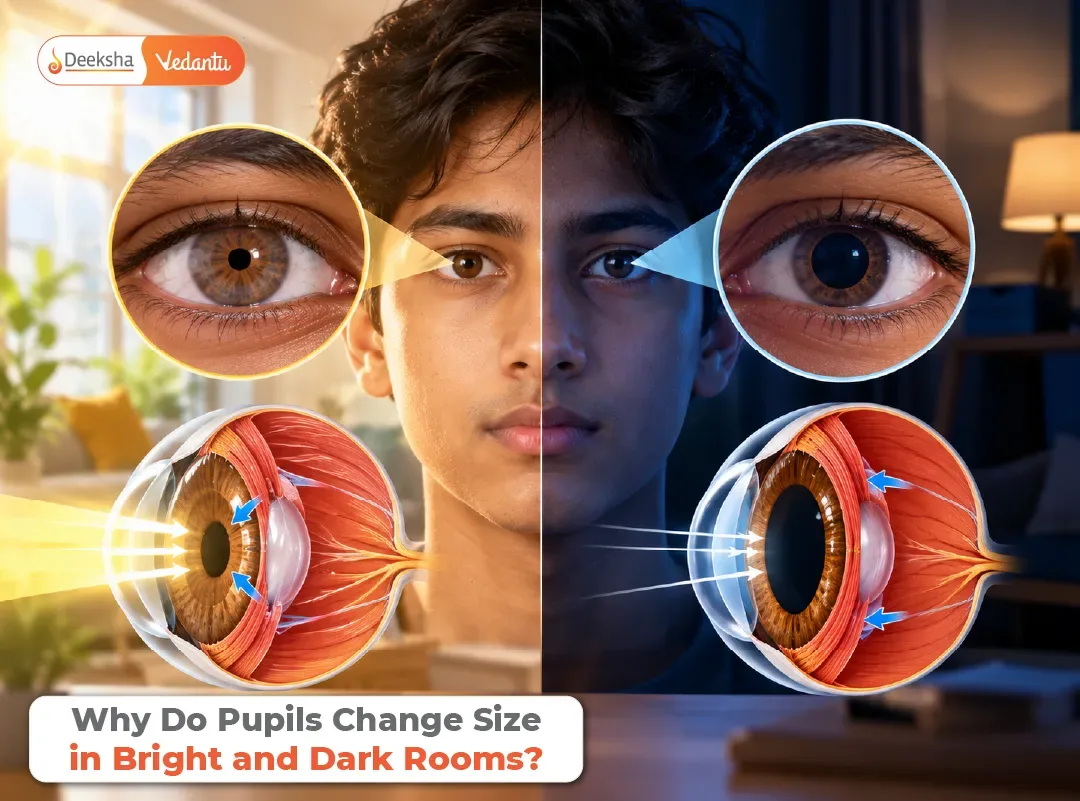


Step out of a dim room into bright sunlight and you squint, blink, and for a moment everything looks washed out. Walk into a dark cinema from the bright street and you see almost nothing until your eyes “settle”. Both are the same small mechanism at work: the pupil changing size to control how much light enters the eye.
This guide explains how the iris does it, why it is a reflex and not a decision, the nerve path the message follows, and what the eye has in common with a camera.
The Iris Is the Dimmer Switch
The coloured part of the eye is the iris, a ring of muscle. The hole in its centre is the pupil, the opening through which light enters the eye. Two sets of muscles in the iris control the size of that opening.
- Circular muscles run in rings around the pupil. When they contract, the ring tightens and the pupil gets smaller.
- Radial muscles run outward from the pupil like the spokes of a wheel. When they contract, the pupil gets wider.
Because the two sets pull in opposite directions, the iris can open and close the pupil smoothly, like an adjustable shutter.
Bright Light Versus Dim Light
| Bright light | Dim light | |
| Pupil | Becomes smaller (constricts) | Becomes larger (dilates) |
| Muscles that act | Circular muscles of the iris contract | Radial muscles of the iris contract |
| Light entering the eye | Less | More |
| Purpose | Protect the retina from too much light | Let in enough light to see |
A Reflex, Not a Decision
You do not choose to change your pupil size. Try it: you cannot make your pupils smaller by wanting to. The change is an involuntary reflex, which means it happens automatically and very fast, without thinking. The message follows a short path.
- Receptors: light-sensitive cells in the retina detect how bright the light is.
- Sensory nerve: the optic nerve carries the signal to the brain.
- Brain: the brain processes the signal and decides whether the pupil should be smaller or larger.
- Motor nerve: a motor nerve carries the instruction from the brain to the iris.
- Effector: the iris muscles contract, and the pupil changes size.
It works because a reflex path is short, with only a few steps, and it does not wait for conscious thought. Doctors use this reflex to check quickly that the nervous system is responding, by shining a small light into the eye and watching the pupil. For another everyday example of the same kind of path, see reflex actions explained with everyday examples.
Why the Eye Does This
The retina is delicate. Very bright light can dazzle it and, if intense enough, damage it, so the pupil narrows to protect it. In dim light, the pupil widens to collect as much light as possible so that you can still see. A smaller pupil also gives a sharper image of objects at different distances, and a larger pupil gives a brighter but blurrier one, so the eye is always trading brightness against sharpness.
The Eye and a Camera
| Eye | Camera | Job |
| Pupil | Aperture | The opening that lets light in |
| Iris | Diaphragm | Changes the size of the opening |
| Lens | Lens | Focuses the light |
| Retina | Sensor or film | Receives the image |
The comparison helps because both devices solve the same problem: how to take a clear picture in light that keeps changing. The eye simply does it automatically.
The Slow Adjustment
The pupil responds within a second or so, but your eyes keep adjusting for longer. When you enter a dark cinema, the pupils widen quickly, yet it takes several minutes before you can see the seats and the steps. That slower improvement is called dark adaptation, and it involves changes inside the retina and not just the iris.
Try It Safely at Home
You can watch your own pupils at work with nothing more than a mirror and a pair of hands.
- Sit in a room with ordinary daylight, in front of a mirror.
- Cover both eyes with your palms for about thirty seconds, so that no light reaches them.
- Remove your hands and watch one eye closely in the mirror.
You will see the pupils shrink back within a second or two, from large to smaller. The wide pupils your eyes had made in the dark are returning to the size suited to daylight. Do not use a bright torch or look at the sun for this, which can hurt the eyes. Normal room light is all you need.
Two Muscles, Two Nerve Systems
The two sets of iris muscles are controlled by two parts of the autonomic nervous system, the part that works without your control. One part tells the circular muscles to contract and narrows the pupil. The other tells the radial muscles to contract and widens it. They work as opposite partners, and the balance between them sets the pupil size at any moment. In Class 11 you will meet their names, the parasympathetic and sympathetic systems, and they also control the heart rate and digestion.
This explains a few things you may have noticed. Pupils also widen when you are excited, scared or very interested in something, because those states activate the part of the nervous system that prepares the body for action, and it widens the pupils along with raising the heart rate.
Not All Pupils Are Round
The round pupil is the human design, but other animals use different shapes for different needs.
| Animal | Pupil shape | Likely advantage |
| Humans, dogs | Round | A good all-round shape for daytime and night |
| Cats | Vertical slit in bright light | Lets the pupil change size over a very wide range, which helps with hunting in dim light |
| Goats and sheep | Horizontal slit | A wide view of the ground and surroundings, helpful for grazing animals watching for predators |
These shapes are an example of how the same basic organ is adapted to the way of life of an animal.
When Pupils Are Changed on Purpose
Eye doctors sometimes put special drops in the eyes to widen the pupils, so that they can look at the retina clearly. For a few hours afterwards, a person feels dazzled in bright light and finds it hard to focus on close objects, because the pupil cannot narrow normally. The drops show how much the iris normally does without anyone noticing. Doctors also use the pupil reflex as a quick test, because a pupil that does not respond to light can be a sign that something is wrong with the nerves or the brain.
A Trick for Night Vision
Because dark adaptation takes several minutes, people who need good night vision, such as astronomers, often use dim red light when they have to read a chart, since red light disturbs the dark-adapted eye much less than white light. If you have ever turned on a bright light in the middle of the night and felt briefly blind, you have seen the other side of this: the wide pupil and the sensitive retina are suddenly flooded with light.
Where This Topic Sits in Your Syllabus
The pupil reflex touches two Class 10 chapters. The structure of the eye is in The Human Eye and the Colourful World (Chapter 10 in the CBSE book for 2026-27 and Chapter 11 in the Karnataka SSLC textbook), and you can practise the diagram with this guide to labelling the human eye diagram. Reflexes and the nervous system are in Control and Coordination (Chapter 6 in the CBSE book and Chapter 7 in the SSLC textbook). Revise with these chapter notes on control and coordination and these notes on the nervous system in animals. In Class 11, the topic returns in neural control and coordination, but published deleted-topic lists show the elementary structure and function of the eye and ear, and reflex action, removed from the recent NEET syllabus, so check the latest NMC document. Confirm Class 10 portions with your own board.
Frequently Asked Questions
Q1. Why do the pupils become smaller in bright light?
To protect the retina. In bright light, the circular muscles of the iris contract and make the pupil smaller, so less light enters the eye.
Q2. Why do the pupils become larger in dim light?
To let in more light. In dim light, the radial muscles of the iris contract and widen the pupil, so more light reaches the retina and you can see better.
Q3. Is the change in pupil size voluntary?
No. It is an involuntary reflex controlled by the nervous system, so it happens automatically and very quickly without any thought.
Q4. Which part of the eye controls the size of the pupil?
The iris, a ring of muscle that surrounds the pupil, controls its size.
Q5. Why does it take time to see after entering a dark room?
The pupils widen within a second or so, but the retina takes several minutes to become fully sensitive to dim light. This slower improvement is called dark adaptation.
A Switch You Never Touch
Your pupils are adjusting all day, from the moment you open your eyes, and you never notice. It is a neat reminder that a body can solve a problem without asking for your opinion, using a short path of nerves and two sets of muscles.







Get Social