
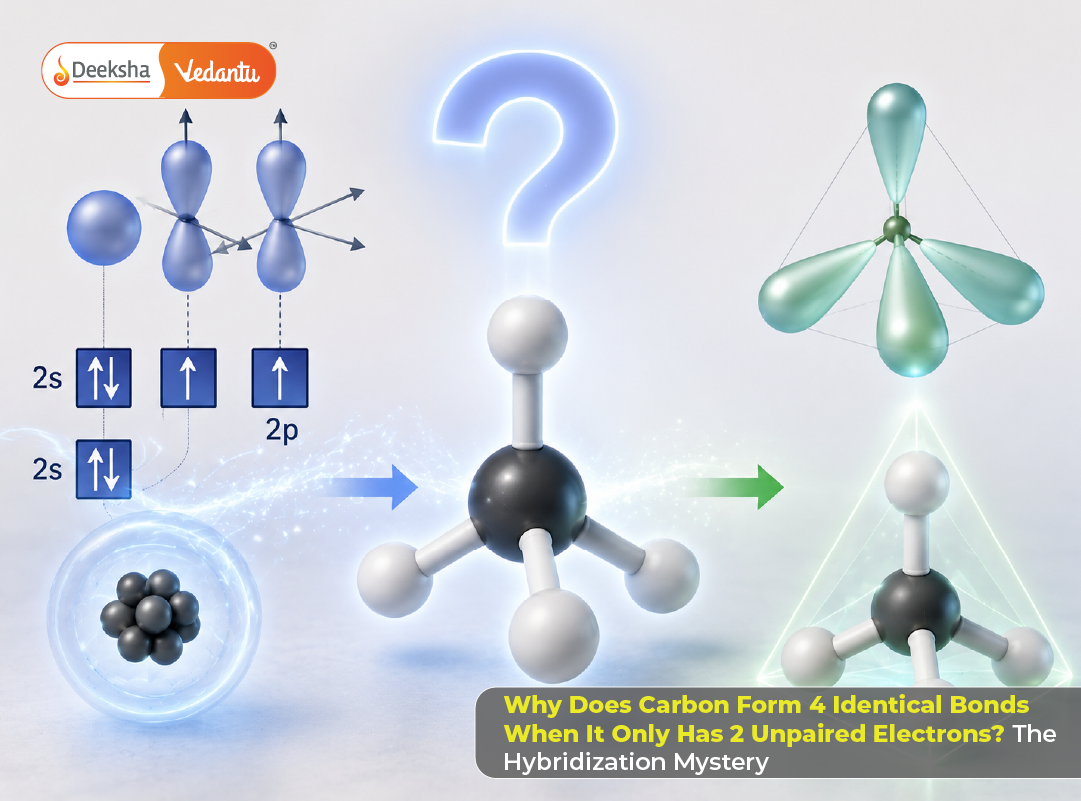


Write out carbon’s ground-state electron configuration and something doesn’t add up. Carbon is 1s² 2s² 2p². The 2s orbital is completely filled – two paired electrons, unavailable for bonding. The 2p orbitals hold exactly two unpaired electrons, spread across two of the three available p orbitals, with the third p orbital sitting completely empty. By every normal rule of bond formation, an atom bonds using its unpaired electrons. Carbon, by this reading, should form exactly two bonds.
And yet methane exists. CH₄. Four bonds. Not two, not three – four, and worse, all four are experimentally identical: same length, same strength, same 109.5° angle to every neighboring bond. If carbon really only had two unpaired electrons to offer, methane shouldn’t just be difficult to explain – it shouldn’t exist in this symmetric form at all. Something is missing from the simple picture, and chasing down exactly what’s missing is the entire reason hybridization exists as a concept.
First Attempt at a Fix: Just Promote an Electron
The most obvious patch to try is this: what if one of the paired 2s electrons simply jumps up into that empty third 2p orbital? This would genuinely give carbon four unpaired electrons total – one in 2s, three in 2p – enough, numerically, to form four bonds.
This idea, called promotion (or excitation), isn’t wrong, but it’s clearly not the whole story either. Promoting an electron from a lower-energy 2s orbital to a higher-energy 2p orbital costs energy – it’s not something that happens for free, and an atom doesn’t spontaneously rearrange its electrons without a reason. More importantly, even if promotion happens, it creates a new problem instead of solving the old one: carbon would now have four unpaired electrons, sure, but they’d sit in orbitals of two genuinely different types – one spherical 2s orbital and three dumbbell-shaped 2p orbitals, all with different shapes, different energies, and no obvious reason to produce four identical bonds. Methane’s actual, experimentally measured symmetry – all four C–H bonds indistinguishable from each other – remains just as unexplained as before.
The Actual Fix: The Orbitals Themselves Have to Change
Here’s the insight that resolves the mystery completely, and it’s genuinely a strange one the first time you encounter it: instead of carbon using its original 2s and 2p orbitals as they naturally exist, the atom mathematically combines them into an entirely new set of orbitals – equal in number, but different in shape and energy from any of the originals. One 2s orbital plus three 2p orbitals combine to produce four brand-new orbitals, called sp³ hybrid orbitals, and critically, all four of these new orbitals are completely identical to each other – same shape, same energy, same everything.
This is the move that actually explains methane. It’s not that carbon “found” four unpaired electrons through promotion alone – it’s that the electron promotion happens and then the reshuffled orbitals blend together into four equivalent hybrids, each holding one electron, each capable of forming one identical bond with hydrogen. The energy cost of promoting that 2s electron turns out to be more than repaid by the extra bond formed (going from 2 bonds to 4 nearly doubles the total bonding energy released), which is exactly why this reshuffling is energetically worthwhile for the atom overall, despite the upfront cost.
The geometric consequence follows almost automatically from there: four identical orbitals, all repelling each other as far apart as possible in three-dimensional space, naturally arrange themselves at exactly 109.5° to each other – the tetrahedral angle, precisely the geometry methane is observed to have. Hybridization didn’t just explain why four identical bonds form – it explained the exact angle between them, for free, as a geometric consequence of four equivalent orbitals spacing themselves out.
The Same Fix, Solving a Different Version of the Puzzle
Once you see hybridization as “the fix for identical-bond symmetry,” a natural question follows: what happens when carbon doesn’t need four identical single bonds, but instead forms a double bond, as in ethene (C₂H₄)?
Here, carbon mixes only one 2s orbital with two of its three 2p orbitals, producing three identical sp² hybrid orbitals – enough for three sigma bonds (two to hydrogen, one to the neighboring carbon), all lying flat in the same plane at 120° to each other. But notice what’s left over: one 2p orbital was deliberately excluded from the hybridization mixing, left completely unhybridized, still in its original dumbbell shape, sticking up perpendicular to the plane of the three sp² orbitals. This leftover, unhybridized p orbital is exactly what forms the second bond of the double bond – a pi bond, formed by sideways overlap rather than the head-on overlap that makes sigma bonds.
Ethyne (C₂H₂), with its triple bond, pushes this pattern one step further: only one 2p orbital gets mixed with the 2s orbital, producing just two sp hybrid orbitals at a stark 180° angle (perfectly linear), while two entire p orbitals are left unhybridized, forming two separate pi bonds perpendicular to each other around the same sigma bond axis.
The Pattern Underneath All Three Cases
| Hybridization | Orbitals Mixed | Orbitals Left Pure | Resulting Geometry | Example |
| sp³ | 1 s + 3 p | None | Tetrahedral, 109.5° | Methane (CH₄) |
| sp² | 1 s + 2 p | 1 p (forms 1 π bond) | Trigonal planar, 120° | Ethene (C₂H₄) |
| sp | 1 s + 1 p | 2 p (forms 2 π bonds) | Linear, 180° | Ethyne (C₂H₂) |
Notice the actual pattern running through all three: hybridization always mixes exactly as many orbitals as needed to produce the required number of identical sigma-bonding orbitals, and whatever p orbitals are left over – unmixed, unhybridized – become the raw material for pi bonds instead. Carbon isn’t following three unrelated rules for methane, ethene, and ethyne; it’s applying the exact same fix, just holding back a different number of p orbitals from the mixing process depending on how many pi bonds the molecule actually needs.
Where This Fits Into Your Broader Bonding Preparation
The complete mathematical treatment of how these hybrid orbitals are constructed, including the specific wave-function combinations involved, is covered in full on the hybridization page – worth returning to now that the underlying “why” is settled. Since hybridization is fundamentally VBT’s mechanism for explaining geometry, it connects directly back to the valence bond theory page, and the geometric predictions hybridization produces are exactly what VSEPR theory arrives at independently through electron-pair repulsion – worth comparing both routes to the same tetrahedral answer.
The pi-bond formation this mystery ultimately resolves connects into the broader chemical bonding and molecular structure unit, and for the specific bond-strength and bond-length consequences of sigma versus pi bonds referenced throughout, the bond parameters page is a useful next stop. Deeksha’s JEE coaching programs are built to connect concepts through exactly this kind of unresolved-puzzle framing, rather than presenting hybridization as an isolated rule to memorize.
Frequently Asked Questions
Does promotion always happen before hybridization, or are they the same step?
They’re distinct conceptual steps – promotion moves an electron to create enough unpaired electrons, and hybridization then reshapes the orbitals themselves into equivalent forms; both are needed to fully explain methane’s symmetry.
Why doesn’t oxygen or nitrogen form four identical bonds the way carbon does?
Oxygen and nitrogen do hybridize (commonly sp³ as well), but they have lone pairs occupying some of those hybrid orbitals instead of bonding pairs, which is why water and ammonia have bent and pyramidal shapes rather than a perfect tetrahedral bond arrangement.
Is hybridization a real physical event, or just a useful mathematical model?
It’s best understood as a mathematical model that accurately predicts observed bond angles, lengths, and symmetry – chemists don’t claim electrons literally “hop” into new orbitals, but the hybridized-orbital picture consistently matches real experimental geometry, which is why it’s kept as the standard explanation.
Carbon’s four identical bonds were never going to make sense as long as the story stopped at “two unpaired electrons.” The mystery only resolves once you accept that the atom doesn’t just promote an electron to get enough of them – it reshapes its own orbitals entirely, trading four different-shaped originals for four identical hybrids, and picking up methane’s perfect tetrahedral symmetry as a direct, almost inevitable consequence.











Get Social