
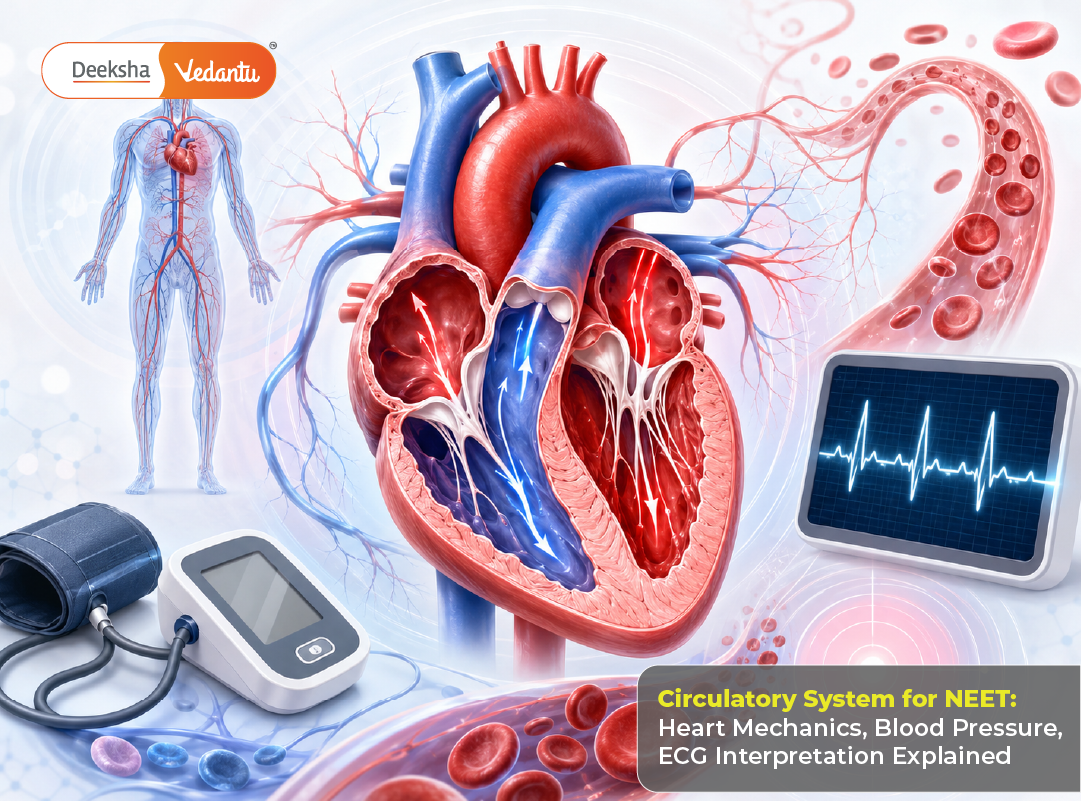


The circulatory system is one of those chapters where NEET Biology students feel comfortable going in and confused coming out. The anatomy looks familiar, the terms sound clinical, and the diagram seems straightforward – until the paper asks you to interpret an ECG wave, identify a valve disorder from a description, or explain what happens to cardiac output when heart rate doubles. This guide covers the mechanics, the pressure dynamics, and the ECG in the way NEET actually tests them.
The Human Heart: Anatomy Built for Function
The human heart is a four-chambered muscular organ located in the thoracic cavity, slightly tilted to the left, enclosed in a double-walled sac called the pericardium. The outer wall of the heart is the epicardium, the middle muscular layer is the myocardium (responsible for contraction), and the innermost lining is the endocardium.
The four chambers divide into two sides – the right side handles deoxygenated blood, the left side handles oxygenated blood. They never mix in a healthy adult heart.
| Chamber | Receives Blood From | Sends Blood To |
| Right Atrium | Superior & Inferior Vena Cava | Right Ventricle |
| Right Ventricle | Right Atrium | Pulmonary Artery (to lungs) |
| Left Atrium | Pulmonary Veins (from lungs) | Left Ventricle |
| Left Ventricle | Left Atrium | Aorta (to body) |
NEET trap: Pulmonary arteries carry deoxygenated blood and pulmonary veins carry oxygenated blood – the opposite of what “artery” and “vein” conventionally imply. This distinction appears in NEET almost every year.
Valves: One-Way Gates That Prevent Backflow
The heart has four valves, each preventing backflow at a critical junction:
Tricuspid valve – between right atrium and right ventricle (3 cusps)
Bicuspid valve (Mitral valve) – between left atrium and left ventricle (2 cusps)
Pulmonary semilunar valve – between right ventricle and pulmonary artery
Aortic semilunar valve – between left ventricle and aorta
The atrioventricular valves (tricuspid and bicuspid) are held in place by chordae tendineae attached to papillary muscles, preventing them from inverting under ventricular pressure. Damage to these structures causes valve prolapse – a concept NEET has framed as a clinical application question.
Cardiac Cycle: The Sequence NEET Dissects
One complete heartbeat is called the cardiac cycle, lasting approximately 0.8 seconds at a resting heart rate of 75 beats per minute.
Atrial systole (0.1 sec) – Both atria contract simultaneously, pushing blood into ventricles. AV valves are open; semilunar valves are closed.
Ventricular systole (0.3 sec) – Both ventricles contract. Pressure rises, AV valves shut (producing the first heart sound, “lubb”), semilunar valves open, blood is ejected into pulmonary artery and aorta.
Joint diastole (0.4 sec) – All chambers relax. Semilunar valves close (producing the second heart sound, “dubb”), AV valves open, and the atria begin filling again.
Cardiac output = Stroke volume × Heart rate
At rest: 70 mL × 75 beats/min = 5250 mL/min ≈ 5.25 L/min
This value – approximately 5 litres per minute – is a direct NEET numerical. Stroke volume is the volume of blood ejected per beat; it is not the total volume in the ventricle (that is the end-diastolic volume, which is ~120 mL; the remaining ~50 mL after ejection is the end-systolic volume).
Blood Pressure: What the Numbers Actually Mean
Blood pressure is the pressure exerted by blood on the walls of blood vessels. It is recorded as systolic pressure / diastolic pressure, expressed in mmHg.
Normal BP: 120/80 mmHg
Systolic pressure (120 mmHg) – peak pressure during ventricular contraction
Diastolic pressure (80 mmHg) – minimum pressure during ventricular relaxation
Pulse pressure = Systolic – Diastolic = 40 mmHg
Mean arterial pressure (MAP) ≈ Diastolic + ⅓ Pulse pressure = 80 + 13 = ~93 mmHg
Blood pressure is regulated by the medullary cardiovascular centre in the brainstem, which receives input from baroreceptors (pressure sensors in the carotid sinus and aortic arch) and chemoreceptors. When BP drops, the sympathetic nervous system accelerates heart rate and constricts vessels to restore pressure – a reflex loop NEET has tested as a fill-in-the-blank and assertion-reason question.
Hypertension (BP consistently above 140/90) is called the “silent killer” because it damages vessels and the heart without obvious early symptoms. NEET uses this in applied ecology and health chapters as well.
ECG: Reading the Heart’s Electrical Signature
The ECG (electrocardiogram) records the electrical activity of the heart over time. It is generated because cardiac muscle cells depolarise and repolarise in a coordinated sequence initiated by the SA node (sinoatrial node) – the natural pacemaker located in the right atrial wall.
The conduction pathway: SA node → AV node → Bundle of His → Bundle branches → Purkinje fibres → Ventricular muscle
A normal ECG trace has five recognisable deflections – P, Q, R, S, T – each corresponding to a specific electrical event:
| Wave/Segment | Electrical Event | What’s Happening |
| P wave | Atrial depolarisation | SA node fires; atria contract |
| PR interval | AV node delay | Signal slows at AV node to allow atrial emptying |
| QRS complex | Ventricular depolarisation | Ventricles contract (systole) |
| ST segment | Plateau phase | Ventricles sustaining contraction |
| T wave | Ventricular repolarisation | Ventricles relax (diastole begins) |
Why is atrial repolarisation not visible on ECG? It occurs simultaneously with ventricular depolarisation and is masked by the larger QRS complex. This is a classic NEET one-liner.
NEET diagram tip: When an ECG strip appears in the question, the first check is the height and regularity of the QRS complex. An absent P wave suggests atrial fibrillation; an elevated ST segment suggests myocardial infarction (heart attack). These clinical correlations have appeared in NEET applied questions.
Double Circulation: Why Mammals Need Two Loops
Humans have double circulation – blood passes through the heart twice in one complete circuit. This separates oxygenated and deoxygenated blood completely and maintains high blood pressure to the body’s tissues.
Pulmonary circulation: Right ventricle → Pulmonary artery → Lungs → Pulmonary veins → Left atrium
Systemic circulation: Left ventricle → Aorta → Body tissues → Vena cava → Right atrium
The left ventricle has a significantly thicker wall than the right ventricle because it must generate enough pressure to push blood through the entire body – not just to the nearby lungs. Wall thickness is a direct reflection of workload, making it another structure-function relationship of the kind central to biomolecules and cell biology questions too.
Practice Questions Styled After NEET
Q1. The first heart sound “lubb” is produced by:
(a) Opening of semilunar valves (b) Closing of AV valves (c) Opening of AV valves (d) Closing of semilunar valves
Answer: (b)
Q2. Which vessel carries oxygenated blood from the lungs to the heart?
(a) Pulmonary artery (b) Aorta (c) Pulmonary vein (d) Vena cava
Answer: (c)
Q3. The QRS complex in an ECG represents:
(a) Atrial depolarisation (b) Ventricular repolarisation (c) Ventricular depolarisation (d) SA node firing
Answer: (c)
Q4. Cardiac output of a person with heart rate 80 bpm and stroke volume 75 mL is:
(a) 5000 mL/min (b) 6000 mL/min (c) 5250 mL/min (d) 4500 mL/min
Answer: (b) – 80 × 75 = 6000 mL/min
Q5. The pacemaker of the heart is:
(a) AV node (b) Bundle of His (c) Purkinje fibres (d) SA node
Answer: (d)
Building Circulatory System Knowledge Across Units
The circulatory system chapter rewards students who connect it outward. The human respiratory system and circulatory system are functionally inseparable – gas exchange at the alveoli feeds directly into pulmonary circulation. The human digestive system delivers absorbed nutrients into the hepatic portal circulation. Neurons regulate heart rate through autonomic control. Even mitochondria connect here – cardiac muscle cells have the highest mitochondrial density of any tissue, because the heart never stops needing ATP.
Students preparing for a second NEET attempt frequently find this chapter is one where marks were lost not from lack of coverage but from shallow revision – knowing the parts without understanding how they interact under pressure. A structured approach that builds these connections deliberately, the kind offered through Deeksha’s NEET repeater course, turns this chapter from a memorisation burden into one of the highest-scoring Biology units on the paper.








Get Social