
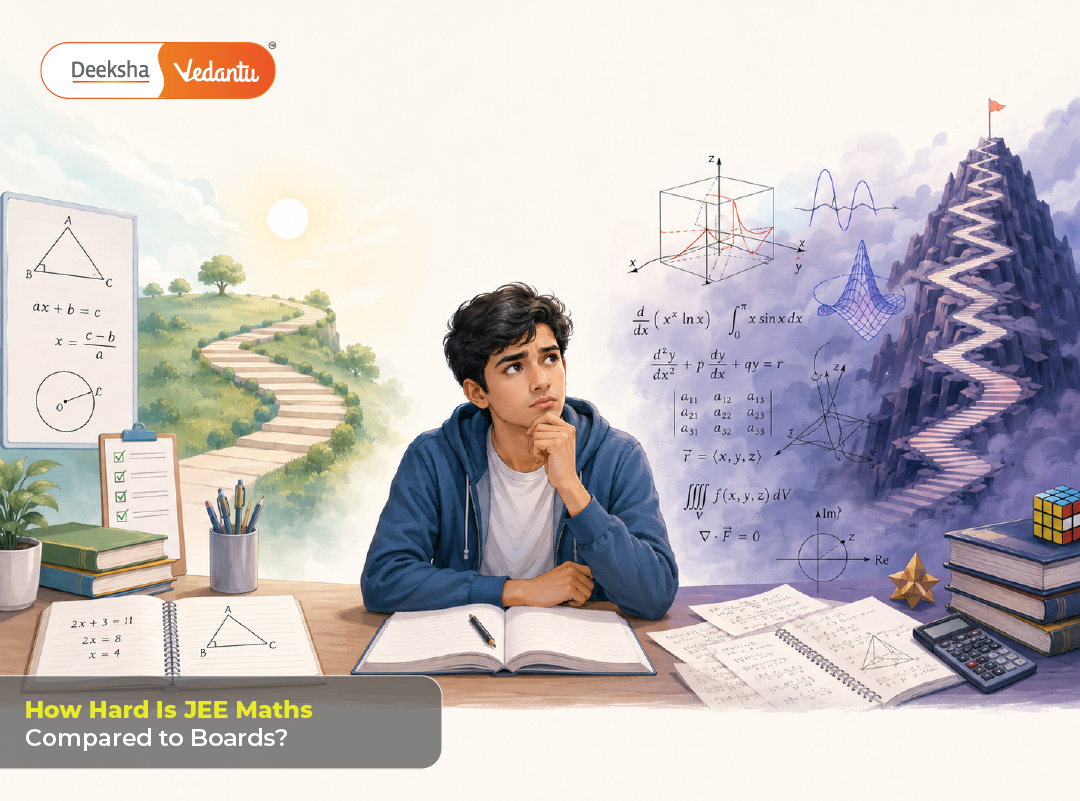


“I’m scoring 90+ in board Maths, so JEE shouldn’t be too different” is one of the most common – and most costly – assumptions Class 12 students make. The syllabus overlap between CBSE boards and JEE Main is genuinely high, often quoted around 70-80%. But identical topic names hide a completely different testing philosophy underneath. The fastest way to see this isn’t through abstract explanation – it’s by placing a real board-style question next to a real JEE-style question on the exact same topic, and watching the gap reveal itself.
Topic 1: Quadratic Equations
Board-style question: Find the roots of the equation 2x² – 5x + 3 = 0.
This is a direct application of the quadratic formula. Substitute the values, simplify, done – a competent student finishes this in under a minute with minimal room for conceptual ambiguity.
JEE-style question: If α and β are roots of x² – 5x + 6 = 0, find the equation whose roots are α² + β² and α²β² without first computing α and β individually.
Notice what changed. The board question asks you to find roots directly. The JEE question assumes you already know how to find roots, and instead tests whether you can manipulate α+β and αβ (via Vieta’s formulas) into a completely different expression – without ever computing the actual numerical roots. The Class 11 Mathematics Sequences chapter and its neighboring algebra topics build exactly this kind of relational thinking that board-level practice rarely demands.
Topic 2: Trigonometry
Board-style question: Prove that sin²θ + cos²θ = 1, and evaluate sin30° + cos60°.
This is largely a memory-and-substitution exercise – recall the identity, recall the standard angle values, add them up.
JEE-style question: If sinθ + sin²θ = 1, find the value of cos¹²θ + 3cos¹⁰θ + 3cos⁸θ + cos⁶θ – 1.
This question fuses two skills the board version tests separately: algebraic manipulation of a trigonometric identity, and pattern recognition to notice the expression resembles a binomial expansion in disguise (it simplifies to (cos²θ + cos²θ)³ using the given condition, ultimately landing at a specific numeric answer). JEE routinely disguises binomial patterns inside trigonometric or algebraic expressions this way – a skill covered more directly in the trigonometric functions unit, but only genuinely tested at this fused, multi-concept level in JEE-style practice.
Topic 3: Circles
Board-style question: Find the equation of a circle with center (2, 3) and radius 5.
Direct substitution into (x-h)² + (y-k)² = r². No trap, no ambiguity, one formula, one answer.
JEE-style question: Find the equation of the circle passing through the points (1, 0) and (0, 1), and touching the line x + y = 2.
Here, the board question hands you the center and radius outright. The JEE question hands you neither – you have to first recognize that “touching a line” means the perpendicular distance from the center to that line equals the radius, then set up a system of equations using the two given points, and solve simultaneously. Three separate ideas (general circle equation, distance from a point to a line, and simultaneous equations) have to combine correctly before you even reach the answer. The Class 11 Mathematics Circle page covers each of these pieces individually, but JEE’s difficulty comes specifically from demanding you assemble them together, unprompted.
Topic 4: Probability
Board-style question: A bag contains 5 red and 3 blue balls. Find the probability of drawing a red ball.
Straightforward: favorable outcomes over total outcomes. No conditional reasoning required.
JEE-style question: A bag contains 5 red and 3 blue balls. Two balls are drawn without replacement. Given that the first ball drawn is red, find the probability that the second ball is also red – then find the probability that at least one of the two balls drawn is blue.
The JEE version introduces conditional probability (dependent on “without replacement” changing the sample space) and then layers a second, related sub-question requiring complementary counting (“at least one” is almost always faster solved via 1 – P(none)). Board Maths rarely asks students to combine dependent events with complementary reasoning in a single question – JEE does this routinely, and the Class 11 Mathematics Probability unit is where this layered reasoning actually needs to be built, not assumed.
Topic 5: Differentiation
Board-style question: Differentiate y = x³ + 2x² – 5x + 7 with respect to x.
Pure application of the power rule, term by term. No decision-making about which technique to use – there’s only one technique available.
JEE-style question: If y = sin(log(tan x)), find dy/dx.
This single line demands you correctly identify and layer three nested functions (sin of something, log of something, tan of x) and apply the chain rule three times in sequence, without losing track of a single layer. Board differentiation questions almost never nest more than one function inside another; JEE routinely nests three or four, which is exactly why building genuine layer-recognition – not just chain rule memorization – matters so much, a skill worth reinforcing through the intuitive idea of derivatives foundation before attempting multi-layer problems.
What’s Actually Changing Across All Five Pairs
Looking at all five comparisons together, the pattern is consistent: JEE isn’t testing new content you haven’t seen – it’s testing whether you can combine two or three things you learned separately into a single, unprompted decision about which tools to use and in what order. Board exams test whether you know the formula. JEE tests whether you can recognize when three different formulas need to work together, often with no hint in the question about which ones.
| Dimension | Board Maths | JEE Maths |
| Concepts per question | Usually 1 | Usually 2–4, fused together |
| Time per question | Generous, partial credit exists | Tight, single final answer |
| Question framing | States what to find/use directly | Requires identifying the right approach yourself |
| Negative marking | None | Yes, penalizing guesses |
| Practice needed | Formula fluency | Formula fluency + pattern recognition under pressure |
Closing the Gap Without Feeling Overwhelmed
The good news buried in this comparison: since JEE mostly recombines board-level building blocks rather than introducing entirely foreign content, strong board preparation isn’t wasted effort – it’s the raw material JEE draws from. The real preparation shift is practicing fused questions specifically, not just re-drilling isolated formulas. Working consistently through JEE Main previous year question papers is the single best way to internalize exactly how JEE recombines familiar topics, since these fusion patterns repeat far more than students expect.
If balancing this deeper level of practice alongside board exam pressure feels overwhelming, it’s worth reading through this guide on how to prepare for JEE with board exams without burnout, which addresses exactly this timing conflict. And for a broader map of which topics carry the heaviest fusion-style weight in the actual exam, this checklist of math concepts every JEE aspirant should master is a useful starting point before you dive deeper into any single chapter.
For structured guidance that specifically builds this fusion-level thinking rather than isolated formula drilling, Deeksha’s JEE coaching programs are designed around exactly this gap between board-level and JEE-level Maths.
Frequently Asked Questions
If I’m scoring well in board Maths, does that mean I’m JEE-ready?
Not automatically – strong board scores mean your formula fluency is solid, which matters, but JEE additionally tests whether you can combine multiple formulas under time pressure, a skill that needs separate, deliberate practice.
Is JEE Maths testing completely different topics from the board syllabus?
No – the topic overlap is substantial. The difficulty gap comes from how questions combine topics and how tightly time is constrained, not from unfamiliar content.
Should I stop focusing on board-level practice once JEE becomes the priority?
No – board-level fluency is the foundation JEE questions are built on top of. The right approach is layering fusion-style JEE practice on top of solid board fundamentals, not abandoning one for the other.
The gap between board Maths and JEE Maths was never really about the difficulty of individual concepts – it’s about how many of those concepts you’re expected to combine, unprompted, within a tight window. Once you see that pattern across enough question pairs like the ones above, JEE Maths stops feeling like a harder subject and starts feeling like the same subject, played at a faster, more demanding tempo.







Get Social