
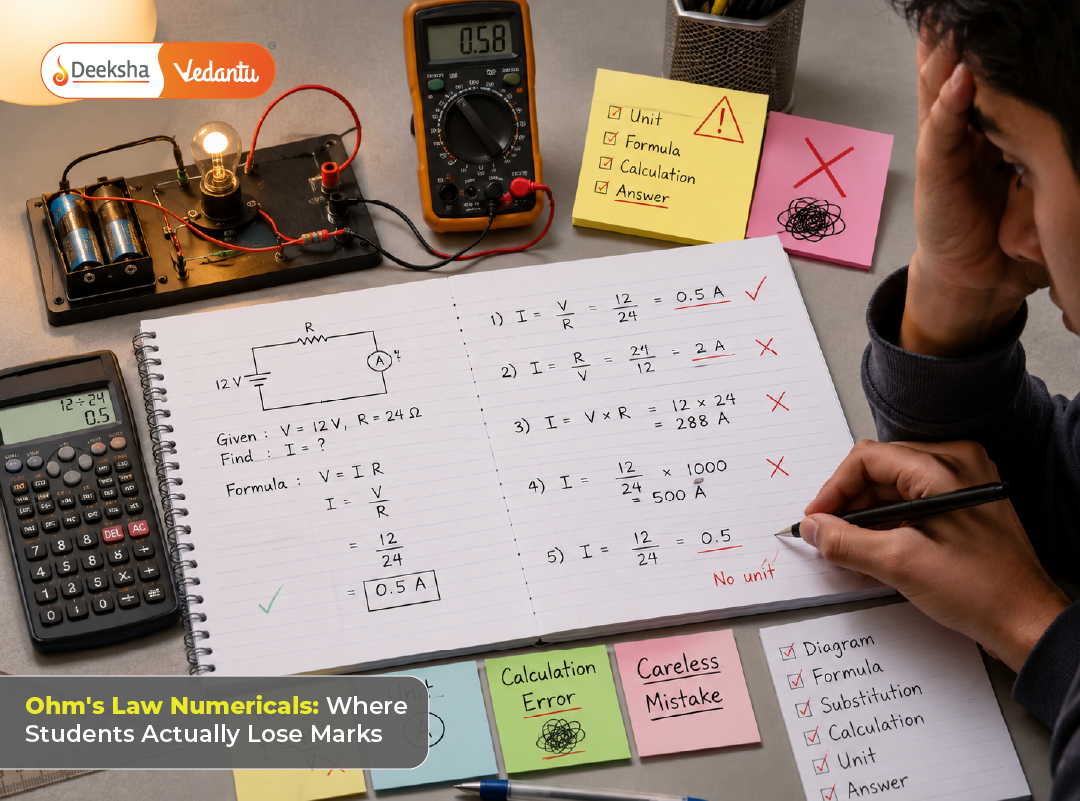


Ohm’s Law itself is almost embarrassingly simple – V = IR, three letters, one equation. And yet Ohm’s Law numericals are consistently where otherwise strong students lose marks on Class 10 Physics papers, not because the concept is hard, but because a small set of very specific, very repeatable errors keep showing up in the same places. Here are five real mistake patterns, each shown as the wrong version next to the corrected version, so the exact failure point is visible rather than abstract.
Mistake 1: Mixing Up Series and Parallel Resistance Formulas
The question: Two resistors of 4Ω and 6Ω are connected in parallel. Find the equivalent resistance.
The wrong approach:
R(eq) = R₁ + R₂ = 4 + 6 = 10Ω
What went wrong: This is the series formula, applied to a parallel circuit – a genuinely common slip, especially under exam time pressure, since both formulas involve the same two resistance values and it’s easy to default to simple addition without pausing to check which configuration the question actually describes.
The corrected approach:
1/R(eq) = 1/R₁ + 1/R₂ = 1/4 + 1/6 = 3/12 + 2/12 = 5/12
R(eq) = 12/5 = 2.4Ω
The fix that prevents this: Before touching any formula, physically underline or circle the word “series” or “parallel” in the question itself. This sounds almost too simple to matter, but the habit of explicitly confirming the configuration before calculating is what catches this exact error before it happens, rather than after the answer is already written down.
Mistake 2: Forgetting to Convert Units Before Substituting
The question: A current of 500 mA flows through a resistor of 20Ω. Find the potential difference across it.
The wrong approach:
V = IR = 500 × 20 = 10,000V
What went wrong: The current was given in milliamps (mA), but substituted directly into the formula as if it were amps – Ohm’s Law requires current in amperes, and skipping the mA-to-A conversion produces an answer that’s off by a factor of 1000, an error that’s immediately implausible (10,000V from a small resistor is not a realistic household or lab value) but easy to miss if you’re not sanity-checking your final number.
The corrected approach:
500 mA = 0.5 A
V = IR = 0.5 × 20 = 10V
The fix that prevents this: Before substituting any given value into a formula, write out its unit explicitly next to the number, and specifically check whether it matches the unit the formula requires (amperes for current, ohms for resistance, volts for potential difference). This single habit – pausing to verify units before calculating, not after – catches nearly every version of this mistake.
Mistake 3: Confusing Which Quantity Is Being Asked For
The question: A wire of resistance 5Ω allows a current of 2A when connected to a battery. If the same wire is now connected to a battery with double the voltage, find the new current.
The wrong approach: Solving for voltage first (V = IR = 2 × 5 = 10V), doubling it to 20V, then stopping there – answering with “20V” as the final answer.
What went wrong: The question specifically asks for the new current, not the new voltage – the doubled voltage (20V) was only ever an intermediate step needed to reach the actual answer being asked for. This is a reading-comprehension error dressed up as a physics error: the calculation performed was entirely correct, but it answered a question that wasn’t actually asked.
The corrected approach:
Original: V = IR = 2 × 5 = 10V
New voltage = 2 × 10V = 20V
New current: I = V/R = 20/5 = 4A
The fix that prevents this: After finishing any multi-step numerical, go back and re-read the exact final sentence of the question one more time before writing your final answer, checking specifically that the quantity you’ve boxed matches the quantity actually being asked for – not just a plausible-looking intermediate value from partway through your working.
Mistake 4: Not Showing the Formula Before Substitution
The question: Calculate the resistance of a conductor if a potential difference of 12V produces a current of 3A through it.
The wrong approach: Writing only “R = 4Ω” as the final answer, with no formula or substitution shown, even though the calculation itself (R = V/I = 12/3 = 4) was done correctly, likely mentally or on rough work not submitted.
What went wrong: This isn’t a conceptual error at all – the physics and the arithmetic are both entirely correct. The lost marks come purely from presentation: CBSE’s marking scheme for numericals typically allocates separate marks for stating the correct formula, correctly substituting given values into it, and arriving at the correct final answer with units – not just for the final number alone. A correct answer with no visible working can lose two of these three available marks, even though the underlying physics was never in question.
The corrected approach:
Formula: R = V/I
Substitution: R = 12/3
Answer: R = 4Ω
The fix that prevents this: Treat “show the formula, then the substitution, then the answer” as a non-negotiable three-line minimum for every single numerical, regardless of how simple or mentally obvious the calculation feels – the marks are allocated to the visible steps, not to the correctness of an answer that appears without them.
Mistake 5: Ignoring the Effect of Temperature or Wire Dimensions Implied in the Question
The question: A wire of length L and resistance R is stretched until its length becomes 2L, with its volume remaining constant. Find the new resistance in terms of R.
The wrong approach: R(new) = R (assuming resistance stays the same since it’s “the same wire,” just stretched)
What went wrong: This mistake comes from not applying the relationship between resistance, length, and cross-sectional area (R ∝ L/A) – stretching a wire to double its length, while keeping volume constant, forces its cross-sectional area to shrink to exactly half, since volume = length × area must stay fixed. Both of these changes (length doubling, area halving) push resistance in the same direction, compounding rather than canceling out.
The corrected approach:
Since volume is constant: L × A = 2L × A(new), so A(new) = A/2
R ∝ L/A, so R(new) ∝ 2L/(A/2) = 4L/A = 4 × (L/A) = 4R
The fix that prevents this: Whenever a question describes a wire being physically altered (stretched, cut, reshaped) rather than simply given fixed values, explicitly write out how each individual factor in R ∝ L/A changes before combining them – treating “the wire changed” as a single vague event, rather than as two separate, quantifiable changes to length and area, is exactly where this mistake originates.
All Five Mistakes, Side by Side
| Mistake | What Looks Right But Isn’t | The Actual Fix |
| Series/parallel mix-up | Adding resistances directly | Underline “series” or “parallel” before calculating |
| Unit conversion skipped | Substituting mA as if it were A | Write units next to every value before substituting |
| Wrong final quantity | Correct intermediate step reported as the answer | Re-read the question’s final sentence before finalizing |
| Missing shown work | Correct final answer, no visible steps | Always show formula → substitution → answer, minimum |
| Wire-stretching relationships | Assuming resistance is unchanged | Explicitly track how L and A each change separately |
Building This Into Your Practice Routine
Every mistake above is fixable through a specific checking habit, not through re-learning the underlying physics – which means the fastest way to close these gaps is deliberately practicing Ohm’s Law numericals while consciously applying each specific check, rather than simply solving more problems and hoping accuracy improves on its own. Working through top 10 electricity numericals for Class 10 Physics with solutions is a useful next step for applying these five checks against a wider range of problem types.
This same “show every step” presentation discipline connects directly to the broader pattern covered in what actually separates a 90 from a 95 in CBSE boards, where numerical presentation is one of several small, learnable habits distinguishing the two score bands. For the underlying conceptual foundation behind Ohm’s Law itself, the Ohm’s Law page and resistance of a system of resistors page cover the series-versus-parallel distinction from Mistake 1 in more formal depth, while factors on which the resistance of a conductor depends covers the L and A relationship behind Mistake 5.
Frequently Asked Questions
Is it worth memorizing the parallel resistance formula, or is there a shortcut for two resistors specifically?
For exactly two resistors in parallel, a useful shortcut is R(eq) = (R₁×R₂)/(R₁+R₂), which avoids the reciprocal-and-flip steps of the general formula – worth knowing specifically because two-resistor parallel questions are extremely common in board exams.
Do all five of these mistakes cost the same number of marks?
No – unit conversion errors (Mistake 2) and wrong-quantity errors (Mistake 3) tend to cost the most, since they produce a fully wrong final answer despite correct method, while missing-work errors (Mistake 4) typically cost only the specific steps left unshown, not the entire question’s marks.
Is checking units before every single substitution really necessary for simple numericals?
Yes, specifically because unit-conversion mistakes are most common on questions that feel simple enough to solve quickly without pausing – the habit matters most exactly where it feels least necessary, since that’s precisely when it gets skipped.
Ohm’s Law numericals were never actually hard – the formula is one line, and most students understand it correctly the first time they see it. The marks lost happen entirely in the small, repeatable gap between understanding the physics and executing the specific habits – checking configuration, converting units, confirming the right final quantity, showing full working – that turn correct understanding into a correctly graded answer.











Get Social