

Last time, we left carbon in the middle of solving its own identity crisis – reshaping its orbitals into sp³, sp², or sp hybrids depending on how many pi bonds a molecule needed, and picking up methane’s perfect tetrahedral symmetry as a reward for the trouble. That story didn’t end with methane. It was really the opening chapter of a much bigger pattern, and alkanes, alkenes, and alkynes are simply that same story, continuing – now explaining not just shape, but why one of these three families sits quietly on a shelf for years while another reacts the moment you look at it wrong.
Chapter Recap: Where We Left Off
Quick reminder of the mechanism, since everything below depends on it: carbon mixes its 2s orbital with some number of its 2p orbitals to form identical hybrid orbitals for sigma bonding, and whatever p orbitals get left out of that mixing become raw material for pi bonds instead. Sp³ carbon uses all three p orbitals in the mix, leaving nothing for pi bonds. Sp² carbon holds one p orbital back, enough for one pi bond. Sp carbon holds two back, enough for two pi bonds. That’s the entire mechanism. Everything about alkanes, alkenes, and alkynes below is just this mechanism playing out in three different contexts.
Alkanes: The Chapter Where Nothing Is Left Over
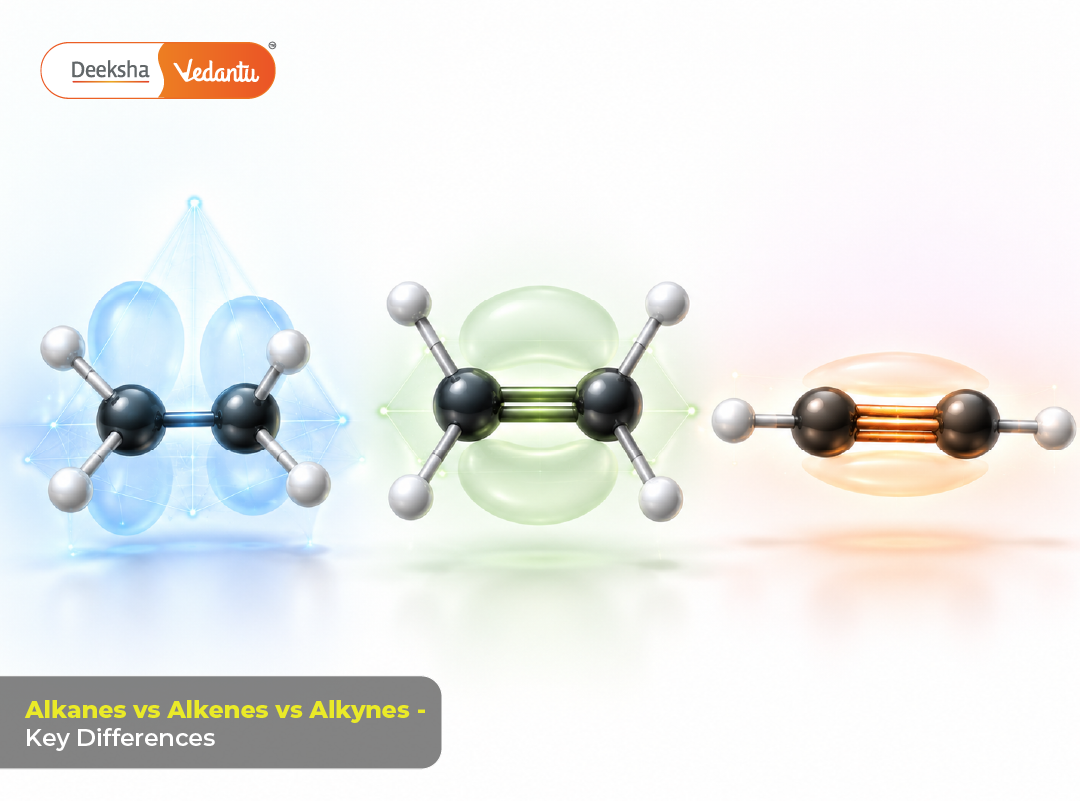
Alkanes – methane, ethane, propane, and the rest of the saturated hydrocarbon family – are built entirely from sp³ hybridized carbons. Every single p orbital carbon has got mixed into the hybridization process, which means there’s nothing left over to form a pi bond anywhere in the molecule. Every carbon-carbon and carbon-hydrogen bond in an alkane is a sigma bond, full stop.
This single fact – no leftover p orbitals, no pi bonds anywhere – is the entire reason alkanes are famously unreactive. Sigma bonds, formed by direct head-on orbital overlap, are strong, tightly held, and don’t offer an easy point of attack for most reagents. There’s no exposed, loosely-held electron cloud sitting above or below the bond axis, waiting to be grabbed by an incoming electrophile – because there simply isn’t a pi bond to provide one. This is exactly why alkanes are frequently described as chemically “inert” except under fairly extreme conditions (like combustion, or free-radical halogenation under UV light) – reactions have to work hard to disturb a molecule with nothing but strong sigma bonds throughout.
The sp³ geometry itself matters too: every bond angle sits at 109.5°, giving alkanes their characteristic zigzag chain shape, and the free rotation around each sigma bond (nothing locks the geometry in place) is exactly why alkanes are flexible, coiling molecules rather than rigid, flat ones.
Alkenes: The Chapter Where One P Orbital Was Deliberately Held Back
Alkenes contain at least one carbon-carbon double bond, and this is where the hybridization story from last time becomes directly, practically useful rather than just structurally interesting. Recall: forming a double bond means the relevant carbons are sp² hybridized, with exactly one p orbital held back from the mixing process, left in its original dumbbell shape, sticking out perpendicular to the plane of the three sp² sigma bonds.
That single leftover p orbital on each of the two double-bonded carbons overlaps sideways with its neighbor’s equivalent leftover orbital, forming a pi bond. And a pi bond is nothing like a sigma bond in terms of how tightly its electrons are held: because the overlap is sideways rather than head-on, the electron density sits more loosely, further from the direct line between the two nuclei, and is considerably more exposed and available to incoming reagents.
This is the entire reason alkenes are so much more reactive than alkanes, and specifically why that reactivity is localized – it happens right at the double bond, not distributed vaguely across the whole molecule. An electrophile approaching an alkene isn’t attacking some generalized weak point; it’s specifically drawn to the exposed, loosely-held electron density of that one pi bond, which is exactly why addition reactions (bromine water decolorizing, or hydrogenation adding H₂ directly across the double bond) target that specific site with predictable precision. The sp² geometry also explains why alkenes are flat and rigid at the double bond specifically – the three sp² orbitals lock into a single plane at 120°, and unlike the alkane’s free single-bond rotation, rotation around a double bond is restricted, since twisting it would require breaking the sideways pi overlap entirely.
Alkynes: The Chapter Where Two P Orbitals Were Held Back
Push the same logic one step further, and alkynes – hydrocarbons with a carbon-carbon triple bond – become the natural conclusion of the pattern rather than a new topic. Triple-bonded carbons are sp hybridized: only one p orbital gets mixed into the hybrid set, meaning two full p orbitals are left unhybridized, each forming its own separate pi bond, perpendicular to each other, wrapped around the same sigma bond axis like two overlapping rings of electron density.
Two pi bonds instead of one means alkynes carry even more exposed, loosely-held electron density than alkenes do, which is exactly why alkynes tend to be even more reactive in addition reactions than alkenes – there’s simply more vulnerable electron density available for an electrophile to attack. The sp geometry also explains alkyne’s most visually distinctive feature: a perfectly linear 180° bond angle at the triple bond, since only two hybrid orbitals are involved, and two orbitals repelling each other as far apart as possible in space can only ever produce a straight line.
The Pattern, Now Explaining Reactivity, Not Just Shape
| Family | Hybridization | Leftover P Orbitals | Bond Type Present | Reactivity |
| Alkanes | sp³ | 0 | Sigma bonds only | Low – no exposed pi electron density |
| Alkenes | sp² | 1 | One sigma + one pi | Moderate – reactive specifically at the pi bond |
| Alkynes | sp | 2 | One sigma + two pi | High – even more exposed electron density |
Notice what’s actually being tracked down this table: it’s the exact same “how many p orbitals got left out of hybridization” question from the last article, just now answering a completely different question than shape alone – reactivity, bond behavior, and even physical rigidity all trace back to this single mechanism. Alkanes, alkenes, and alkynes were never three unrelated hydrocarbon families to memorize separately. They’re one continuous consequence of how many pi bonds a molecule’s hybridization scheme happens to leave room for.
Where This Story Continues in Your Preparation
The specific reaction mechanisms this reactivity gradient produces – addition reactions, their electrophilic and free-radical pathways – are covered in depth on the hydrocarbons and hydrocarbons classification pages, which build directly on the reactivity pattern established here. For the hybridization mechanism itself, in case any part of the sp³/sp²/sp mixing felt unfamiliar, revisiting why carbon forms 4 identical bonds fills in exactly where this story began.
The broader question of why carbon forms so many different compound types in the first place is covered on versatile nature of carbon, and the geometric predictions referenced throughout connect back to VSEPR theory, which arrives at the same bond angles independently through electron-pair repulsion rather than orbital mixing. Deeksha’s JEE coaching programs are built around exactly this kind of connected, sequential understanding, where one concept’s resolution becomes the next concept’s starting point.
Frequently Asked Questions
Why are alkynes more reactive than alkenes if both have exposed pi bonds?
Alkynes have two pi bonds compared to an alkene’s one, meaning there’s more loosely-held, exposed electron density available for an electrophile to attack, which generally makes alkynes more reactive in addition reactions.
Why can’t a carbon-carbon double bond rotate freely the way a single bond can?
Rotating a double bond would require twisting the two carbons relative to each other, which breaks the sideways overlap of the pi bond’s p orbitals – since that overlap only works when both orbitals stay parallel, rotation is restricted.
Does every carbon in an alkene or alkyne have to be sp² or sp hybridized?
Only the carbons directly involved in the double or triple bond take on that specific hybridization – other carbons elsewhere in the same molecule, not part of that particular multiple bond, remain sp³ hybridized as usual.
Alkanes, alkenes, and alkynes were never really three separate hydrocarbon families demanding three separate sets of memorized properties. They’re the same hybridization mechanism from before, simply asked a new question – not “what shape does this produce,” but “what happens when a reagent comes looking for a way in.” Count the leftover p orbitals, and you already know the answer.








Get Social