
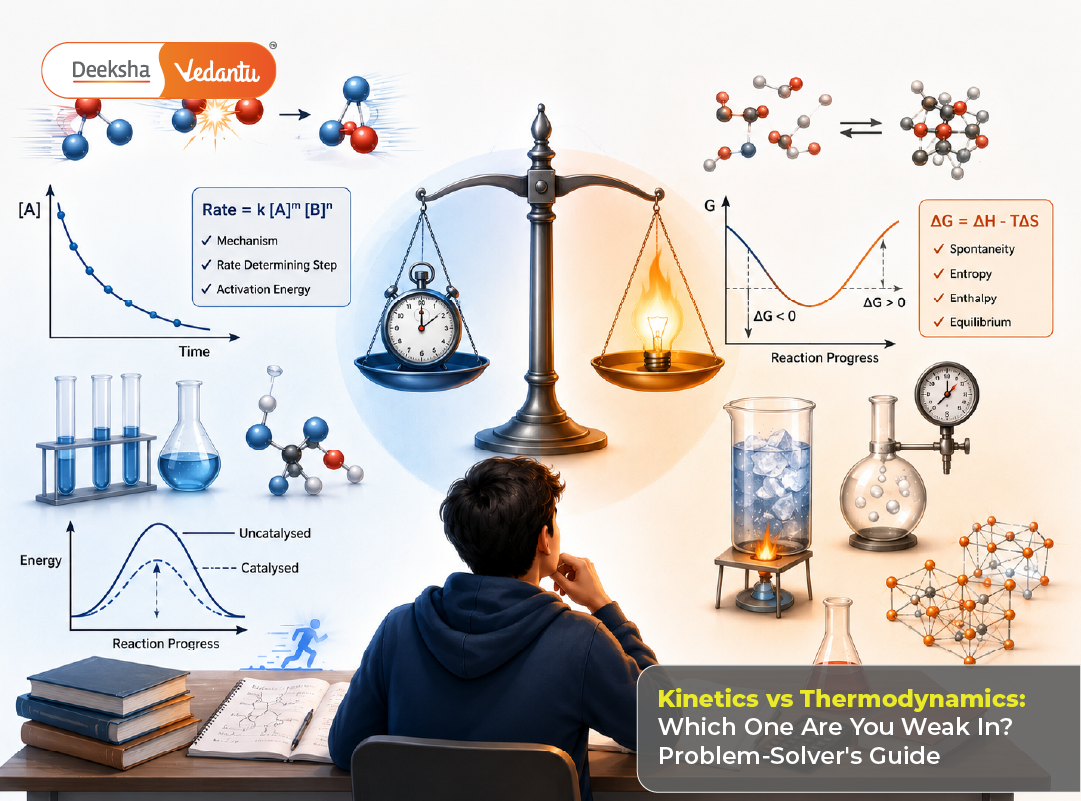


Ask most NEET aspirants whether a question is testing kinetics or thermodynamics, and the honest answer is often “I’m not sure until I see the formula.” That hesitation is the real problem – not a lack of formula knowledge, but a lack of clarity on what each branch is actually asking. Thermodynamics tells you whether a reaction can happen and how much energy is involved. Kinetics tells you how fast it happens. Confusing the two is the single most common conceptual error in this part of NEET Chemistry.
The One-Sentence Test That Fixes Most Confusion
Before attempting any question in this space, ask: is this about energy and feasibility, or about speed and time? If the question mentions enthalpy, entropy, Gibbs energy, spontaneity, or heat exchange – it’s thermodynamics. If it mentions rate, time, concentration changing over time, order of reaction, or activation energy – it’s kinetics. This single filter resolves the majority of NEET’s “which formula do I use” hesitation before you even read the options.
Thermodynamics: Does the Reaction Want to Happen?
Thermodynamics deals with energy changes during a reaction and predicts whether a process is spontaneous – completely independent of how fast it occurs. A useful starting point for the vocabulary used throughout this branch is covered in the thermodynamic terms chapter, which defines system, surroundings, and the different types of thermodynamic processes NEET expects you to distinguish.
Enthalpy (ΔH): Heat at Constant Pressure
ΔH = Hproducts – Hreactants
A negative ΔH means the reaction releases heat (exothermic); a positive ΔH means it absorbs heat (endothermic). NEET frequently gives bond enthalpies and asks for the overall reaction enthalpy:
ΔH = Σ(bond enthalpies of reactants) – Σ(bond enthalpies of products)
The complete classification of enthalpy types – formation, combustion, neutralisation – along with worked numericals, is detailed in the reaction enthalpy chapter.
Measuring ΔU and ΔH: Calorimetry
NEET occasionally tests the practical distinction between ΔU (measured at constant volume, in a bomb calorimeter) and ΔH (measured at constant pressure). The relationship connecting them:
ΔH = ΔU + ΔngRT
where Δng is the change in moles of gas. A full walkthrough of calorimetric measurement and this correction formula is available in the calorimetry chapter.
Entropy (ΔS): Disorder and the Second Law
Entropy measures the degree of randomness or disorder in a system. Reactions that increase disorder (e.g., a solid decomposing into gases) tend to have positive ΔS, favouring spontaneity from an entropy standpoint.
Gibbs Free Energy: The Spontaneity Verdict
This is where thermodynamics delivers its final answer.
ΔG = ΔH – TΔS
| ΔG Value | Spontaneity |
| ΔG < 0 | Spontaneous |
| ΔG > 0 | Non-spontaneous |
| ΔG = 0 | At equilibrium |
NEET’s most reliable Gibbs energy question gives ΔH, ΔS, and temperature, and asks whether the reaction is spontaneous – a direct substitution once the formula is memorised. The full sign-based logic, including how temperature shifts spontaneity for borderline reactions, is explained in the spontaneity chapter.
The connection to equilibrium: ΔG° = -RT ln K, linking thermodynamics directly to the equilibrium constant. This relationship is explored further in the relation between K, Q, and Gibbs energy chapter – a frequent source of NEET’s harder integrated questions that test thermodynamics and equilibrium together.
Solved NEET-Style Numerical: Gibbs Energy and Spontaneity
A reaction has ΔH = -40 kJ/mol and ΔS = -100 J/K/mol at 300 K. Is the reaction spontaneous?
ΔG = ΔH – TΔS = -40,000 – (300 × -100) = -40,000 + 30,000 = -10,000 J = -10 kJ/mol
Since ΔG < 0, the reaction is spontaneous at 300 K, despite the negative entropy change – because the enthalpy term dominates at this temperature.
Kinetics: How Fast Does It Actually Happen?
Where thermodynamics answers “can it happen,” kinetics answers “how quickly.” A reaction can be thermodynamically spontaneous (ΔG < 0) and still proceed extremely slowly – diamond converting to graphite is the textbook example NEET sometimes references conceptually.
Rate of Reaction and Rate Law
Rate = k[A]^m[B]^n
where m and n are the orders of reaction with respect to each reactant (determined experimentally, not from the balanced equation), and k is the rate constant.
Overall order = m + n
NEET frequently gives experimental data (initial rates at different concentrations) and asks you to determine the order – solved by comparing how rate changes when one concentration is varied while others are held constant.
Order-wise Rate Constant Units (A Quick Reference)
| Order | Rate Constant (k) Units |
| Zero order | mol L⁻¹ s⁻¹ |
| First order | s⁻¹ |
| Second order | L mol⁻¹ s⁻¹ |
| Third order | L² mol⁻² s⁻¹ |
Numerical hack: If you’re given the units of k in a question and asked for the order, work backwards from this table instead of deriving it – a significant time-saver in MCQs.
Integrated Rate Equations
First order: k = (2.303/t) log([A]₀/[A])
Half-life for first order: t½ = 0.693/k (independent of initial concentration – a defining feature of first-order kinetics, and a frequently tested NEET conceptual point)
Zero order half-life: t½ = [A]₀/2k (depends on initial concentration, unlike first order)
This contrast – first-order half-life being concentration-independent while zero-order half-life is not – is one of NEET’s most repeated kinetics distinctions.
Activation Energy and the Arrhenius Equation
k = Ae^(-Ea/RT)
Higher temperature increases k exponentially, which is why reaction rates roughly double for every 10°C rise – a rule of thumb NEET sometimes uses in qualitative questions. The Arrhenius equation also explains why catalysts work: they lower Ea, increasing k, without altering ΔG or the equilibrium position – a direct link back to the catalyst behaviour also tested in chemical equilibrium chapters.
Solved NEET-Style Numerical: First-Order Half-Life
A first-order reaction has a rate constant k = 0.0231 min⁻¹. Find its half-life.
t½ = 0.693/k = 0.693/0.0231 ≈ 30 minutes
The Side-by-Side Comparison NEET Rewards Knowing Cold
| Feature | Thermodynamics | Kinetics |
| Answers | Can the reaction happen? | How fast does it happen? |
| Key terms | ΔH, ΔS, ΔG | Rate, order, k, Ea |
| Depends on | Initial and final states only | Reaction pathway/mechanism |
| Catalyst’s role | No effect on ΔG or spontaneity | Lowers Ea, increases rate |
| Time dependence | None | Central to every calculation |
Practice Questions Styled After NEET
Q1. A reaction with ΔG < 0 is:
(a) Always fast (b) Always slow (c) Spontaneous, but rate is independent of this (d) Non-spontaneous)
Answer: (c)
Q2. The half-life of a first-order reaction:
(a) Depends on initial concentration (b) Is independent of initial concentration (c) Increases with concentration (d) Is always 1 minute)
Answer: (b)
Q3. A catalyst increases reaction rate by:
(a) Increasing ΔG (b) Lowering activation energy (c) Increasing temperature (d) Shifting equilibrium)
Answer: (b)
Q4. For a reaction to be spontaneous at all temperatures, the signs of ΔH and ΔS should be:
(a) ΔH negative, ΔS positive (b) ΔH positive, ΔS negative (c) Both positive (d) Both negative)
Answer: (a)
Diagnosing Your Own Weak Spot
If you consistently get Gibbs energy and enthalpy questions wrong, the gap is usually conceptual – you haven’t internalised that thermodynamics only cares about start and end states, not the path taken. If you consistently fumble rate law and half-life questions, the gap is usually procedural – you know the concept but haven’t drilled enough integrated-rate-equation numericals to recognise patterns quickly. These are different problems requiring different fixes, much like how distinguishing reaction enthalpy calculations from kinetic rate calculations requires recognising which “track” a question belongs to before applying any formula.
For repeaters, this pairing of chapters is a common scoring trap precisely because both feel “familiar” from the first attempt without being reliably fast or accurate. Deeksha’s NEET repeater course treats kinetics and thermodynamics as two separate diagnostic areas during revision, helping students identify which one is the actual weak link rather than re-studying both equally.








Get Social