
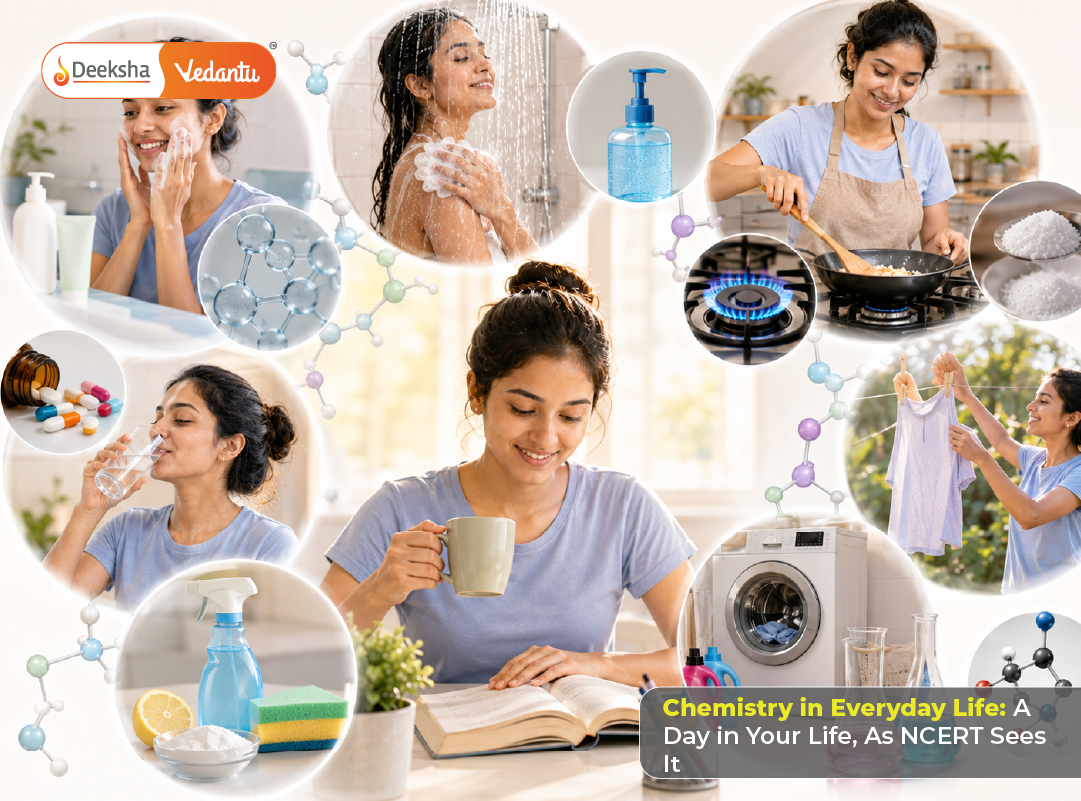


This is the one NCERT chemistry chapter that doesn’t need a single analogy to feel real, because it’s already describing your actual morning. The headache tablet in your cabinet, the artificial sweetener in your coffee, the soap in your bathroom – all of it is this chapter, playing out before you’ve even opened the textbook. Here’s the entire syllabus, traced through one ordinary day, in the order you’d actually encounter it.
7:00 AM – The Headache Tablet and the Idea of a Drug
You wake up with a mild headache and reach for a painkiller. That tablet is your first stop in this chapter: a drug, defined as any chemical substance that affects the biochemical or physiological processes of the body.
Painkillers like this fall under analgesics, one of several drug classifications NCERT expects you to know cold. Analgesics themselves split into two types worth distinguishing clearly: narcotic analgesics (like morphine, which relieve severe pain but carry addiction risk and depress the central nervous system) and non-narcotic analgesics (like aspirin, which relieve mild-to-moderate pain without those same risks, and additionally act as antipyretics – reducing fever).
The reason this particular tablet works ties into how drugs interact with the body at a molecular level: most drugs act by binding to specific receptor molecules, either mimicking a natural body chemical closely enough to trigger a response (called an agonist) or blocking a receptor to prevent a response from happening at all (called an antagonist). This receptor-based mechanism connects directly back to the enzymes concept from your NCERT Biology, since many drugs work specifically as enzyme inhibitors – worth revisiting if that connection isn’t already solid.
7:30 AM – Coffee, Sweetener, and the Chemistry of “Sugar-Free”
You stir a sachet of artificial sweetener into your coffee instead of sugar. This single act pulls in an entire NCERT sub-topic: chemicals in food.
Artificial sweeteners like saccharin, aspartame, and sucralose are engineered to activate the same taste receptors as sugar while contributing negligible or zero calories – a distinction NCERT tests specifically through comparing their relative sweetness (saccharin is roughly 550 times sweeter than cane sugar, for instance) and their stability under heat, which is exactly why aspartame isn’t used in cooked or baked foods, while sucralose can be.
If your coffee comes pre-packaged, there’s likely a preservative involved too – chemicals like sodium benzoate that prevent microbial spoilage, working by creating an environment hostile to bacterial and fungal growth without altering the taste of the product itself.
8:00 AM – Breakfast and the Antioxidant You Didn’t Notice
That packet of chips or biscuits sitting in your kitchen almost certainly contains an antioxidant – a chemical added specifically to prevent the oxidation of fats and oils in the food, which is what causes that unpleasant “stale” or rancid smell in old snacks. Common examples like BHT (butylated hydroxytoluene) work by reacting preferentially with oxygen themselves, effectively sacrificing themselves so the food’s fats don’t oxidize first.
This is a small but frequently tested NCERT distinction: antioxidants prevent food from degrading, while preservatives (from the coffee sachet moment above) prevent microbial growth – two different jobs that often get mentally lumped together, but test as separate concepts.
8:30 AM – Washing Up, and Why Soap Actually Works
Before leaving for the day, you wash your hands with soap. This moment carries the third and final major pillar of this chapter: cleansing agents.
Soap molecules have a distinctive dual nature – a long hydrocarbon “tail” that’s hydrophobic (repelled by water, but attracted to grease and oil) and a charged “head” that’s hydrophilic (attracted to water). When soap meets a greasy stain, the hydrophobic tails bury themselves into the grease while the hydrophilic heads stay oriented toward the surrounding water, eventually clustering into a spherical structure called a micelle – trapping the grease at the center and allowing the whole cluster to be rinsed away with water. This exact molecular structure is why soap can lift oil-based dirt that water alone simply slides past.
Soap has one real limitation worth knowing: in hard water (water containing calcium and magnesium ions), soap reacts with those ions to form an insoluble scum, reducing its cleaning effectiveness – which is exactly why synthetic detergents were developed. Detergents use a similar hydrophobic-hydrophilic structure but with a sulfonate or sulfate group instead of soap’s carboxylate group, and this small structural change means detergents don’t form scum with hard water at all, staying effective regardless of water quality. The underlying chemistry of this hydrophobic-hydrophilic dual structure connects directly back to soaps and detergents, which walks through the molecular mechanics in more depth if this section feels unfamiliar.
Later That Day – The Drug Classification You’ll Actually Be Tested On
If you take any medication throughout the day – an antacid for indigestion, an antihistamine for allergies, or an antibiotic prescribed for an infection – you’re moving through NCERT’s core drug classification list, organized by what they act against or how they act:
- Antacids neutralize excess stomach acid (commonly through compounds like magnesium hydroxide)
- Antihistamines block histamine receptors to relieve allergic symptoms
- Antibiotics either kill bacteria outright (bactericidal) or stop them from multiplying (bacteriostatic) – a distinction NCERT tests specifically, since it’s not just “kills bacteria” as a blanket description
- Antiseptics are applied to living tissue to prevent infection, while disinfectants are applied to non-living surfaces – a commonly confused pair, distinguished by where they’re applied, not by their chemical mechanism
- Tranquilizers act on the central nervous system to relieve mental stress and anxiety
The Chapter, Summarized as Your Day
| Moment | NCERT Concept | Key Distinction to Remember |
| Headache tablet | Analgesics (narcotic vs non-narcotic) | Addiction risk and CNS depression vs. not |
| Coffee sweetener | Artificial sweeteners | Sweetness ratio, heat stability |
| Packaged snack | Antioxidants vs. preservatives | Prevents oxidation vs. prevents microbial growth |
| Handwashing | Soap vs. synthetic detergent | Scum formation in hard water |
| Medicine cabinet | Antacids, antihistamines, antibiotics | Mechanism and bactericidal vs. bacteriostatic |
| Applying antiseptic | Antiseptic vs. disinfectant | Living tissue vs. non-living surface |
Where This Chapter Fits Into Your JEE and NEET Preparation
Chemistry in Everyday Life carries relatively modest weightage compared to physical or organic chemistry chapters, but it’s almost entirely memory-based rather than calculation-heavy, which makes it one of the highest return-on-effort chapters for last-minute revision. If you’re mapping out where this chapter sits relative to higher-weightage topics, this guide on the best topics to focus on for high scores in JEE Chemistry is a useful prioritization reference.
Since drug mechanisms connect closely to organic functional groups, revisiting amines, amides, and reactions strengthens the structural side of this chapter considerably, since many drug molecules are built around exactly these functional groups. For NEET aspirants specifically, since this chapter carries slightly more relative weight on that exam, how to score 150 in NEET Chemistry is a good companion resource for fitting this chapter into a broader scoring strategy.
Practicing recall of these classifications against real exam conditions through JEE Main previous year question papers will show you exactly how NCERT-close this chapter’s questions tend to be – often testing definitions and distinctions almost verbatim from the textbook. Deeksha’s JEE coaching programs build memory-based chapters like this one through structured revision cycles rather than one-time reading, which matters more here than in calculation-heavy chapters.
Frequently Asked Questions
Is Chemistry in Everyday Life worth prioritizing for JEE Main specifically?
It carries lower weightage than core physical or organic chemistry chapters, but since it requires almost no calculation, it offers a strong return for the relatively small time investment needed to master its classifications.
What’s the most commonly confused pair of terms in this chapter?
Antiseptics versus disinfectants trips up the most students – the distinction is about where they’re applied (living tissue vs. non-living surfaces), not a difference in their chemical action.
Why don’t synthetic detergents form scum in hard water the way soap does?
Detergents use a sulfonate or sulfate group instead of soap’s carboxylate group, and this functional group doesn’t react with calcium and magnesium ions the way soap’s does, so no insoluble scum forms.
Chemistry in Everyday Life was never a chapter you needed a lab to understand – it’s been narrating your own mornings back to you the entire time. Once you notice that your headache tablet, your coffee sweetener, and your bar of soap are all just this chapter in disguise, the classifications stop feeling like a list to memorize and start feeling like things you already knew, just now with names attached.









Get Social