
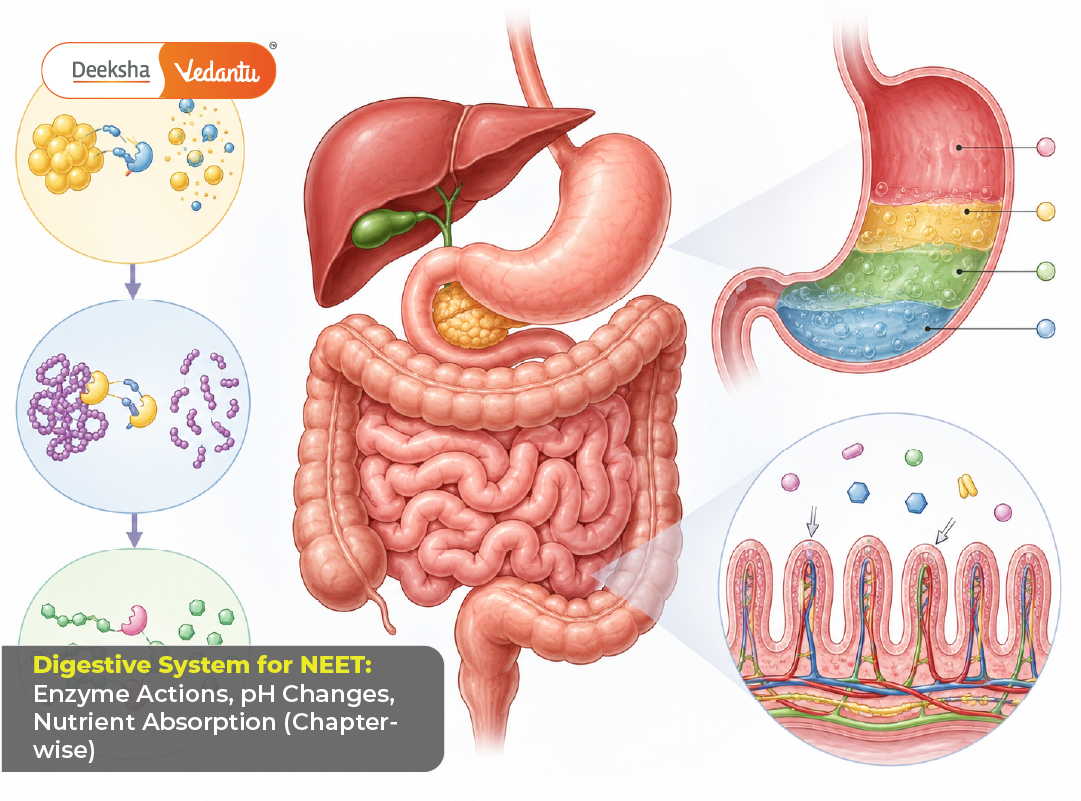


The digestive system is a chapter NEET aspirants often dismiss as “easy NCERT reading” – until the paper asks which enzyme acts at which pH, why pepsin doesn’t digest the stomach lining, or how a triglyceride actually crosses the intestinal epithelium. This chapter rewards precision over familiarity. Here’s the structure-function, enzyme-by-enzyme, organ-by-organ breakdown NEET actually tests.
Why This Chapter Punishes Vague Revision
NEET typically draws 3-4 questions directly from the human digestive system, but the real cost of under-preparing it shows up elsewhere – in questions on enzymes, biomolecules, and even the circulatory system, since absorbed nutrients enter circulation through specific pathways. The chapter has three exam-critical axes: which enzyme acts where, what pH each region requires, and how each nutrient class is finally absorbed. Master these three axes and most digestive system questions become pattern-matching rather than memorisation.
The Alimentary Canal: A Quick Anatomical Map
Food travels through: Mouth → Pharynx → Oesophagus → Stomach → Small intestine (duodenum, jejunum, ileum) → Large intestine (caecum, colon, rectum) → Anus
Accessory glands feeding into this canal include the salivary glands, liver, and pancreas – none of which are part of the canal itself but all of which are essential to digestion.
Stage 1: The Mouth – Where pH Starts Neutral
Saliva, secreted by three pairs of salivary glands (parotid, submandibular, sublingual), has a near-neutral pH of 6.8. It contains:
Salivary amylase (ptyalin) – begins starch digestion, breaking it into maltose. This enzyme requires a near-neutral pH and is rendered inactive once it reaches the highly acidic stomach.
Lysozyme – an antibacterial enzyme protecting against ingested pathogens.
Mechanical digestion (chewing) increases surface area for enzymatic action – a structure-function point NEET sometimes frames as “why does increased surface area increase digestion rate?”
Stage 2: The Stomach – Acidic Activation
The stomach maintains a strongly acidic environment, pH 1.5-2.5, generated by HCl secreted by parietal (oxyntic) cells. This acidity serves three purposes: killing ingested microbes, denaturing dietary proteins (unfolding them for enzymatic attack), and converting an inactive enzyme precursor into its active form.
Pepsinogen → Pepsin conversion is one of NEET’s most-tested enzyme activation steps. Chief (peptic) cells secrete inactive pepsinogen; HCl converts it to active pepsin, which then digests proteins into peptones and proteoses. Pepsin itself can also activate more pepsinogen – an autocatalytic loop.
Why doesn’t HCl digest the stomach’s own lining? Goblet cells in the gastric mucosa secrete a thick mucus layer that protects the epithelium. NEET frames this as both a direct question and an assertion-reason pair about gastric ulcers – when this mucus barrier fails (often due to H. pylori infection or NSAID overuse), HCl damages the lining, causing peptic ulcers.
Rennin (in infants) – curdles milk protein (caseinogen → casein), aiding digestion in infancy; largely absent in adults.
Gastric lipase plays a minor role here; most fat digestion happens later, in the small intestine.
Stage 3: The Duodenum – The pH Reversal Point
When acidic chyme leaves the stomach and enters the duodenum, the pH must shift dramatically – from acidic (~2) to alkaline (~7.5-8.5). This reversal is achieved by:
Bicarbonate ions (HCO₃⁻) secreted by the pancreas, neutralising stomach acid and creating the alkaline environment needed for pancreatic and intestinal enzymes (which are inactive at low pH).
This pH-reversal point is a favourite NEET conceptual trap: students often forget that an enzyme working perfectly in the stomach (pepsin) becomes completely inactive in the duodenum precisely because of this pH shift – pepsin requires acidity and is denatured in an alkaline environment.
Bile: An Emulsifier, Not an Enzyme
Bile, produced by the liver and stored in the gallbladder, contains bile salts that emulsify fats – breaking large fat globules into smaller droplets, increasing surface area for lipase action. Bile contains no digestive enzymes itself; this is a frequently misremembered NEET fact. Bile also contains bilirubin (a pigment from haemoglobin breakdown) and helps in fat-soluble vitamin absorption (A, D, E, K).
Pancreatic Secretions: The Enzyme Powerhouse
| Enzyme | Substrate | Product |
| Trypsin (from trypsinogen) | Proteins/peptones | Peptides |
| Chymotrypsin | Proteins | Peptides |
| Pancreatic amylase | Starch | Maltose |
| Pancreatic lipase | Emulsified fats | Fatty acids + glycerol/monoglycerides |
| Nucleases | Nucleic acids | Nucleotides |
Trypsinogen activation mirrors the pepsinogen story: trypsinogen is activated to trypsin by enterokinase, an enzyme secreted by the intestinal mucosa. This protects the pancreas from self-digestion – pancreatic tissue would be damaged if trypsin were active while still inside the gland. NEET has tested this as a “why” question more than once.
Stage 4: The Small Intestine – Final Digestion and Absorption
The intestinal mucosa secretes succus entericus, containing the final-stage brush border enzymes:
Maltase, sucrase, lactase – break disaccharides into monosaccharides (glucose, fructose, galactose)
Dipeptidases – break dipeptides into free amino acids
Intestinal lipase – completes fat digestion
By the time chyme reaches the end of digestion, carbohydrates are reduced to monosaccharides, proteins to amino acids, and fats to fatty acids and glycerol – the only forms small enough to be absorbed across the intestinal epithelium.
Absorption Mechanisms by Nutrient Type
| Nutrient | Absorption Mechanism | Destination |
| Glucose, galactose | Active transport (co-transport with Na⁺) | Blood capillaries → Hepatic portal vein |
| Fructose | Facilitated diffusion | Blood capillaries → Hepatic portal vein |
| Amino acids | Active transport | Blood capillaries → Hepatic portal vein |
| Fatty acids, glycerol | Diffusion; reassembled into triglycerides, coated with protein as chylomicrons | Lacteals (lymph) → Thoracic duct → Bloodstream |
The fat absorption pathway is the one NEET uses to test conceptual depth. Unlike glucose and amino acids, which enter blood capillaries directly and travel via the hepatic portal vein, fats are absorbed into lacteals (lymphatic vessels inside intestinal villi) as chylomicrons, bypassing the liver initially and entering systemic circulation through the thoracic duct. This connects directly to how the circulatory system integrates lymphatic and blood pathways.
Villi and microvilli dramatically increase the absorptive surface area of the small intestine – a textbook structure-function relationship NEET tests through diagram-based questions. Each villus contains a network of capillaries and a central lacteal.
Stage 5: The Large Intestine – Water and Electrolyte Reclamation
By the time material reaches the large intestine, digestion is essentially complete. Its primary roles are absorbing water and electrolytes, and housing gut microbiota that ferment undigested material (producing some vitamins, like Vitamin K and certain B vitamins, as a byproduct). Faeces are stored in the rectum before elimination through the anus.
A Quick pH Reference Table
| Region | Approximate pH | Why |
| Mouth | 6.8 (neutral) | Salivary amylase needs neutral pH |
| Stomach | 1.5-2.5 (acidic) | Activates pepsin, kills microbes |
| Duodenum/small intestine | 7.5-8.5 (alkaline) | Pancreatic bicarbonate neutralises acid for enzyme activity |
| Large intestine | ~6.5-7 (near neutral) | Microbial fermentation environment |
Practice Questions Styled After NEET
Q1. Pepsinogen is converted to active pepsin by:
(a) Bile salts (b) Hydrochloric acid (c) Enterokinase (d) Trypsin
Answer: (b)
Q2. Bile aids digestion mainly by:
(a) Hydrolysing fats directly (b) Emulsifying fats (c) Digesting proteins (d) Activating pepsinogen
Answer: (b)
Q3. Trypsinogen is activated by:
(a) HCl (b) Pepsin (c) Enterokinase (d) Bile
Answer: (c)
Q4. Absorbed fatty acids and glycerol are reassembled into triglycerides and transported via:
(a) Hepatic portal vein (b) Lacteals (c) Renal vein (d) Pulmonary vein
Answer: (b)
Q5. The enzyme responsible for converting maltose into glucose is:
(a) Maltase (b) Amylase (c) Lactase (d) Sucrase
Answer: (a)
Why This Chapter’s Connections Matter for NEET Scoring
The digestive system rarely stays isolated on the NEET paper. Enzyme structure-function logic links straight back to biomolecule chapters covering active sites and inhibition. Glucose absorption mechanics connect to cellular respiration happening inside mitochondria. Nutrient transport into the bloodstream ties into the circulatory system’s hepatic portal circulation, and neural control of peristalsis and gastric secretion is governed by the same autonomic pathways covered in the nervous system chapter.
Students attempting NEET a second time often realise this chapter was learned as isolated facts rather than as a connected enzymatic sequence – which is exactly where marks slip under exam pressure. Revising it as a pH-and-enzyme pipeline, rather than a list of organs, is what converts familiarity into accuracy. Deeksha’s NEET repeater course structures Biology revision around exactly this kind of interconnected, mechanism-first approach.










Get Social