
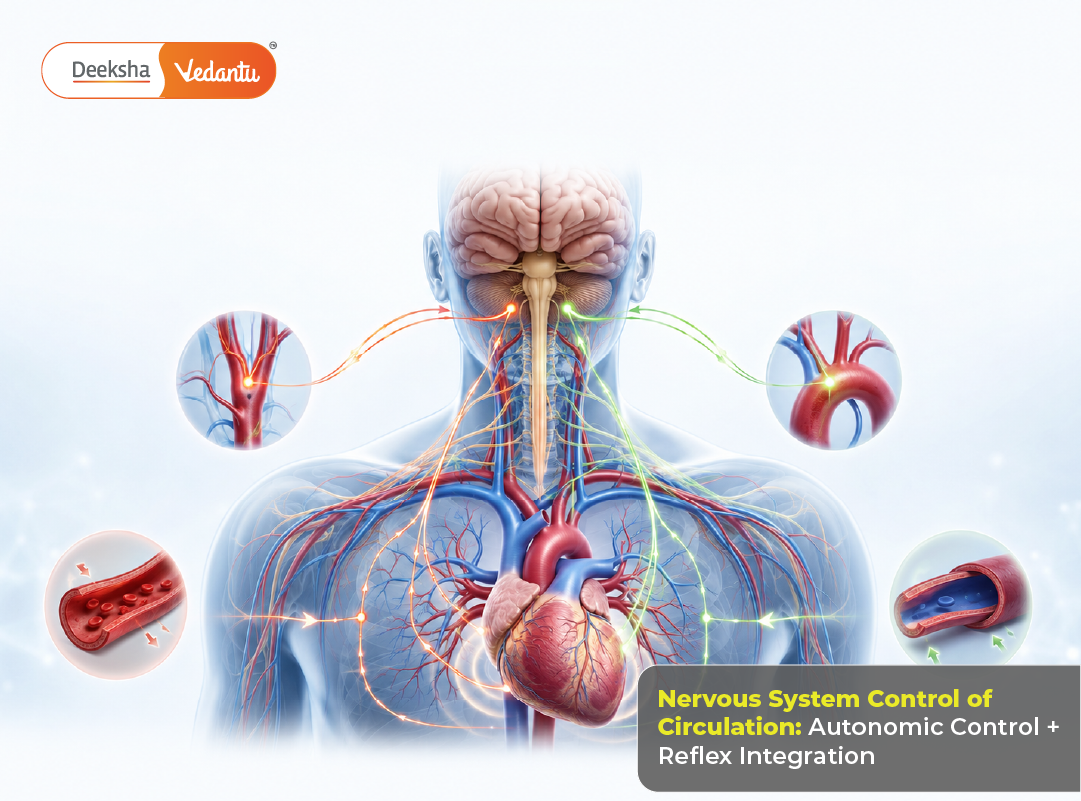


Most NEET aspirants study the heart’s electrical conduction system (SA node, AV node, Purkinje fibres) as if the heart sets its own pace independently – and structurally, it does. But NEET’s harder questions test something else entirely: how the nervous system overrides and fine-tunes that intrinsic rhythm moment to moment. Understanding this autonomic layer is what separates a surface-level grasp of the circulatory system from one that can handle scenario-based NEET questions about exercise, fear, or sudden blood pressure changes.
Why the Heart Needs External Nervous Control at All
The SA node generates its own rhythm independently – this is why a transplanted heart, with no nerve connections to the recipient’s brain, still beats. But a fixed, unchangeable heart rate would be a serious problem: the body’s demand for blood flow changes constantly, spiking during exercise or stress and dropping during rest. The autonomic nervous system exists precisely to modulate this intrinsic rhythm in response to the body’s real-time needs, building directly on the broader principles covered in neural control and coordination.
The Two Autonomic Branches and Their Opposite Effects on the Heart
The autonomic nervous system has two divisions that act on the heart in opposing directions, and NEET frequently tests this antagonism directly.
Sympathetic nervous system – releases norepinephrine (noradrenaline) onto the SA node, AV node, and cardiac muscle. Effects: increased heart rate (positive chronotropic effect), increased force of contraction (positive inotropic effect), and faster AV node conduction. This is the “fight or flight” branch, dominant during exercise, stress, or fear.
Parasympathetic nervous system – primarily via the vagus nerve, releases acetylcholine onto the SA and AV nodes. Effects: decreased heart rate (negative chronotropic effect), and slowed AV conduction. This is the “rest and digest” branch, dominant during calm, resting states.
A frequently tested NEET detail: the vagus nerve’s resting influence on the heart is actually dominant under normal conditions – meaning the heart’s natural intrinsic rate (around 100 bpm if left completely uninfluenced) is constantly being slowed down by parasympathetic “braking” to the familiar resting rate of around 70-75 bpm. This is why cutting vagal input (as seen in certain experimental or clinical contexts) causes heart rate to rise, not fall – a counterintuitive fact NEET sometimes frames as a trick question.
| Feature | Sympathetic | Parasympathetic |
| Neurotransmitter | Norepinephrine | Acetylcholine |
| Effect on heart rate | Increases | Decreases |
| Effect on contraction force | Increases | Minimal direct effect |
| Dominant nerve | Cardiac sympathetic fibres | Vagus nerve |
| Dominant condition | Exercise, stress, fear | Rest |
The Baroreceptor Reflex: NEET’s Favourite Integration Example
This is where nervous control of circulation becomes a genuine reflex arc, and it’s one of the most reliably tested integration questions in this part of the syllabus.
Baroreceptors are stretch-sensitive receptors located in the carotid sinus and aortic arch, continuously monitoring blood pressure by detecting the degree of stretch in vessel walls.
The reflex sequence, step by step:
- Blood pressure rises (e.g., due to increased cardiac output) → vessel walls stretch more → baroreceptor firing rate increases
- This signal travels via afferent nerves to the medullary cardiovascular centre in the brainstem
- The medulla responds by increasing parasympathetic (vagal) output and decreasing sympathetic output
- This decreases heart rate and reduces vasoconstriction, lowering blood pressure back toward normal
The reverse sequence occurs when blood pressure drops: reduced baroreceptor firing leads to increased sympathetic output and decreased parasympathetic output, raising heart rate and constricting vessels to restore pressure. This entire negative feedback loop directly extends the regulation mechanisms discussed in the circulatory system chapter, where blood pressure numbers were introduced without yet explaining how they’re actively maintained.
NEET frequently presents this as a scenario question: “A person stands up suddenly and experiences a temporary drop in blood pressure – which reflex restores it, and what is the immediate physiological response?” The answer traces the baroreceptor reflex exactly as outlined above, with sympathetic activation as the corrective response.
The Medullary Cardiovascular Centre: The Integration Hub
The medulla oblongata houses the cardiovascular centre, which receives input not just from baroreceptors but also from chemoreceptors (detecting blood CO₂, O₂, and pH levels) and higher brain centres (including emotional and stress responses originating in the hypothalamus and cortex). This makes the medulla the genuine integration point where nervous control of circulation converges – a single physiological hub processing multiple simultaneous inputs and producing one coordinated autonomic output.
This integration explains why emotional states (a sudden fright) and chemical states (low blood oxygen during breath-holding) can both independently alter heart rate through the same final autonomic pathway, even though the triggering stimuli are completely different in nature.
Chemoreceptors: The Second Reflex Input
While baroreceptors respond to pressure, chemoreceptors in the carotid and aortic bodies respond to chemical changes in the blood – primarily falling oxygen levels, rising CO₂, or falling pH. When detected, these chemoreceptors signal the medulla to increase sympathetic output, raising heart rate and breathing rate together. This dual sensory system (mechanical via baroreceptors, chemical via chemoreceptors) feeding into one integration centre is exactly the kind of multi-input reflex NEET likes to test through assertion-reason questions, where students must correctly attribute a given physiological change to the right receptor type.
Connecting Back to Cardiac Output
Recall that cardiac output = stroke volume x heart rate. Autonomic control primarily acts on heart rate (chronotropic effect) and, via sympathetic stimulation, on stroke volume too (inotropic effect, increasing contractility). This means the nervous system’s influence on circulation isn’t limited to simply speeding up or slowing down the heart – it can genuinely increase the total volume of blood pumped per minute by strengthening each contraction, a detail that connects directly to cardiac output numericals covered in circulatory system chapters.
Solved NEET-Style Conceptual Question
A person’s vagus nerve is experimentally severed. Predict the immediate effect on resting heart rate, and explain why.
Since the vagus nerve provides the dominant resting “brake” on the SA node, severing it removes parasympathetic inhibition entirely. The heart reverts closer to its intrinsic, unbraked rate of approximately 100 bpm. Heart rate increases, despite no change in sympathetic activity – purely from the loss of parasympathetic restraint.
Practice Questions Styled After NEET
Q1. The baroreceptor reflex responds primarily to changes in:
(a) Blood glucose (b) Blood pressure/vessel stretch (c) Blood pH only (d) Body temperature)
Answer: (b)
Q2. Increased baroreceptor firing due to high blood pressure leads to:
(a) Increased sympathetic activity (b) Increased parasympathetic activity (c) No change in autonomic output (d) Immediate cardiac arrest)
Answer: (b)
Q3. The neurotransmitter released by the vagus nerve at the SA node is:
(a) Norepinephrine (b) Acetylcholine (c) Dopamine (d) Serotonin)
Answer: (b)
Q4. The cardiovascular centre that integrates autonomic input to the heart is located in the:
(a) Cerebellum (b) Hypothalamus (c) Medulla oblongata (d) Cerebral cortex)
Answer: (c)
Treating Circulation as a Nervously Regulated System, Not Just a Pump
The biggest conceptual upgrade available in this topic is recognising that the heart’s intrinsic conduction system (SA node, AV node) and its nervous regulation (sympathetic, parasympathetic, baroreceptor reflex) are two separate but connected layers – one sets the baseline rhythm, the other adjusts it in real time based on the body’s needs. This layered thinking mirrors how the broader animal nervous system coordinates rapid, involuntary responses elsewhere in the body, and reinforces why circulatory physiology can’t be fully understood as an isolated topic separate from neural control.
For students revisiting NEET Biology after a first attempt, autonomic-circulatory integration is a frequent blind spot – the heart’s anatomy gets revised thoroughly, but the nervous override mechanisms controlling it get treated as a footnote. Deeksha’s NEET repeater course corrects this by treating circulatory and neural control as a single connected unit during revision, ensuring reflex-based scenario questions don’t catch students off guard on exam day.










Get Social