
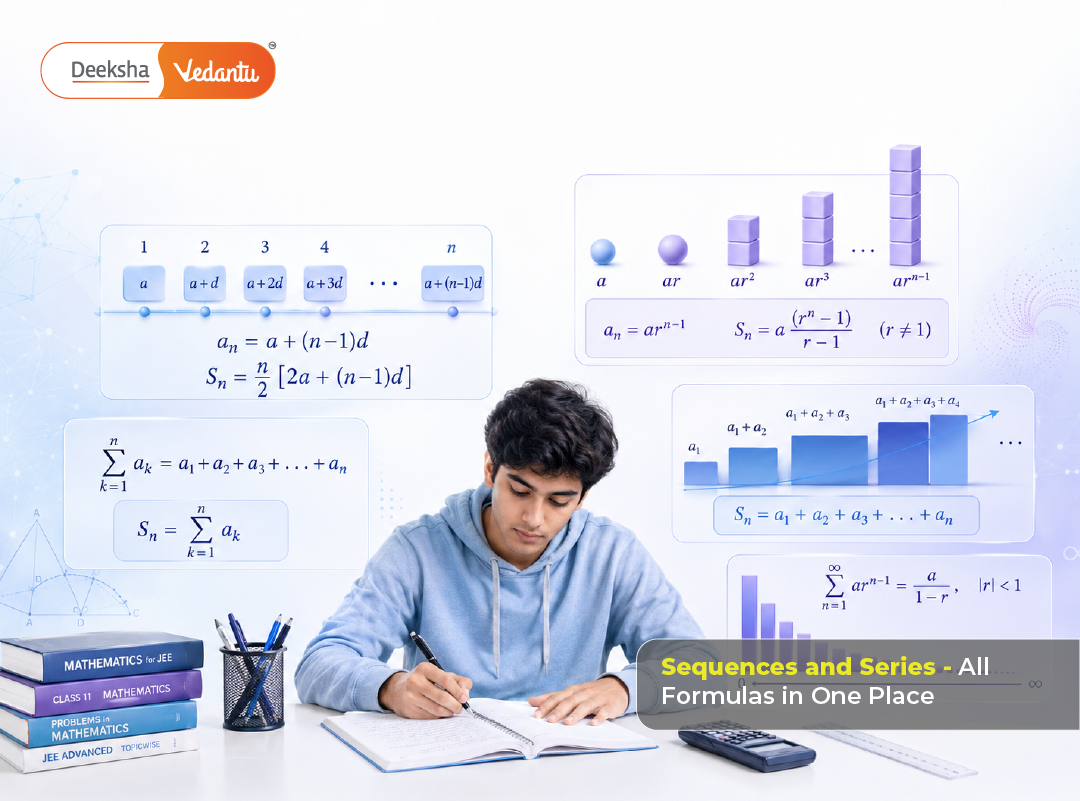


Sequences and Series is one of the few JEE Maths chapters where the formulas themselves aren’t hard – there are just a lot of them, scattered across AP, GP, HP, and special series, each looking similar enough to blur together under exam pressure. This is a single, organized reference sheet built to fix exactly that problem: everything grouped by category, with the one distinguishing detail per formula that actually matters on test day.
Arithmetic Progression (AP)
An AP is a sequence where each term differs from the previous one by a constant value, called the common difference (d).
- nth term: aₙ = a + (n-1)d
- Sum of first n terms: Sₙ = n/2 [2a + (n-1)d], or equivalently Sₙ = n/2 (a + l), where l is the last term
- Arithmetic Mean (AM) of two numbers: AM = (a+b)/2
The formula worth memorizing exactly is Sₙ = n/2 (a + l) – it’s the one JEE questions quietly expect you to reach for when the last term is given directly, saving you from recalculating d unnecessarily. For the foundational build-up to these formulas, the nth term of an AP and sum of first n terms of an AP pages are worth a quick revisit if either formula feels like something you’re recalling rather than understanding.
Geometric Progression (GP)
A GP is a sequence where each term is obtained by multiplying the previous term by a constant ratio (r).
- nth term: aₙ = a·rⁿ⁻¹
- Sum of first n terms (r ≠ 1): Sₙ = a(rⁿ-1)/(r-1), or a(1-rⁿ)/(1-r) when r < 1
- Sum to infinity (only valid when |r| < 1): S∞ = a/(1-r)
- Geometric Mean (GM) of two numbers: GM = √(ab)
The condition |r| < 1 for the infinite sum formula is the single most commonly overlooked detail in this section – applying S∞ = a/(1-r) when r ≥ 1 gives a meaningless answer, and JEE occasionally tests exactly this oversight by hiding an r value just outside the valid range. The full derivation and worked context for this is covered in Geometric Progression.
Harmonic Progression (HP)
A sequence is an HP if the reciprocals of its terms form an AP. There’s no direct “sum of n terms” formula for HP – instead, convert to the reciprocal AP, solve there, and invert back.
- nth term of HP: if the reciprocal AP has nth term = a + (n-1)d, then the HP term is 1/[a + (n-1)d]
- Harmonic Mean (HM) of two numbers: HM = 2ab/(a+b)
The AM-GM-HM Relationship
For any two positive numbers, these three means always satisfy:
AM ≥ GM ≥ HM, with equality holding only when both numbers are equal.
There’s also a fixed relationship connecting them directly: GM² = AM × HM. This single identity resolves a surprisingly large share of JEE questions that mix AM, GM, and HM in the same problem without needing three separate calculations – solve for two of the three means, and the third follows immediately from this relationship, detailed further on the relationship between AM and GM page.
Special Series (Sum of Powers of Natural Numbers)
These three formulas appear constantly, often buried inside larger summation problems rather than asked directly:
- Sum of first n natural numbers: Σn = n(n+1)/2
- Sum of squares of first n natural numbers: Σn² = n(n+1)(2n+1)/6
- Sum of cubes of first n natural numbers: Σn³ = [n(n+1)/2]²
Notice the elegant relationship in that last line: the sum of cubes is literally the square of the sum of the first n natural numbers. This isn’t a coincidence worth memorizing separately – recognizing it means you only need to remember one formula (Σn) to reconstruct the cubes formula on the spot if your memory slips during the exam.
Arithmetico-Geometric Series (AGP)
This hybrid series combines an AP and a GP term-by-term – for example, 1, 3x, 5x², 7x³, … where the coefficients form an AP (1, 3, 5, 7…) and the powers of x form a GP.
Sum to infinity (for |x| < 1): S∞ = a/(1-r) + dr/(1-r)²
This formula looks intimidating, but it’s really just the AP sum-to-infinity structure with an extra correction term for the common difference d – most JEE questions on this topic are solved faster by re-deriving the sum using the standard “multiply by r and subtract” technique rather than plugging directly into this formula, since the technique reinforces understanding that a memorized formula alone doesn’t.
Exponential and Logarithmic Series
These two series appear less frequently than AP/GP but show up reliably enough in JEE Advanced to be worth memorizing exactly:
- Exponential series: eˣ = 1 + x + x²/2! + x³/3! + … (valid for all real x)
- Logarithmic series: ln(1+x) = x – x²/2 + x³/3 – x⁴/4 + … (valid only for -1 < x ≤ 1)
The validity range on the logarithmic series is the detail students most often forget – unlike the exponential series, which holds for every real number, the log series formula breaks down outside -1 < x ≤ 1, and that boundary condition is exactly the kind of detail JEE likes testing indirectly. Deeper treatment of both series, including their series-manipulation applications, is available on the exponential series and logarithmic series pages.
The Complete Formula Sheet
| Category | Key Formula | Watch For |
| AP – nth term | aₙ = a + (n-1)d | Common difference sign |
| AP – sum | Sₙ = n/2(2a+(n-1)d) = n/2(a+l) | Use (a+l) form when last term is known |
| GP – nth term | aₙ = a·rⁿ⁻¹ | – |
| GP – sum (finite) | Sₙ = a(rⁿ-1)/(r-1) | – |
| GP – sum (infinite) | S∞ = a/(1-r) | Only valid for |r| < 1 |
| HP | Convert to reciprocal AP first | No direct sum formula exists |
| AM, GM, HM | AM≥GM≥HM; GM² = AM×HM | Equality only when numbers are equal |
| Sum of n | n(n+1)/2 | – |
| Sum of n² | n(n+1)(2n+1)/6 | – |
| Sum of n³ | [n(n+1)/2]² | Equals (Σn)² |
| Exponential series | eˣ = Σ xⁿ/n! | Valid for all x |
| Logarithmic series | ln(1+x) = Σ (-1)ⁿ⁺¹xⁿ/n | Valid only for -1 < x ≤ 1 |
Making This Sheet Actually Stick
A formula sheet only earns its keep once you’ve tested it against real questions – running through a set of JEE Main previous year question papers is the fastest way to see which of these formulas shows up most often for your specific target exam, and where the “watch for” column above actually costs students marks in practice. If Sequences and Series is one of several chapters you’re consolidating right now, this checklist of math concepts every JEE aspirant should master is a useful way to see how this topic connects to the rest of your syllabus, and Deeksha’s JEE coaching programs are built to reinforce exactly this kind of formula fluency alongside genuine conceptual understanding.
Frequently Asked Questions
Is it necessary to memorize the HP formulas separately, or is converting to AP always enough?
Converting to the reciprocal AP is almost always the safer and faster route – HP doesn’t have clean standalone formulas the way AP and GP do, so treating it as “AP in disguise” avoids errors from trying to memorize a separate, less intuitive formula set.
Which formula in this entire list is most commonly misapplied in JEE?
The GP sum-to-infinity formula, S∞ = a/(1-r), applied without checking that |r| < 1 – this single oversight is one of the most frequent silent errors students make under time pressure.
Do I need to memorize the arithmetico-geometric series formula exactly, or is the derivation method enough?
The derivation method (multiply the series by r, then subtract) is generally more reliable than the memorized formula, since it reinforces the logic and adapts naturally if the question varies the series structure slightly.
Sequences and Series rewards organization more than raw memorization. Keep this sheet close during revision, but treat the “watch for” column as seriously as the formulas themselves – that’s usually where marks are actually won or lost on exam day.










Get Social