
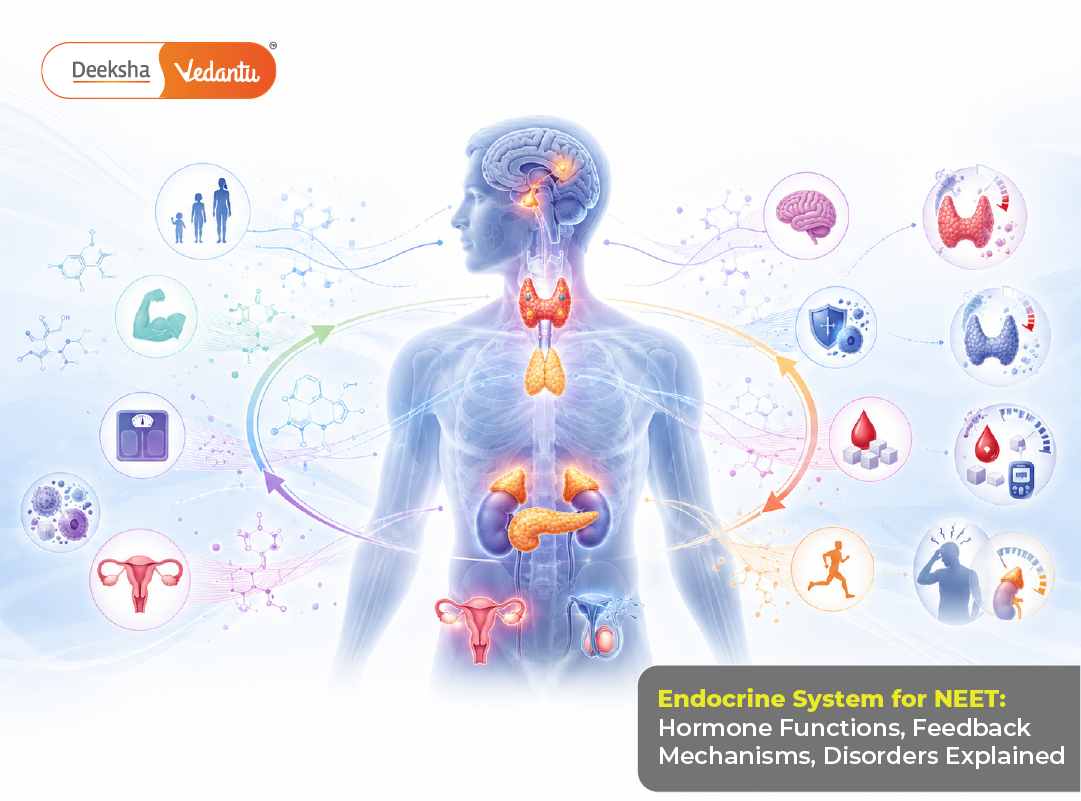


The endocrine system is a chapter that punishes students who treat it as a hormone-naming exercise. NEET rarely asks “which gland secretes X” in isolation – it asks what happens when that hormone is deficient, how one gland’s output controls another’s, and why a feedback loop matters physiologically. This guide is structured exactly along those lines: gland by gland, hormone by hormone, with the feedback logic and clinical correlations NEET actually tests.
Why This Chapter Rewards Systems Thinking
NEET draws 4–6 questions from “Chemical Coordination and Integration,” and almost none of them are simple recall. The exam wants you to understand the hypothalamus-pituitary axis, trace negative feedback loops, and connect hormone excess or deficiency to named disorders. Treat each gland not as an isolated fact-card but as part of a control circuit, and this chapter becomes one of the highest-scoring sections in Biology.
The Hypothalamus: The Master Controller
The hypothalamus sits at the interface of the nervous and endocrine systems, making it the natural bridge between neural control mechanisms and hormonal regulation. It secretes releasing hormones and inhibiting hormones that travel to the anterior pituitary via a portal blood system, controlling the release of pituitary hormones.
This is the starting point of nearly every major feedback axis in the body: hypothalamus > pituitary > target gland > hormone > feedback to hypothalamus.
Pituitary Gland: The Master Gland with Two Faces
The pituitary, located at the base of the brain, has two structurally and functionally distinct lobes.
Anterior Pituitary (Adenohypophysis)
| Hormone | Target | Function |
| Growth Hormone (GH) | Bones, muscles | Stimulates growth; deficiency causes dwarfism, excess causes gigantism/acromegaly |
| Thyroid Stimulating Hormone (TSH) | Thyroid gland | Stimulates thyroxine release |
| Adrenocorticotropic Hormone (ACTH) | Adrenal cortex | Stimulates cortisol release |
| Follicle Stimulating Hormone (FSH) | Gonads | Stimulates gamete production |
| Luteinizing Hormone (LH) | Gonads | Triggers ovulation, testosterone production |
| Prolactin (PRL) | Mammary glands | Stimulates milk production |
GH excess in childhood (before growth plates fuse) causes gigantism; excess in adulthood causes acromegaly (enlarged hands, feet, jaw – growth plates already fused, so bones thicken rather than lengthen). This distinction is a frequent NEET clinical-application question.
Posterior Pituitary (Neurohypophysis)
The posterior pituitary doesn’t synthesise hormones itself – it stores and releases hormones made in the hypothalamus.
Oxytocin – stimulates uterine contractions during childbirth and milk ejection (not production – that’s prolactin’s job; this distinction is commonly tested).
Vasopressin (ADH) – increases water reabsorption in the kidney’s collecting duct, a connection that ties directly into the excretory system’s osmoregulation mechanisms.
Thyroid Gland: Metabolism’s Regulator
The thyroid, located in the neck, secretes thyroxine (T4) and triiodothyronine (T3), both iodine-containing hormones that regulate basal metabolic rate, growth, and development. It also secretes calcitonin, which lowers blood calcium by inhibiting bone resorption.
Iodine deficiency prevents thyroxine synthesis, causing the thyroid to enlarge as TSH rises in compensation – this is goitre, a structure-function consequence NEET frequently frames as a feedback question.
| Condition | Cause | Effect |
| Hypothyroidism (childhood) | Low T3/T4 | Cretinism – stunted physical and mental growth |
| Hypothyroidism (adult) | Low T3/T4 | Myxoedema – low metabolic rate, weight gain, lethargy |
| Hyperthyroidism | Excess T3/T4 | Graves’ disease – exophthalmos, weight loss, increased heart rate |
Parathyroid Glands: Calcium’s Counterbalance
Four small parathyroid glands embedded in the thyroid secrete Parathyroid Hormone (PTH), which raises blood calcium levels by promoting bone resorption, renal calcium reabsorption, and activation of Vitamin D.
PTH and calcitonin are antagonistic – PTH raises blood Ca²⁺, calcitonin lowers it. This antagonism is a guaranteed source of NEET assertion-reason questions.
Adrenal Glands: Two Glands in One
Each adrenal gland has a distinct cortex and medulla, functioning almost as separate endocrine organs.
Adrenal Cortex (three zones)
Mineralocorticoids (aldosterone) – regulate Na⁺/K⁺ balance, directly tying into the renin-angiotensin pathway covered in the excretory system.
Glucocorticoids (cortisol) – regulate carbohydrate metabolism, suppress inflammation, and help the body respond to stress.
Gonadocorticoids – small amounts of sex hormones.
Addison’s disease (cortisol deficiency) and Cushing’s syndrome (cortisol excess) are the two clinical correlations NEET tests most.
Adrenal Medulla
Secretes adrenaline (epinephrine) and noradrenaline (norepinephrine) – the “fight or flight” hormones, released under sympathetic nervous stimulation. They increase heart rate, blood glucose, and alertness, linking directly back to the circulatory system’s cardiac output regulation.
Pancreas: The Dual-Function Gland
The pancreas is both exocrine (digestive enzymes) and endocrine, with the endocrine portion concentrated in the Islets of Langerhans.
| Cell Type | Hormone | Effect |
| Alpha cells | Glucagon | Raises blood glucose (glycogen > glucose) |
| Beta cells | Insulin | Lowers blood glucose (glucose > glycogen, cellular uptake) |
Insulin and glucagon are antagonistic, maintaining blood glucose homeostasis. Diabetes mellitus results from insulin deficiency (Type 1) or insulin resistance (Type 2) and is one of NEET’s most reliable clinical-disorder questions – often paired with glucosuria, a concept that connects to filtration thresholds in the nephron.
Gonads: Reproductive Hormone Production
Testes – Leydig cells secrete testosterone, responsible for spermatogenesis and secondary male characteristics.
Ovaries – secrete estrogen (follicular development, secondary female characteristics) and progesterone (maintains pregnancy, prepares uterus). These hormones operate under the same hypothalamus-pituitary feedback logic, governed by FSH and LH from the anterior pituitary.
Negative Feedback: The Mechanism Behind Every Axis
Nearly every endocrine axis in this chapter follows the same logical structure, and NEET tests this logic repeatedly using different glands as the example.
Hypothalamus releases TRH > Anterior pituitary releases TSH > Thyroid releases T3/T4 > Rising T3/T4 levels suppress TRH and TSH release (negative feedback)
This loop ensures hormone levels stay within a tight physiological range. The same structure applies to the HPA axis (hypothalamus-pituitary-adrenal) regulating cortisol, and the HPG axis (hypothalamus-pituitary-gonadal) regulating sex hormones.
Positive feedback is rarer but appears in oxytocin release during childbirth – uterine contraction stimulates more oxytocin release, which increases contraction further, until delivery interrupts the loop. NEET sometimes uses this as a contrast question against the more common negative feedback pattern.
Practice Questions Styled After NEET
Q1. Acromegaly results from excess secretion of which hormone after the closure of growth plates?
(a) Thyroxine (b) Growth hormone (c) Insulin (d) Cortisol)
Answer: (b)
Q2. Which hormone is responsible for milk ejection rather than milk production?
(a) Prolactin (b) Oxytocin (c) Estrogen (d) LH)
Answer: (b)
Q3. Goitre develops due to deficiency of:
(a) Calcium (b) Iodine (c) Iron (d) Vitamin D)
Answer: (b)
Q4. Which hormone pair is antagonistic in calcium regulation?
(a) Insulin and glucagon (b) PTH and calcitonin (c) Aldosterone and cortisol (d) FSH and LH)
Answer: (b)
Q5. Beta cells of the Islets of Langerhans secrete:
(a) Glucagon (b) Insulin (c) Somatostatin (d) Gastrin)
Answer: (b)
Q6. The HPA axis primarily regulates secretion of:
(a) Thyroxine (b) Cortisol (c) Insulin (d) Testosterone)
Answer: (b)
Connecting the Endocrine System Across NEET Biology
The endocrine system rarely stands alone on the NEET paper. Its regulation of blood pressure overlaps with the circulatory system’s baroreceptor reflexes. Its water-balance hormones tie directly into excretory products and their elimination. Its sympathetic stress response is triggered by neural control and coordination pathways, and reproductive hormone axes connect forward into human reproduction chapters in Class 12.
Students retaking NEET often find that endocrine questions cost them marks not because the facts were unfamiliar, but because the feedback logic wasn’t internalised – they could name a hormone but not predict what happens when it rises or falls. Deeksha’s NEET repeater course is built to close exactly this gap, treating each endocrine axis as a traceable mechanism rather than a list of glands to memorise.







Get Social