
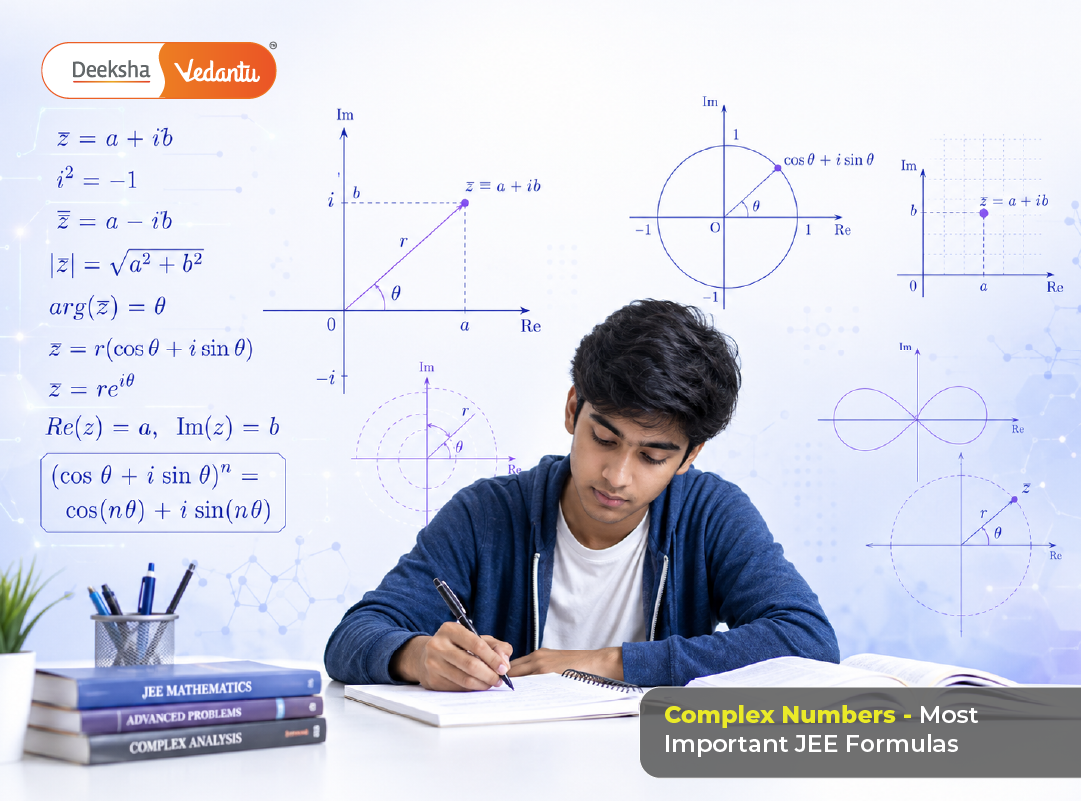


Most formula sheets fail because you read them passively – your eyes move down the page, nothing sticks, and three weeks later you’re back to googling the same formula. This one works differently. For each core idea in Complex Numbers, you’ll see a genuine JEE-style problem first. Try it mentally for ten seconds before reading on. Then the formula reveals itself, along with why it’s the tool for exactly this situation. This is how the formula actually gets wired into memory – not by reading it, but by feeling the gap it fills.
Checkpoint 1: Modulus of a Product
Try this first: If z₁ = 3 + 4i and z₂ = 1 – i, find |z₁z₂| without multiplying the complex numbers out first.
Struggled without expanding? Here’s the formula that skips the multiplication entirely:
|z₁z₂| = |z₁| × |z₂|
|z₁| = √(9+16) = 5, and |z₂| = √(1+1) = √2. So |z₁z₂| = 5√2 – no expansion needed. This single property, along with its sibling |z₁/z₂| = |z₁|/|z₂|, eliminates an enormous amount of unnecessary algebra in JEE questions that only ask for a modulus, not the full product.
Checkpoint 2: Conjugate of a Complicated Expression
Try this first: Find the conjugate of z̄² + 3z̄ + 2 without computing z̄ explicitly first.
The shortcut here is that conjugation distributes cleanly across sums, products, and powers:
conjugate(z₁ ± z₂) = z̄₁ ± z̄₂, conjugate(z₁z₂) = z̄₁z̄₂, conjugate(zⁿ) = (z̄)ⁿ
This means you can treat the entire conjugate operation as something you apply term-by-term to an expression, rather than something you compute only after simplifying everything into a+bi form first. It’s a small mental shift that saves real time on multi-term expressions.
Checkpoint 3: Argument of a Complex Number in an Unusual Quadrant
Try this first: Find the argument of z = -1 – i without simply computing tan⁻¹(1) and moving on.
This is where students lose easy marks – tan⁻¹(y/x) alone doesn’t account for which quadrant z actually sits in. The formula needs a quadrant correction:
arg(z) = tan⁻¹(y/x), adjusted by ± π depending on the quadrant of (x, y)
For z = -1 – i, both real and imaginary parts are negative, placing it in the third quadrant. tan⁻¹(1) = π/4, but the actual principal argument is π/4 – π = -3π/4. Memorize the quadrant-adjustment rule as tightly as the formula itself – this is the single most common silent error in argument-based JEE questions.
Checkpoint 4: Converting to Polar Form Fast
Try this first: Express z = 1 + i√3 in polar form in under 15 seconds.
z = r(cosθ + isinθ), where r = |z| and θ = arg(z)
Here, r = √(1+3) = 2, and θ = tan⁻¹(√3) = π/3 (first quadrant, no adjustment needed). So z = 2(cos π/3 + i sin π/3). Once you’re fast at finding r and θ separately, polar conversion stops being a calculation and becomes a lookup.
Checkpoint 5: Raising a Complex Number to a High Power
Try this first: Compute (1+i)¹⁰ without expanding using the binomial theorem.
Expanding this by hand would take several minutes and invite errors. Instead, convert to polar form first, then apply:
De Moivre’s Theorem: [r(cosθ + isinθ)]ⁿ = rⁿ(cos nθ + isin nθ)
Since 1+i = √2(cos π/4 + i sin π/4), raising it to the 10th power gives (√2)¹⁰(cos 10π/4 + i sin 10π/4) = 32(cos 5π/2 + i sin 5π/2) = 32(0 + i(1)) = 32i. One formula collapses what would otherwise be a lengthy binomial expansion into three lines.
Checkpoint 6: Finding All Roots of a Complex Number
Try this first: Find all cube roots of unity without guessing and checking values.
The nth roots of z = r(cosθ + isinθ) are given by: r^(1/n)[cos((θ+2kπ)/n) + isin((θ+2kπ)/n)], for k = 0, 1, …, n-1
For cube roots of unity specifically (z = 1, r = 1, θ = 0), this generates the three familiar values: 1, ω, and ω², where ω = (-1+i√3)/2. The property 1 + ω + ω² = 0 and ω³ = 1 show up constantly in JEE algebra questions, often disguised inside factorization or series problems that don’t look like complex numbers at first glance.
Checkpoint 7: Geometric Rotation of a Complex Number
Try this first: A point z is rotated by 90° about the origin – express the new point in terms of z without redrawing the diagram.
Rotation formula: z’ = z · e^(iθ), or equivalently z’ = z(cosθ + isinθ)
For a 90° rotation, θ = π/2, so z’ = z · i. This means rotating any complex number by 90° is as simple as multiplying it by i – a fact that turns geometry-heavy JEE questions about rotated points, triangles, and squares in the Argand plane into pure algebra.
Checkpoint 8: Locus Problems in the Argand Plane
Try this first: Identify the locus of z satisfying |z – 2| = |z – (-2)| without plotting multiple points.
This equation says z is equidistant from the points 2 and -2, which is the definition of a perpendicular bisector – here, the imaginary axis itself. More generally:
|z – z₁| = |z – z₂| represents the perpendicular bisector of the segment joining z₁ and z₂
|z – z₀| = r represents a circle centered at z₀ with radius r
Recognizing these two patterns instantly, rather than algebraically expanding the modulus equations, is what separates fast solvers from students still squaring both sides halfway through the exam.
Quick Reference: The Eight Formulas at a Glance
| Checkpoint | Formula | Used For |
| 1 | |z₁z₂| = |z₁|·|z₂| | Modulus of products/quotients |
| 2 | conjugate distributes over +, ×, ^n | Simplifying conjugate expressions |
| 3 | arg(z) with quadrant correction | Correct argument in any quadrant |
| 4 | z = r(cosθ + isinθ) | Polar conversion |
| 5 | De Moivre’s Theorem | High powers of complex numbers |
| 6 | nth roots formula | Roots of unity and general roots |
| 7 | z’ = z·e^(iθ) | Rotation in the Argand plane |
| 8 | |z-z₁|=|z-z₂| / |z-z₀|=r | Locus: bisectors and circles |
Where This Fits Into Your JEE Maths Preparation
Once these eight checkpoints feel automatic, it’s worth reinforcing the underlying theory through the Class 11 Mathematics Complex Numbers page, along with dedicated deep-dives into the algebra of complex numbers, modulus and conjugate properties, and the Argand plane and polar representation, which builds out the geometric side of this chapter in more depth than a formula sheet alone can.
This topic also connects directly into Complex Numbers and Quadratic Equations, since roots of unity and conjugate root pairs reappear constantly once quadratics with complex roots enter the picture. For broader context on where Complex Numbers sits relative to the rest of your syllabus, this checklist of math concepts every JEE aspirant should master is worth revisiting.
To convert this formula fluency into an actual score improvement, this guide on how to score 180 in JEE Maths with smart practice is a useful next step, and testing yourself against real exam conditions using JEE Main previous year question papers will show you exactly how often each of these eight checkpoints actually appears. Tracking your improvement through the best mock test series for JEE Mains with ranking logic will confirm whether these formulas are actually saving you time on test day, not just in practice.
For structured, concept-first guidance that builds this kind of instant formula recall rather than last-minute memorization, Deeksha’s JEE coaching programs are designed around exactly this checkpoint-by-checkpoint mastery approach.
Frequently Asked Questions
Which Complex Numbers formula is tested most frequently in JEE Main?
De Moivre’s Theorem and the nth roots formula appear especially often, since they collapse otherwise lengthy calculations into a few lines – exactly the kind of question JEE Main favors under time pressure.
Why does the argument formula need a quadrant correction?
Because tan⁻¹(y/x) alone only returns values between -π/2 and π/2, which can’t distinguish between a point in the first quadrant and its mirror image in the third – the correction restores that missing information.
Is the rotation formula really just multiplying by i for 90°?
Yes, specifically for a 90° counterclockwise rotation. For any other angle θ, the same idea applies – multiply by e^(iθ), or equivalently (cosθ + isinθ).
The fastest way to actually remember these formulas isn’t rereading them – it’s noticing the specific gap each one fills the moment you hit it in a problem. Run through these eight checkpoints a few times under real exam conditions, and formula recall stops being something you study for and starts being something you simply have.










Get Social