
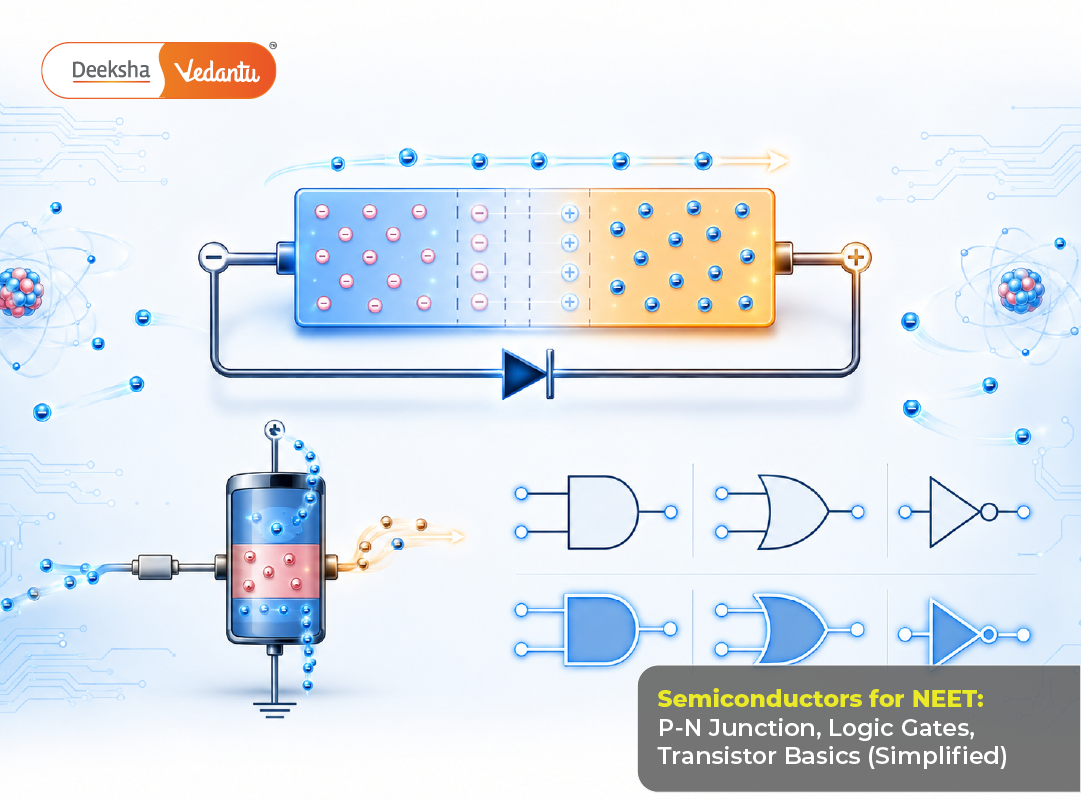


Semiconductors is a chapter NEET Biology-focused students often underweight, assuming it belongs more to JEE than NEET. That’s a mistake – NEET Physics consistently draws 2-3 questions from this chapter, and because the concepts are visual and rule-based rather than derivation-heavy, it’s one of the fastest chapters to convert into guaranteed marks. This guide simplifies the three pillars NEET tests: the p-n junction, transistor action, and logic gates.
Why Semiconductors Sit Between Conductors and Insulators
A material’s ability to conduct electricity depends on its energy band structure – specifically the gap between the valence band and conduction band. Conductors have overlapping or near-zero band gaps; insulators have very large band gaps (>3 eV); semiconductors sit in between, with a band gap of roughly 1-2 eV (silicon: 1.1 eV, germanium: 0.7 eV).
This intermediate gap means semiconductors can conduct under specific conditions – when energy is supplied (heat, light) or when impurities are deliberately added. That second method, called doping, is the foundation of the entire chapter.
Doping: Creating the Two Types of Semiconductors
Pure (intrinsic) semiconductors conduct poorly. Doping introduces controlled impurities to create extrinsic semiconductors with dramatically improved conductivity.
N-type semiconductor – formed by doping silicon (group 14, 4 valence electrons) with a pentavalent impurity (group 15, e.g., phosphorus, arsenic). The extra electron becomes a free charge carrier. Majority carriers: electrons. Minority carriers: holes.
P-type semiconductor – formed by doping with a trivalent impurity (group 13, e.g., boron, aluminium). The missing electron creates a “hole” – an absence of an electron that behaves as a positive charge carrier. Majority carriers: holes. Minority carriers: electrons.
NEET frequently tests this through a simple identification question: given an impurity atom’s group number, identify whether the resulting semiconductor is n-type or p-type.
| Property | N-type | P-type |
| Dopant | Pentavalent (P, As, Sb) | Trivalent (B, Al, Ga, In) |
| Majority carrier | Electron | Hole |
| Minority carrier | Hole | Electron |
| Donor/Acceptor level | Donor level near conduction band | Acceptor level near valence band |
The P-N Junction: Where the Real Physics Begins
When a p-type and n-type semiconductor are joined, electrons from the n-side diffuse into the p-side and holes diffuse from the p-side into the n-side. This diffusion creates a thin depletion region at the junction, depleted of mobile charge carriers, with a built-in potential barrier (~0.7V for silicon, ~0.3V for germanium) that opposes further diffusion.
A full breakdown of this junction formation and its electric field behaviour is covered in detail in the dedicated p-n junction chapter – worth revisiting if the depletion region concept feels shaky.
Forward Bias vs Reverse Bias
Forward bias – p-side connected to positive terminal, n-side to negative terminal. This reduces the potential barrier, allowing majority carriers to flow easily once the applied voltage exceeds the barrier potential. Current increases sharply once this threshold is crossed.
Reverse bias – p-side connected to negative terminal, n-side to positive terminal. This widens the depletion region and increases the barrier, allowing only a tiny leakage current (from minority carriers) to flow.
NEET’s V-I characteristic graph question is built entirely around this asymmetry: a forward-bias curve that rises sharply past the threshold voltage, and a reverse-bias curve that stays nearly flat until breakdown voltage is reached.
Diodes: Practical Applications of the P-N Junction
Rectifier Diode
A diode allows current in forward bias and blocks it in reverse bias – the basis for converting AC to DC. A half-wave rectifier uses a single diode, passing only one half of the AC cycle. A full-wave rectifier uses two diodes (or four, in a bridge configuration) to use both halves of the cycle, producing a smoother and more efficient DC output. The center-tapped and bridge configurations are explored further in the full-wave rectifier chapter, including efficiency comparisons NEET sometimes tests numerically.
Zener Diode
A specially doped diode designed to operate in the reverse breakdown region without damage, used as a voltage regulator. Once the Zener voltage is reached, the voltage across the diode stays nearly constant despite changes in current – a property exploited in voltage stabilisation circuits. The detailed V-I characteristics and circuit symbol conventions are covered in the Zener diode chapter, which NEET sometimes references in circuit-based assertion-reason questions.
LED and Photodiode (Conceptual Recall)
LEDs emit light when forward biased (electron-hole recombination releases energy as photons); photodiodes generate current when light falls on a reverse-biased junction. NEET typically tests these as one-line identification questions rather than numericals.
Transistors: Amplification and Switching
A transistor has three regions – emitter, base, collector – with the base being extremely thin and lightly doped compared to the other two. The two configurations NEET focuses on are NPN and PNP.
Key transistor relationships:
IE = IB + IC (emitter current = base current + collector current)
Current amplification factor (β): β = IC/IB (typically 20-500 for practical transistors)
Relationship between α and β: α = β/(1+β), where α = IC/IE
NEET frequently gives one ratio and asks you to calculate the other – a direct algebraic substitution once you recognise which formula applies.
Transistor as a Switch vs Amplifier
In switching applications, the transistor operates between cutoff (fully off) and saturation (fully on) regions. In amplifier applications, it operates in the active region, where small changes in base current produce large, proportional changes in collector current – the basis of voltage amplification.
Logic Gates: The Digital Application Layer
Semiconductors enable digital electronics, where logic gates process binary inputs (0 and 1) according to fixed truth-table rules. NEET tests the basic gates and their truth tables directly.
| Gate | Symbol Logic | Output is 1 when… |
| AND | A·B | Both A and B are 1 |
| OR | A+B | Either A or B is 1 |
| NOT | A’ | Input is 0 (inverts) |
| NAND | (A·B)’ | NOT both A and B are 1 |
| NOR | (A+B)’ | NOT either A or B is 1 |
NAND and NOR are called universal gates because any other logic gate can be constructed using only NAND gates or only NOR gates – a fact NEET has tested directly as a conceptual one-liner. A complete walkthrough of gate combinations and truth-table derivations is available in the basic logic gates chapter, useful for students who want additional truth-table practice beyond NEET’s typical single-gate question.
Solved NEET-Style Numerical: Transistor Current Gain
A transistor has IB = 0.5 mA and IC = 49.5 mA. Find β and α.
β = IC/IB = 49.5/0.5 = 99
α = β/(1+β) = 99/100 = 0.99
Check: IE = IB + IC = 0.5 + 49.5 = 50 mA, and α = IC/IE = 49.5/50 = 0.99 ✓
Practice Questions Styled After NEET
Q1. Doping silicon with phosphorus produces:
(a) P-type semiconductor (b) N-type semiconductor (c) Intrinsic semiconductor (d) Insulator)
Answer: (b)
Q2. In reverse bias, the depletion region:
(a) Narrows (b) Widens (c) Disappears (d) Remains unchanged)
Answer: (b)
Q3. A Zener diode is normally operated in:
(a) Forward bias, active region (b) Reverse breakdown region (c) Cutoff region (d) Saturation region)
Answer: (b)
Q4. Which logic gate is known as a universal gate?
(a) AND (b) OR (c) NAND (d) NOT)
Answer: (c)
Q5. For a transistor, if α = 0.98, the value of β is approximately:
(a) 49 (b) 0.98 (c) 1.98 (d) 100)
Answer: (a) – β = α/(1-α) = 0.98/0.02 = 49
Why Semiconductors Deserve Dedicated Revision Time
Semiconductors often gets compressed into a last-minute revision topic, but its question patterns are highly predictable – identification (n-type vs p-type), graph interpretation (V-I characteristics), and direct formula substitution (transistor ratios). This predictability makes it similar in exam-strategy terms to chapters like Kirchhoff’s law circuit problems or Wheatstone bridge numericals – once the underlying rule is clear, the questions become fast points rather than time sinks. A broader overview tying together band theory, doping, and device behaviour is available in the dedicated semiconductors chapter for students who want the JEE-level depth alongside NEET-level application.
For repeaters specifically, chapters like this one – short on derivation, heavy on pattern recognition – are exactly where focused revision in the final weeks produces a disproportionate score improvement. Deeksha’s NEET repeater course deliberately allocates revision time toward these high-yield, low-derivation chapters so that Physics scores aren’t left to chance in the final stretch.








Get Social