
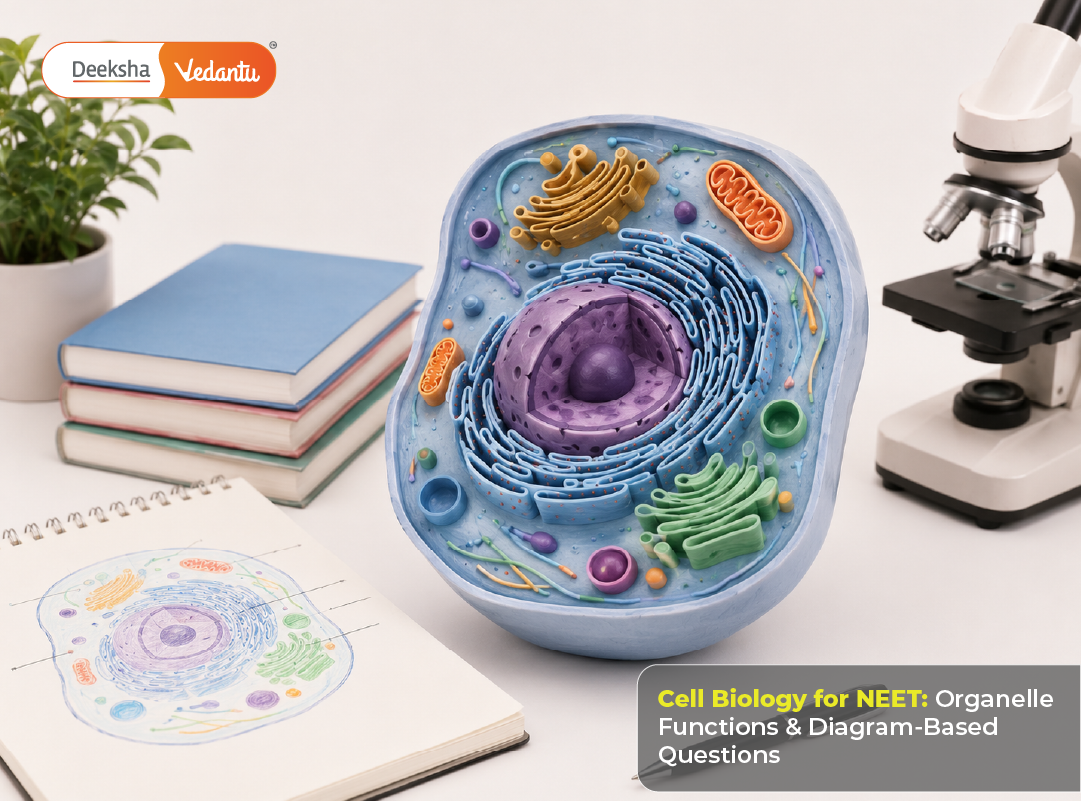


If there’s one chapter that NEET Biology students consistently underestimate, it’s cell biology. On the surface, it looks like pure memorisation – names, structures, functions. But the NEET paper routinely uses diagrams, assertion-reason pairs, and function-matching questions that punish surface-level learning. This guide breaks down every major organelle you need to know, how they show up in diagrams, and the exact question patterns NEET uses to test them.
Why Cell Biology Carries More NEET Marks Than It Seems
The chapter “Cell: The Unit of Life” sits in Unit 4 of Class 11 Biology and contributes directly to 3-5 questions in most NEET papers. But its reach is wider – concepts from this chapter appear inside questions on photosynthesis (chloroplast structure), respiration (mitochondria), protein synthesis (ribosomes and ER), and cell division (centrioles, nucleus). Ignoring cell biology thoroughly is a score-leak that compounds across units.
The Three-Membrane Framework: How to Organise Your Revision
Before diving into individual organelles, use this mental framework. Every cell organelle falls into one of three categories based on its membrane structure:
| Category | Organelles | Key Trait |
| Non-membrane bound | Ribosomes, Centrioles, Cilia, Flagella | No lipid bilayer; found in both prokaryotes and eukaryotes |
| Single membrane bound | ER, Golgi, Vacuoles, Lysosomes, Peroxisomes | One phospholipid bilayer |
| Double membrane bound | Mitochondria, Chloroplast, Nucleus | Two concentric membranes; semi-autonomous |
NEET has asked directly: “Which of the following is not a membrane-bound organelle?” Knowing this framework means you answer that in under 5 seconds.
Organelle-by-Organelle Breakdown
Nucleus
The nucleus is the control centre of the cell and one of the most diagram-rich organelles in NEET. The nuclear envelope consists of two membranes perforated by nuclear pores, which regulate the traffic of RNA and proteins between nucleus and cytoplasm. Inside sits the nucleoplasm, which houses chromatin (DNA + histone proteins) and the nucleolus.
The nucleolus is where ribosomal RNA (rRNA) is synthesised. NEET has asked: “Where does the synthesis of rRNA occur?” – the answer is nucleolus, not nucleus in general. That distinction matters.
Diagram tip: When labelling a nucleus diagram, always identify the outer nuclear membrane (continuous with ER), inner nuclear membrane, nuclear pores, and nucleolus inside. Missing the nuclear pores is a common labelling error.
Mitochondria – The Powerhouse with Two Compartments
Mitochondria are double-membrane organelles with a highly folded inner membrane called the cristae, which dramatically increases surface area for ATP synthesis. The space between the two membranes is the intermembrane space, while the interior is called the matrix, where the Krebs cycle takes place.
NEET loves the Krebs cycle connection – know that the matrix contains its own circular DNA, 70S ribosomes, and enzymes for aerobic respiration. This is why mitochondria are described as semi-autonomous organelles.
The F₀-F₁ particles (oxysomes) are located on the inner surface of the inner mitochondrial membrane and are the sites of ATP synthesis. This is a high-frequency diagram-label question.
Chloroplast – The Organised Solar Panel
Found only in plant cells and certain algae, chloroplasts are double-membrane organelles with a third internal membrane system called the thylakoid. Thylakoids are stacked into grana (singular: granum), and the fluid-filled space surrounding them is the stroma.
The light reactions occur in the thylakoid membrane. The dark reactions (Calvin cycle) occur in the stroma. This spatial separation is a frequent NEET target.
Diagram tip: A well-labelled chloroplast diagram should include the outer membrane, inner membrane, thylakoid, granum, stroma lamellae (intergranal lamellae connecting grana), and stroma.
Endoplasmic Reticulum – Rough vs. Smooth, and Why It Matters
The ER is a network of interconnected tubules and sheets continuous with the nuclear envelope. It comes in two forms:
Rough ER (RER) is studded with ribosomes on its cytoplasmic surface and is the site of protein synthesis and processing – particularly for proteins destined for secretion or membrane insertion.
Smooth ER (SER) lacks ribosomes and is involved in lipid synthesis, steroid hormone synthesis, and detoxification. In liver cells, SER plays a central role in detoxifying drugs and alcohol.
NEET asks this as a function-matching question more often than as a definition. Know that secretory cells (like pancreatic acinar cells) have abundant RER, while steroid-secreting cells (like adrenal cortex cells) have abundant SER.
Golgi Apparatus – The Post Office of the Cell
The Golgi apparatus is a stack of flattened membrane sacs called cisternae. It receives proteins from RER, modifies them (glycosylation, phosphorylation), packages them, and dispatches them to their destinations – either the cell membrane, lysosomes, or outside the cell via secretion.
The two faces of the Golgi have distinct names: the cis face (receiving face, facing the ER) and the trans face (shipping face, facing the plasma membrane). Vesicles bud off from the trans face.
NEET question type: “Which organelle is involved in the glycosylation of proteins?” – Golgi apparatus.
Lysosomes – The Cell’s Waste Management System
Lysosomes are single-membrane vesicles containing over 40 types of hydrolytic enzymes that work optimally at an acidic pH (~5). They digest worn-out organelles (autophagy), foreign particles (phagocytosis), and, in certain programmed situations, the cell itself (autolysis).
NEET has called them “suicidal bags” of the cell – a term coined by Christian de Duve, who also discovered them.
Ribosomes – Small but Non-Negotiable
Ribosomes are non-membrane bound organelles made of rRNA and proteins. They are the actual sites of protein synthesis (translation).
| Ribosome Type | Sedimentation Value | Found In |
| 70S | 50S + 30S subunits | Prokaryotes, Mitochondria, Chloroplasts |
| 80S | 60S + 40S subunits | Eukaryotic cytoplasm, RER |
This table is a NEET staple. The fact that mitochondria and chloroplasts have 70S ribosomes is direct evidence for the endosymbiotic theory.
Vacuoles and Centrosomes
Plant cells contain a large central vacuole occupying up to 90% of the cell volume, bound by a membrane called the tonoplast. It maintains turgor pressure and stores pigments, waste products, and water.
Centrosomes contain two centrioles arranged at right angles to each other. They are absent in higher plant cells and form the aster during cell division, organising the spindle apparatus. NEET question: “Which organelle is absent in plant cells but present in animal cells?” – Centrosome/Centriole.
NEET Diagram Questions: What to Always Label
When a cell diagram appears in NEET, certain labels are tested far more frequently than others. Know these cold:
- On a mitochondria diagram: cristae, matrix, F₀-F₁ particles, outer membrane, inner membrane
- On a chloroplast diagram: thylakoid, granum, stroma, stroma lamellae, outer and inner membrane
- On a nucleus diagram: nuclear pore, nucleolus, outer membrane, inner membrane, chromatin
- On a Golgi diagram: cisternae, cis face, trans face, vesicles
Quick Revision: Organelle Discoverers NEET Has Tested
| Organelle | Discoverer |
| Nucleus | Robert Brown |
| Mitochondria | Richard Altmann (named by Benda) |
| Golgi Apparatus | Camillo Golgi |
| Lysosome | Christian de Duve |
| Cell (first observed) | Robert Hooke |
Practice Questions Styled After NEET
Q1. The cristae in mitochondria are associated with which process?
(a) Krebs cycle (b) Glycolysis (c) ATP synthesis (d) Fatty acid oxidation)
Answer: (c) – Cristae house the F₀-F₁ ATPase complexes.
Q2. Which of the following statements is incorrect about the 70S ribosome?
(a) Found in prokaryotes (b) Has 50S and 30S subunits (c) Found in eukaryotic cytoplasm (d) Found in chloroplasts)
Answer: (c) – 70S ribosomes are found in prokaryotes and inside mitochondria/chloroplasts, not in the eukaryotic cytoplasm (where 80S ribosomes are present).
Q3. A cell that secretes large amounts of protein would be expected to have an abundance of:
(a) SER (b) Lysosomes (c) RER (d) Vacuoles)
Answer: (c)
Q4. The fluid-filled space of the chloroplast where the Calvin cycle occurs is called:
(a) Matrix (b) Stroma (c) Lumen (d) Thylakoid)
Answer: (b)
Connecting the Dots: How Organelles Work Together
NEET doesn’t just test isolated facts – it increasingly tests functional connections. Here’s a sequence worth memorising:
Protein secretion pathway: Ribosome (on RER) → RER lumen → Transport vesicle → Golgi cis face → Golgi modification → Trans face → Secretory vesicle → Plasma membrane → Outside cell
This assembly line explains why secretory cells are packed with RER and Golgi. If you’re revising cell organelles in depth, map this pathway alongside the diagram of each organelle.
Understanding how cells are structured at the foundational level makes it significantly easier to answer the systems-based questions that appear in NEET’s higher-difficulty Biology section. Students who struggle with these questions in their first attempt often find that the gap was less about intelligence and more about how early they locked in their cell biology foundation – which is exactly the kind of revision that structured NEET repeater programs focus on from day one.
For students revisiting this chapter in a focused preparation cycle, pairing organelle theory with diagram labelling practice and timed MCQs – rather than reading alone – is what converts knowledge into marks.











Get Social