
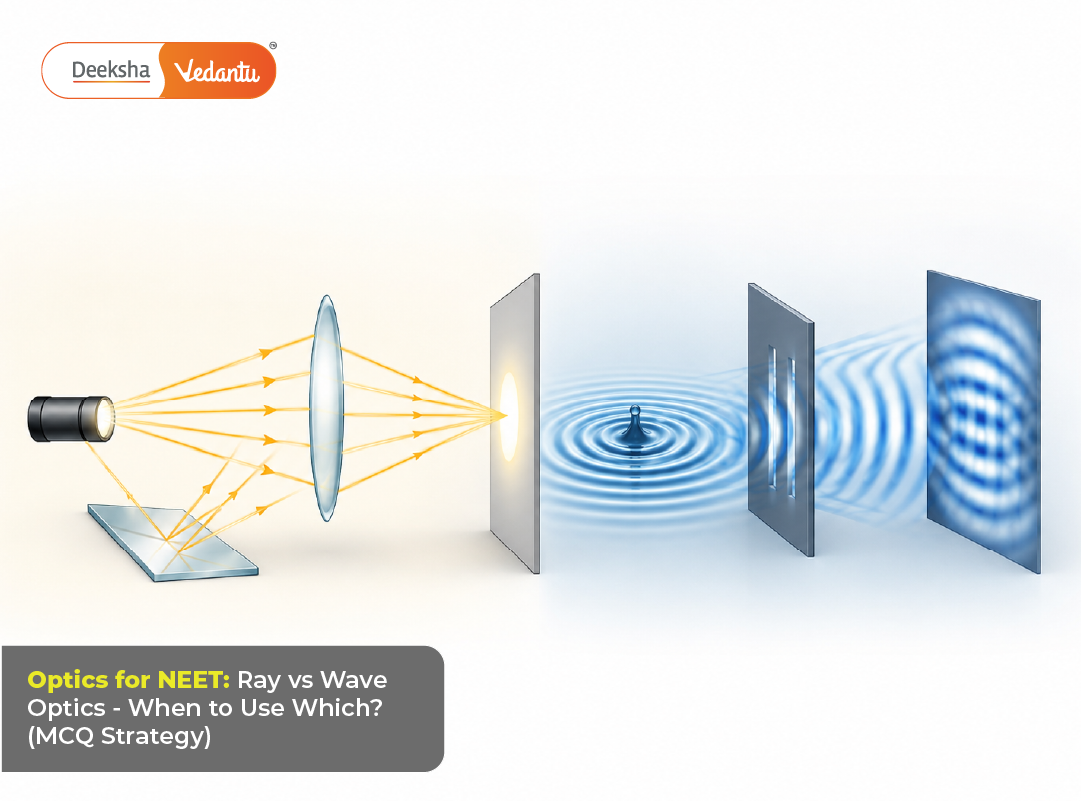


Optics is unusual among NEET Physics chapters because it isn’t really one chapter – it’s two distinct frameworks bolted together: ray optics (geometric, formula-driven) and wave optics (interference, diffraction, conceptual). Students who blend the two approaches lose marks not from ignorance but from misapplication – using a ray-optics formula where a wave-optics principle was required, or vice versa. This guide builds the decision framework NEET questions are actually testing, the same way clarity around Newton’s laws helps you classify mechanics problems correctly.
The Core Distinction You Must Internalise First
Ray optics treats light as travelling in straight lines, ignoring its wave nature. It explains reflection, refraction, image formation by mirrors and lenses, and optical instruments. Wave optics treats light as a wave, explaining phenomena that straight-line ray tracing cannot – interference, diffraction, and polarisation.
The single biggest clue in any NEET question: if the question involves an image, a mirror, a lens, magnification, or a refractive index calculation, you’re in ray optics territory. If it involves fringes, slits, coherent sources, path difference, or bending of light around obstacles, you’re in wave optics territory.
When Ray Optics Applies: The Decision Triggers
Trigger 1: Image Formation Questions
Whenever a question describes an object placed in front of a mirror or lens and asks about the image – its nature, position, size, or magnification – apply ray optics, specifically the mirror or lens formula.
Mirror formula: 1/v + 1/u = 1/f
Lens formula: 1/v – 1/u = 1/f
Magnification: m = –v/u (mirrors) or m = v/u (lenses)
NEET numerical pattern: An object is placed at a given distance from a concave mirror of known focal length – find image position and nature. This is pure ray optics; wave nature of light is irrelevant here.
Trigger 2: Refraction and Refractive Index
Snell’s Law: n₁sinθ₁ = n₂sinθ₂
Used whenever light bends while crossing a boundary between media. Total internal reflection, critical angle, and apparent depth problems all fall here.
Critical angle: sinθc = 1/n (denser to rarer medium)
This connects to real-world applications like optical fibres and mirages, often tested through application-based NEET questions. The same refraction principles appear when light passes through a glass prism, where dispersion separates white light into its component colours.
Trigger 3: Optical Instruments
Telescopes, microscopes, and the eye are all ray-optics applications, since they’re explained through image formation by combinations of lenses. A compound microscope uses two converging lenses in sequence to achieve high magnification – a structure worth revisiting if magnification numericals feel unfamiliar.
Magnifying power of a simple microscope: M = 1 + D/f
Magnifying power of a compound microscope: M = (L/f₀) × (D/fₑ) approximately, for normal adjustment
If a NEET question asks about resolving power or magnifying power of an instrument, it sits at the boundary – magnifying power calculations are ray optics, but resolving power calculations require wave optics, since resolving power depends on the wavelength of light. This boundary is a frequent source of NEET trick questions.
When Wave Optics Applies: The Decision Triggers
Trigger 1: Interference – Two Coherent Sources
Young’s Double Slit Experiment (YDSE) is the anchor topic. Two coherent sources produce a pattern of bright and dark fringes due to constructive and destructive interference.
Fringe width: β = λD/d
where λ is wavelength, D is the distance from slits to screen, and d is the slit separation.
Condition for bright fringe (constructive interference): Path difference = nλ
Condition for dark fringe (destructive interference): Path difference = (n + ½)λ
NEET numerical type: Given λ, D, and d, calculate fringe width or the position of the nth bright fringe.
Whenever a NEET question mentions “two coherent sources,” “interference pattern,” “fringe width,” or “path difference,” ray optics formulas are irrelevant – you need wave optics.
Trigger 2: Diffraction – Bending Around Obstacles
Diffraction occurs when light bends around obstacles or through narrow slits, producing a pattern with a wide central maximum and progressively weaker secondary maxima – distinct from the evenly spaced fringes of interference.
Width of central maximum in single-slit diffraction: related to 2λD/a, where a is the slit width.
NEET typically tests the qualitative distinction: interference fringes are equally spaced and equally bright; diffraction patterns have an intense central band with diminishing side bands.
Trigger 3: Polarisation
Polarisation only makes sense if light is treated as a transverse wave – this is direct proof of light’s wave nature and a guaranteed wave-optics-only topic.
Malus’s Law: I = I₀cos²θ
where θ is the angle between the polariser and analyser axes. NEET often asks for intensity after passing through a polariser at a given angle, or addresses Brewster’s angle (the angle at which reflected light is completely polarised): tanθB = n.
The Trap Zone: Questions That Seem to Overlap
NEET occasionally constructs questions that test whether you know which framework even applies. Three classic trap patterns:
Trap 1 – Resolving Power vs Magnifying Power: As mentioned, magnifying power is ray optics; resolving power formulas (like the Rayleigh criterion, involving 1.22λ/D for circular apertures) require wave optics because resolution fundamentally depends on diffraction limiting how finely two points can be distinguished.
Trap 2 – “Why does light bend at a prism?” vs “Why does light produce fringes?” Bending at a prism (dispersion, refraction) is ray optics – different wavelengths have different refractive indices, but the bending itself is still explained geometrically. Fringe formation, however, can only be explained by wave superposition. This same wavelength-dependence logic resurfaces when you study scattering of light, which explains phenomena like the blue colour of the sky.
Trap 3 – Huygens’ Principle Questions: Huygens’ Principle, which states that every point on a wavefront acts as a source of secondary wavelets, is used to derive the laws of reflection and refraction within wave theory – meaning it bridges both frameworks. NEET sometimes asks you to derive Snell’s Law using Huygens’ construction, which is technically a wave-optics method applied to a ray-optics result. Recognising this overlap prevents confusion when the question seems to mix both.
A Quick Reference Table for MCQ Triage
| Keyword in Question | Framework to Apply |
| Image, magnification, mirror/lens formula | Ray optics |
| Refractive index, critical angle, TIR | Ray optics |
| Telescope/microscope magnifying power | Ray optics |
| Fringe width, coherent sources, path difference | Wave optics |
| Diffraction pattern, single slit | Wave optics |
| Polarisation, Malus’s Law, Brewster’s angle | Wave optics |
| Resolving power (any instrument) | Wave optics |
| Huygens’ construction deriving Snell’s Law | Both (wave method, ray result) |
Solved NEET-Style Numericals
Numerical 1 – YDSE Fringe Width
In a YDSE setup, λ = 600 nm, D = 1 m, d = 1 mm. Find the fringe width.
β = λD/d = (600 × 10⁻⁹ × 1) / (1 × 10⁻³)
β = 6 × 10⁻⁴ m = 0.6 mm
Numerical 2 – Image Formation by a Concave Mirror
An object is placed 30 cm from a spherical mirror (concave) of focal length 10 cm. Find the image position.
1/v + 1/u = 1/f
Using sign convention: u = –30 cm, f = –10 cm
1/v = 1/f – 1/u = –1/10 – (–1/30) = –1/10 + 1/30 = –3/30 + 1/30 = –2/30
v = –15 cm
The image forms 15 cm in front of the mirror, real and inverted – pure ray optics, no wave consideration needed.
Numerical 3 – Malus’s Law Application
Unpolarised light passes through two polarisers with their axes at 60° to each other. If the intensity after the first polariser is I₀, find the intensity after the second.
I = I₀cos²(60°) = I₀ × (½)² = I₀/4
This is wave optics – purely about the transverse nature of light.
Practice Questions Styled After NEET
Q1. Which of the following phenomena cannot be explained using ray optics alone?
(a) Refraction (b) Reflection (c) Diffraction (d) Image formation by a lens)
Answer: (c)
Q2. The resolving power of a microscope improves with:
(a) Increasing wavelength (b) Decreasing wavelength (c) Increasing focal length (d) Decreasing aperture)
Answer: (b)
Q3. Brewster’s angle is the angle of incidence at which:
(a) Refracted ray disappears (b) Reflected light is completely polarised (c) Total internal reflection occurs (d) Light disperses)
Answer: (b)
Q4. In YDSE, if the slit separation is doubled, the fringe width:
(a) Doubles (b) Halves (c) Remains the same (d) Quadruples)
Answer: (b) – since β ∝ 1/d
Building the Right Instinct for Exam Day
The students who consistently get optics questions right under time pressure aren’t necessarily the ones who’ve memorised more formulas – they’re the ones who’ve trained themselves to classify a question correctly within the first few seconds of reading it. This classification instinct also matters in topics like refraction of light through a prism, where students often default to memorised angle formulas without checking whether the question is actually asking about dispersion, deviation, or total internal reflection.
The same logic of recognising which framework or formula a question is testing applies broadly across NEET Physics – whether you’re deciding between laws of motion and energy conservation in mechanics, or identifying whether a circuits question needs Kirchhoff’s laws versus simple series-parallel reduction, or even recalling how defects of vision connect lens optics to the human eye as an optical instrument. Optics simply makes the pattern more visible because the two frameworks are so clearly separated.
If numericals across Physics chapters are where marks are slipping in a repeat attempt, it’s rarely about formula knowledge – it’s about the speed and accuracy of recognising which formula a question is actually asking for. Deeksha’s NEET repeater course builds this recognition deliberately through mixed practice sets, rather than chapter-isolated drilling, so that by exam day the classification step becomes automatic.








Get Social