


The motion of objects flying through the air has always intrigued scientists and curious individuals. In physics, projectile motion is a key concept that explains how objects propelled into the air move, influenced mainly by gravity. This article explores the basics of projectile motion, its mathematical principles, and real-world applications.
What Is a Projectile?
A projectile is any object thrown into space, primarily influenced by gravity. Though other forces might act on it, their effect is minimal compared to gravity. The path followed by a projectile is called a trajectory. Examples of projectiles include a baseball thrown or batted.
What Is Projectile Motion?
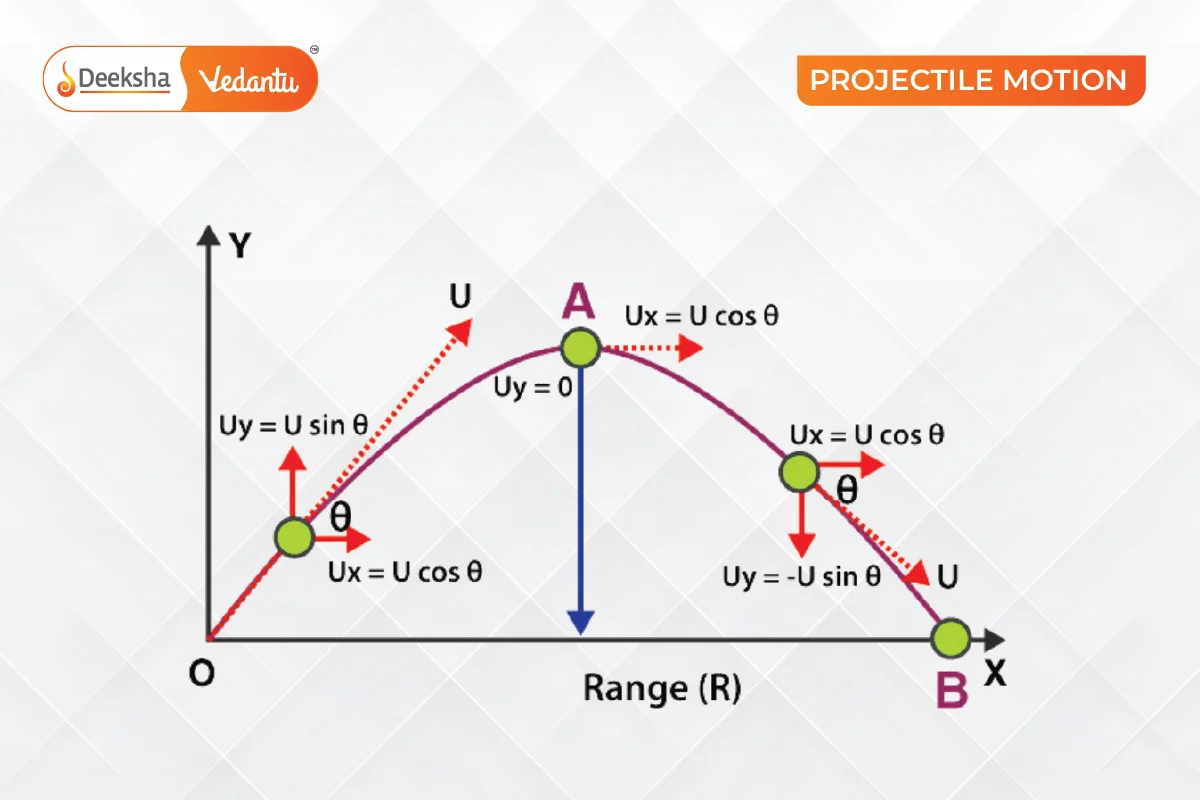
Projectile motion occurs when an object is thrown near the earth’s surface, moving along a curved path under constant acceleration directed towards the earth’s center. This motion consists of two simultaneous independent motions:
- Horizontal Motion: Uniform velocity responsible for the forward motion.
- Vertical Motion: Uniform acceleration due to gravity responsible for the downward motion.
Parabolic Motion of Projectiles
Consider a ball projected at an angle θ with an initial velocity u. The point of projection is O, and OB is the horizontal range. The total time taken for the particle to travel from O to B is the time of flight.
For different parameters related to projectile motion, we use the equations of motion:


where, u is the initial velocity, g is the acceleration due to gravity, t is the time, s is the displacement, and v is the final velocity.
Total Time of Flight
The total time of flight (T) can be found using:

Horizontal Range
The horizontal range (R) is given by:

Maximum Height of Projectile
The maximum height (H) of the projectile is given by:

Equation of Trajectory
The equation of the trajectory for projectile motion, which proves its parabolic nature, is:

Real-World Applications: Basketball Physics
Projectile motion applies to many real-world scenarios. For example, in basketball, when a player jumps and throws the ball into the basket, the ball follows a projectile motion. Similarly, throwing a cricket ball, a stone into a river, a javelin, or a football are all examples of projectile motion. In these cases, gravity is the main force acting on the object, pulling it downward and giving it an equal acceleration.


Understanding projectile motion helps predict how long a projectile will stay in the air and where it will land. Without air resistance, there would be no horizontal acceleration, making the motion purely two-dimensional near the Earth’s surface.
Summary
Projectile motion involves analyzing the independent motions in the horizontal and vertical directions under the influence of gravity. Using the equations of motion, we can calculate key parameters like time of flight, horizontal range, and maximum height. This concept finds numerous applications in sports, engineering, and everyday activities, making it an essential topic in physics.
FAQs
Projectile motion is observed in various activities like throwing a ball, launching a rocket, or shooting an arrow, where gravity influences the object’s path.
Projectile motion is influenced by the initial velocity, the angle of projection, and the acceleration due to gravity.
Projectile motion is the curved path an object follows when it is thrown near the Earth’s surface, moving under the influence of gravity alone.










Get Social