
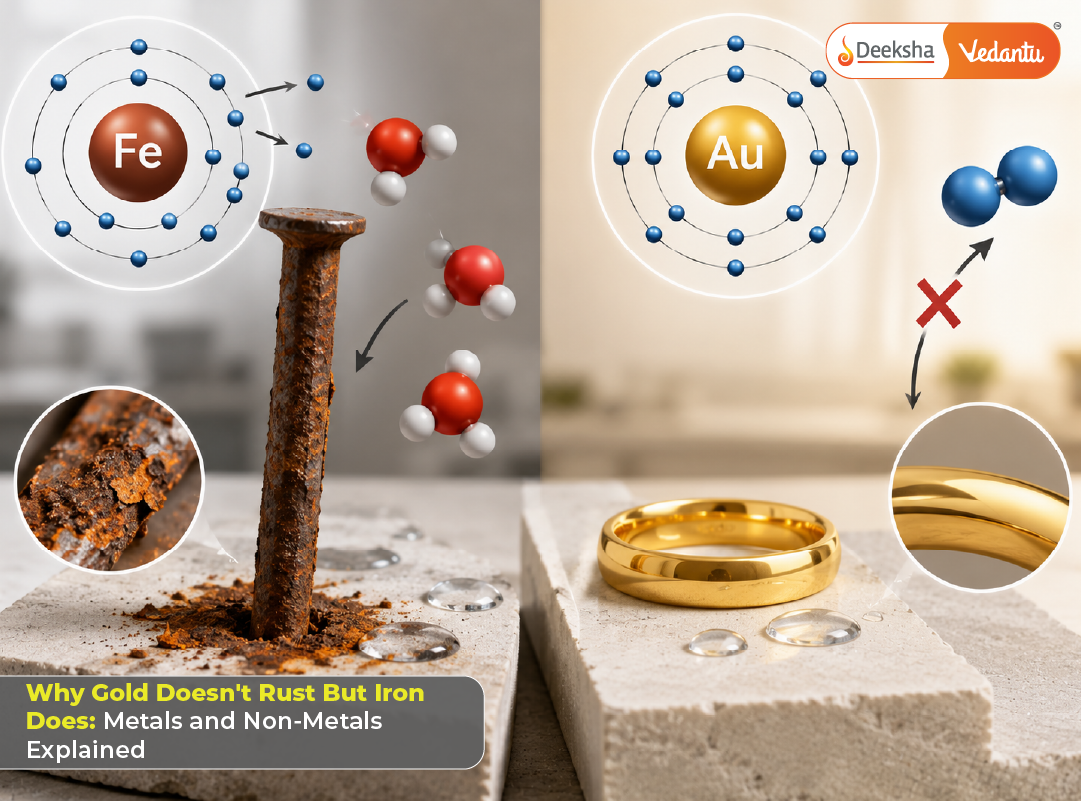


A gold ring passed down through three generations still looks exactly as bright as the day it was made. Leave an iron nail out in the rain for a few weeks, and it’s already crumbling into orange-brown flakes. Both are metals. Both sit in the same broad chapter of your Class 10 textbook. And yet one survives centuries of exposure while the other visibly deteriorates within days – a difference so extreme it’s worth actually understanding, rather than just memorizing as a fact about “reactivity.”
The Reactivity Series Isn’t a List – It’s a Ranking of How Badly Each Metal Wants to Escape
Every metal atom, in a sense, “wants” to lose electrons and become a stable, positively charged ion – this is the entire basis of what chemists call reactivity. Some metals want this so badly they’ll react with almost anything nearby to achieve it – oxygen in the air, moisture, even the mild acidity of skin contact. Other metals are, chemically speaking, far more content to stay exactly as they are, holding onto their electrons stubbornly even when given every opportunity to react.
Gold sits at the far, unreactive end of this spectrum. Its outer electrons are held so tightly, and its atomic structure is so stable, that gold essentially declines every reaction opportunity the atmosphere offers it – no reaction with oxygen, no reaction with moisture, no reaction with most acids. This is precisely why gold jewelry, gold coins, and even gold artifacts recovered from centuries-old shipwrecks are typically found gleaming, untarnished, exactly as bright as the day they were made – there was simply nothing in the surrounding environment reactive enough to disturb gold’s stubborn electron arrangement.
Iron sits considerably further up the reactivity ladder, and that difference in position is the entire explanation for rust.
What Rust Actually Is (And Why It’s Not Simply “Iron Getting Old”)
Rust isn’t iron decaying or wearing out in some vague, general sense – it’s a specific, well-defined chemical reaction. Iron reacts with oxygen and moisture in the air to form iron oxide (Fe₂O₃), the reddish-brown compound you recognize as rust:
4Fe + 3O₂ + 2H₂O (moisture) → 2Fe₂O₃ (rust, technically hydrated)
Notice this reaction requires both oxygen and moisture together – this is exactly why iron objects kept in genuinely dry conditions resist rusting far longer than identical objects exposed to humid air, and why rusting accelerates dramatically near coastlines or during monsoon season, where moisture in the air is abundant. Iron’s comparatively higher reactivity means it doesn’t take much environmental encouragement to trigger this reaction, unlike gold, which essentially refuses the same invitation under nearly any conditions.
Why Your Grandmother’s Copper Vessel Turns Green, Not Reddish-Brown
Copper occupies a middle ground on the reactivity spectrum – considerably less reactive than iron, but nowhere near as inert as gold. Left exposed to air and moisture over time, copper reacts slowly to form a greenish coating called copper carbonate – the same distinctive green patina visible on old copper vessels, temple bells, and famously, the Statue of Liberty’s entire surface.
This green coating tells you something useful chemically: copper does react with its environment, just far more slowly and mildly than iron does, producing a stable protective layer rather than iron’s crumbling, flaking rust. This is actually a meaningfully different outcome from iron’s corrosion – copper’s green coating, once formed, tends to protect the metal underneath from further reaction, while iron’s rust is porous and flaky, exposing fresh iron underneath to continue reacting, which is exactly why rust, left unchecked, eventually consumes an entire iron object rather than stopping at a thin protective layer.
The Sodium Experiment That Makes Reactivity Undeniable
If gold’s total lack of reaction feels almost too passive to notice, and iron’s rust takes weeks to become visible, sodium sits at the opposite, dramatically visible end of the reactivity series. Drop a small piece of sodium metal into water, and it reacts violently and immediately – skating across the water’s surface, hissing, sometimes catching fire from the hydrogen gas it releases, all within seconds of contact.
2Na + 2H₂O → 2NaOH + H₂↑ (+ heat, often enough to ignite the hydrogen)
This is the exact same underlying story as gold’s inertness and iron’s slow rust, just compressed into seconds instead of centuries: sodium’s outer electron is so weakly held that it reacts almost explosively with something as mild as water, while gold, at the opposite extreme, won’t react even when actively provoked. The reactivity series is really just a spectrum with sodium’s violent water reaction on one end and gold’s centuries-long indifference on the other, with iron and copper occupying predictable middle positions based on how tightly each holds onto its electrons.
Why This Matters Beyond Jewelry: Extraction and Protection
This same reactivity spectrum explains two genuinely practical things NCERT tests directly. First, it explains why gold is found in nature as a pure, free metal (native gold), while iron almost never is – gold’s total lack of reactivity means it never bonded with other elements to form compounds in the first place, while iron’s higher reactivity means it exists almost exclusively as ores (iron oxide compounds), requiring active extraction and reduction to obtain pure metal.
Second, it explains why iron objects are galvanized, painted, or oiled specifically to prevent rusting, while gold objects need no such protection at all – galvanization coats iron in a thin layer of zinc, a metal that’s actually more reactive than iron, deliberately sacrificing the zinc layer to react with oxygen and moisture first, protecting the iron underneath for as long as the zinc coating lasts. This is a direct, practical application of understanding exactly where each metal sits on the reactivity spectrum – you wouldn’t galvanize gold, because there’s nothing for the sacrificial zinc layer to protect it from in the first place.
The Reactivity Spectrum, Summarized
| Metal | Relative Reactivity | Real-World Evidence | Practical Consequence |
| Sodium | Very high | Reacts violently, even explosively, with water | Stored in oil to prevent any contact with air/moisture |
| Iron | Moderate-high | Rusts within weeks in humid air | Requires galvanizing, painting, or oiling |
| Copper | Moderate-low | Forms green patina slowly, over years | Patina itself often protects against further reaction |
| Gold | Very low | Remains untarnished across centuries | No protective treatment needed at all |
Where This Fits Into Your Broader Preparation
Once this reactivity intuition feels solid, the complete formal reactivity series – the specific ranked order NCERT expects you to know, along with how it’s experimentally determined – is covered on the chemical properties of metals and occurrence of metals pages, both of which extend directly from the gold-versus-iron story above into the full extraction and reactivity framework. The specific question of how metals and non-metals actually react with each other – not just with oxygen and water – is developed further on how do metals and non-metals react, and the broader physical property distinctions between the two categories are covered on physical properties of metals and non-metals.
For structured, board-exam-specific revision of this chapter, the CBSE Class 10 Science notes for Chapter 3: Metals and Non-Metals is the natural next stop, and testing this understanding against real exam conditions through MCQ questions on metals and non-metals will confirm how much of this reactivity intuition has translated into exam-ready recall.
Frequently Asked Questions
Does galvanizing mean the zinc coating never wears off?
No – galvanizing works precisely because zinc is sacrificial, meaning it deliberately corrodes first to protect the iron underneath; once the zinc layer is fully consumed by reacting with the environment, the iron underneath becomes vulnerable again, which is why galvanized surfaces eventually need reapplication.
If gold is so unreactive, why is pure gold jewelry rare, with most jewelry being an alloy?
This is a hardness issue rather than a reactivity one – pure gold is very soft and easily scratched or bent, so it’s typically alloyed with small amounts of other metals like copper or silver for durability, not because pure gold reacts with anything.
Why does copper’s green patina protect it, while iron’s rust doesn’t protect iron the same way?
Copper’s patina forms as a dense, adherent layer that seals the surface underneath from further exposure, while iron’s rust is porous and flakes away easily, continuously exposing fresh iron to keep reacting – a structural difference in how each corrosion product physically sits on the metal’s surface.
Gold’s untarnished shine and iron’s crumbling rust were never separate stories about two unrelated metals – they’re two points on the exact same reactivity spectrum, one holding its electrons with total stubbornness, the other giving them up almost the moment oxygen and moisture show up to ask. Once you can place any metal somewhere on that same spectrum, predicting how it’ll behave stops being memorization and starts being simple extrapolation.










Get Social