
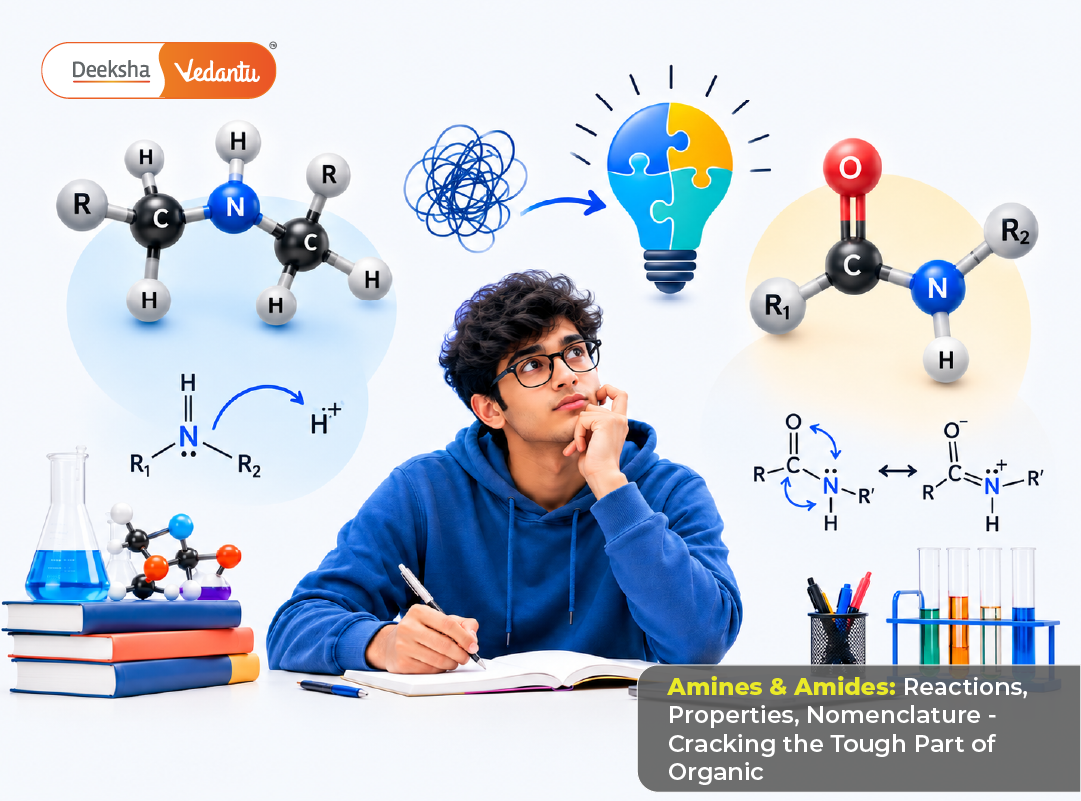


Amines and amides have a reputation among NEET aspirants as the chapter where organic chemistry stops feeling pattern-based and starts feeling arbitrary – basicity orders that seem to contradict intuition, naming conventions that shift between primary, secondary, and tertiary structures, and reactions that look superficially similar to amide chemistry but behave completely differently. The fix isn’t more memorisation; it’s understanding the one structural feature – the nitrogen’s lone pair and what’s pulling on it – that explains almost everything in this chapter.
Why Amines and Amides Confuse Students Despite Looking Similar
Both amines (R-NH₂) and amides (R-CO-NH₂) contain nitrogen bonded to carbon, and on paper they look like close relatives. But their chemical behaviour diverges sharply, and that divergence comes down to one factor: in amines, nitrogen’s lone pair is free and available; in amides, that lone pair is pulled into resonance with the adjacent carbonyl group. This single structural difference explains why amines are basic and amides are barely basic at all – a contrast NEET tests directly and often.
Classifying Amines: Primary, Secondary, Tertiary
Unlike alcohols, where the primary/secondary/tertiary classification depends on the carbon bearing the -OH group, amine classification depends on how many carbon groups are attached to nitrogen – not on the carbon skeleton itself.
Primary amine (1°): R-NH₂ (one alkyl/aryl group attached to N)
Secondary amine (2°): R₂NH (two groups attached to N)
Tertiary amine (3°): R₃N (three groups attached to N)
NEET frequently tests this through a structure-given, classify-the-amine question – and the most common student error is applying the alcohol-style classification logic (counting carbons on the attached carbon) instead of counting groups on nitrogen directly. This naming logic is closely related to the broader nomenclature of organic compounds rules, which establish the IUPAC conventions amines extend with the “-amine” suffix or “amino-” prefix depending on the parent structure.
Basicity of Amines: The Order That Seems to Contradict Itself
This is the single most-tested concept in the chapter, and the order NEET expects in the gas phase versus aqueous phase genuinely differs – which is exactly why it confuses students who memorise only one version.
In the gas phase (isolated molecules, no solvent effects): Tertiary > Secondary > Primary > NH₃
This follows simple inductive reasoning – more alkyl groups donate more electron density to nitrogen, increasing its availability to accept a proton.
In aqueous solution (the order NEET typically tests): Secondary > Primary > Tertiary > NH₃ (for simple alkyl amines like methylamine, dimethylamine, trimethylamine)
The reversal happens because of steric hindrance and solvation effects. A tertiary amine’s three bulky groups make it harder for water molecules to solvate and stabilise the resulting ammonium cation after protonation, partially cancelling out the inductive electron-donating advantage. Secondary amines hit a sweet spot – enough alkyl groups for inductive donation, but not so many that solvation is severely hindered.
For aromatic amines, the order reverses again: Aniline is far less basic than ammonia, because the nitrogen’s lone pair delocalises into the benzene ring through resonance, making it less available to accept a proton. This resonance-based reduction in basicity is the aromatic-amine equivalent of the haloarene resonance effect, and NEET often pairs the two as related “why is X less reactive/basic than expected” conceptual questions.
| Amine Type | Relative Basicity | Reason |
| Aliphatic secondary (aqueous) | Highest | Balanced inductive effect and solvation |
| Aliphatic primary (aqueous) | Moderate | Less inductive donation than secondary |
| Aliphatic tertiary (aqueous) | Lower than expected | Steric hindrance limits solvation |
| Aromatic (e.g., aniline) | Lowest | Lone pair delocalised into ring |
Key Reactions of Amines NEET Tests Repeatedly
Reaction with Nitrous Acid (HNO₂)
Primary aliphatic amines react with HNO₂ to release nitrogen gas and form an alcohol – a reaction used to distinguish primary amines from secondary and tertiary ones, since secondary amines form N-nitrosamines (yellow oily liquid) and tertiary amines generally don’t react under these mild conditions in the same way.
Carbylamine Reaction (Isocyanide Test)
Primary amines react with chloroform and alcoholic KOH to form an isocyanide with a distinctive foul smell – a classic NEET identification test for primary amines specifically, since secondary and tertiary amines give a negative result.
Acylation
Amines react with acid chlorides or anhydrides to form amides – this is the direct structural bridge between the two halves of this chapter, since the product of an amine reaction is often the amide discussed in the second half.
Diazotization
Primary aromatic amines react with nitrous acid at low temperature (0-5°C) to form diazonium salts, which are important intermediates in synthesising azo dyes and other aromatic compounds. The low-temperature condition is essential because diazonium salts are unstable and decompose readily at higher temperatures – a detail NEET sometimes tests as a reaction-condition question.
Amides: Why the Lone Pair Story Changes Everything
In an amide (R-CO-NH₂), nitrogen’s lone pair is delocalised into the carbonyl group through resonance, creating a partial double-bond character between nitrogen and the carbonyl carbon. This resonance is why amide nitrogen is far less basic than amine nitrogen – the lone pair simply isn’t as available to accept a proton.
This same resonance also explains amides’ relatively high melting points (compared to similarly sized amines) and their restricted rotation around the C-N bond, a structural feature significant in biological molecules like proteins, where the peptide bond is essentially an amide linkage.
Hydrolysis of Amides
Amides hydrolyse under acidic or basic conditions to regenerate the carboxylic acid (or its salt) and the amine:
R-CO-NH₂ + H₂O → R-COOH + NH₃ (acidic hydrolysis, simplified)
This reaction is the reverse of the acylation reaction mentioned earlier, closing the conceptual loop between amines and amides – they convert into each other through opposite reaction directions.
Hoffmann Bromamide Degradation
Amides react with bromine and concentrated KOH to produce a primary amine with one carbon fewer than the starting amide – a name-reaction NEET tests directly, often as a one-line identification question given the starting amide structure.
Solved NEET-Style Question: Identifying Amine Type by Reaction
A compound reacts with chloroform and alcoholic KOH to give a foul-smelling product. What type of amine is it, and what is the product called?
This is the carbylamine reaction, given only by primary amines. The product is an isocyanide (R-NC).
Practice Questions Styled After NEET
Q1. Among methylamine, dimethylamine, and trimethylamine in aqueous solution, the most basic is:
(a) Methylamine (b) Dimethylamine (c) Trimethylamine (d) All equally basic)
Answer: (b)
Q2. Aniline is less basic than ammonia because:
(a) Aniline has fewer hydrogens (b) The lone pair on nitrogen delocalises into the benzene ring (c) Aniline is aromatic (d) Ammonia has a smaller molecular size)
Answer: (b)
Q3. The carbylamine reaction is a positive test specifically for:
(a) Secondary amines (b) Tertiary amines (c) Primary amines (d) Amides)
Answer: (c)
Q4. Amide nitrogen is less basic than amine nitrogen because:
(a) Amides have no nitrogen lone pair (b) The lone pair is delocalised into the carbonyl group (c) Amides are acidic (d) Amide nitrogen has extra hydrogens)
Answer: (b)
The One Idea That Makes This Chapter Click
Nearly every confusing result in this chapter – basicity order reversals, why amides barely act as bases, why aniline behaves differently from aliphatic amines – comes back to a single question: how available is nitrogen’s lone pair, and what’s competing for it (resonance, steric hindrance, solvation)? Once that question becomes the default lens, this chapter shifts from feeling arbitrary to feeling genuinely predictable. The same “what’s competing for the lone pair or electron density” reasoning is useful while revisiting organic chemistry general introduction concepts like inductive and resonance effects, and pairs naturally with the mechanism-first thinking required for isomerism questions involving nitrogen-containing compounds.
For repeaters, amines and amides are frequently flagged as “hard” purely because the basicity order feels memorised rather than understood – which means it’s also one of the first concepts to be forgotten under exam pressure. Deeksha’s NEET repeater course addresses this by anchoring nitrogen chemistry revision around the lone-pair-availability framework, so the reasoning holds up even when a question is phrased in an unfamiliar way.








Get Social