
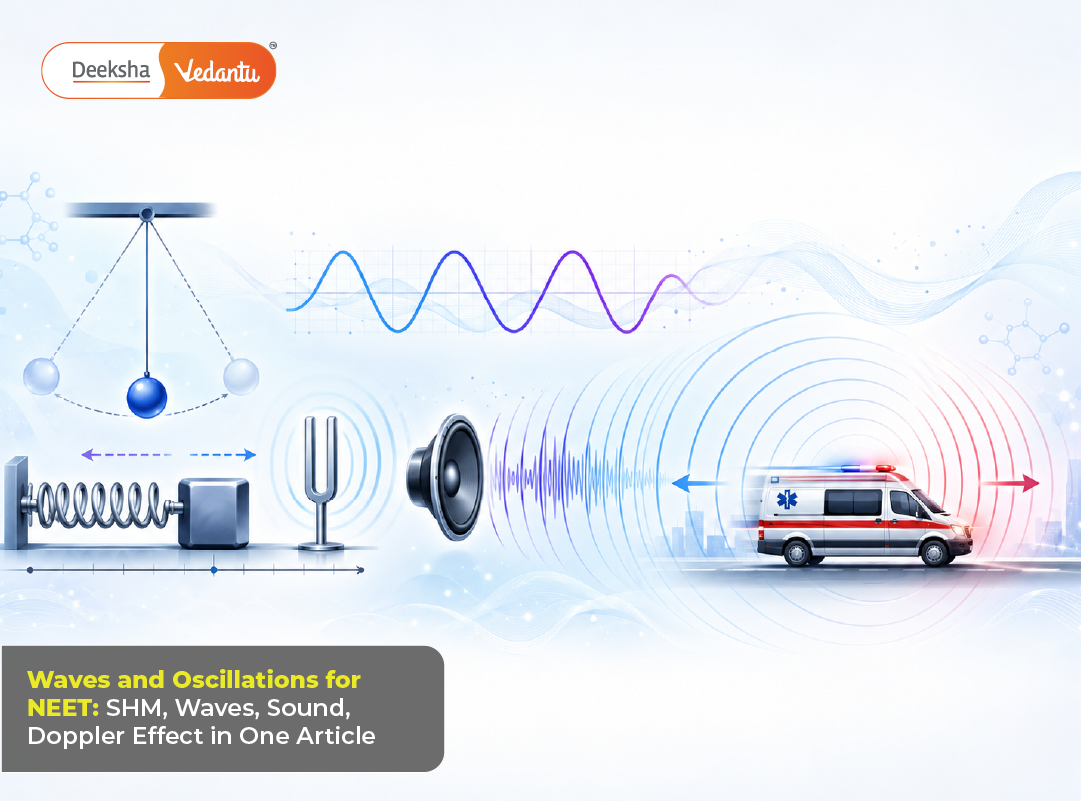


Waves and oscillations is a chapter NEET aspirants often study in fragments – SHM one week, sound waves another, Doppler effect as an afterthought – without realising these are one continuous story. A vibrating particle (SHM) creates a disturbance that travels (a wave); when that wave is a sound wave, it behaves according to specific rules; and when the source or observer moves, those rules shift (Doppler effect). This guide ties the chapter together the way NEET actually examines it.
Simple Harmonic Motion: The Starting Point for Everything
SHM is periodic motion where the restoring force is directly proportional to displacement and directed opposite to it: F = -kx. This single condition generates every other SHM equation NEET tests.
Displacement: x = A sin(ωt + φ)
Velocity: v = Aω cos(ωt + φ), maximum at mean position
Acceleration: a = -Aω²sin(ωt + φ) = -ω²x, maximum at extreme positions
Time period: T = 2π√(m/k) for a spring-mass system, or T = 2π√(L/g) for a simple pendulum
NEET frequently tests the phase relationships: velocity leads displacement by π/2, and acceleration is exactly out of phase with displacement (180°). A worked derivation of these relationships and graphical representations is available in the dedicated simple harmonic motion chapter, which also covers energy conservation in SHM in more depth than NEET typically requires.
Energy in SHM
Total energy: E = ½kA² (constant throughout motion)
Kinetic energy: KE = ½mω²(A² – x²)
Potential energy: PE = ½mω²x²
At the mean position, KE is maximum and PE is zero; at extreme positions, the reverse is true. NEET often gives a fraction of amplitude and asks for the KE-PE split – a quick substitution once the formulas are internalised.
From Oscillation to Wave: What Actually “Travels”
A wave is a disturbance that transfers energy through a medium without transferring matter. Mechanical waves require a medium; electromagnetic waves do not – a distinction that connects to the broader electromagnetic spectrum, which categorises waves by frequency rather than by medium dependence.
Transverse waves – particle displacement is perpendicular to wave propagation (e.g., light waves, waves on a string).
Longitudinal waves – particle displacement is parallel to wave propagation (e.g., sound waves).
Wave equation: y = A sin(ωt – kx), where k = 2π/λ is the wave number.
Wave speed: v = νλ = ω/k
This relationship – frequency times wavelength equals speed – is the single most numerically tested wave formula in NEET, often disguised inside sound or string-vibration problems.
Sound Waves: Mechanical, Longitudinal, and Medium-Dependent
Sound travels as a longitudinal pressure wave, and its speed depends entirely on the medium’s properties, not on the source.
Speed of sound in a medium: v = √(B/ρ) for solids and liquids (B = bulk modulus), or v = √(γP/ρ) for gases (Laplace’s correction to Newton’s formula, accounting for adiabatic rather than isothermal compression).
Effect of temperature on speed in air: v ∝ √T (in Kelvin) – this is why sound travels faster in warmer air, a relationship NEET sometimes tests as a ratio problem (find the percentage change in speed for a given temperature change).
Standing Waves and Resonance
When a wave reflects and superimposes on itself, it forms a standing wave with fixed nodes (zero displacement) and antinodes (maximum displacement).
Closed pipe (one end closed): Supports only odd harmonics. Fundamental frequency: ν = v/4L
Open pipe (both ends open): Supports all harmonics. Fundamental frequency: ν = v/2L
NEET frequently asks you to identify the harmonic series or compare fundamental frequencies between open and closed pipes of equal length – the closed pipe’s fundamental is always half that of an equivalent open pipe.
Beats: Interference in Time
When two sound waves of slightly different frequencies superimpose, the resulting amplitude fluctuates periodically, producing beats.
Beat frequency: fbeat = |f₁ – f₂|
NEET’s standard beat-frequency question gives two source frequencies (or a tuning fork and an unknown source) and asks for the number of beats heard per second – direct subtraction once you correctly identify f₁ and f₂.
The Doppler Effect: When Source or Observer Moves
The Doppler effect describes the apparent change in frequency of a wave due to relative motion between source and observer. NEET tests four distinct scenarios, and choosing the correct sign in each is where most students lose marks.
General formula: f’ = f × (v ± v₀)/(v ± vs)
where v is the speed of sound, v₀ is observer speed, and vs is source speed.
Sign convention rule: Use + in the numerator when the observer moves toward the source, – when moving away. Use – in the denominator when the source moves toward the observer, + when moving away. (Motion toward = frequency increases; motion away = frequency decreases – this directional logic is the fastest way to self-check sign choices under exam pressure.)
| Scenario | Effect on Frequency |
| Source moves toward stationary observer | Frequency increases |
| Source moves away from stationary observer | Frequency decreases |
| Observer moves toward stationary source | Frequency increases |
| Observer moves away from stationary source | Frequency decreases |
| Both move toward each other | Frequency increases (combined effect) |
NEET occasionally extends this to light waves (redshift/blueshift in astronomy), where the same directional logic applies even though the underlying formula changes slightly for electromagnetic waves – a connection worth remembering if a question references the expanding universe or spectral shift.
Solved NEET-Style Numericals
Numerical 1 – SHM Energy Split
A particle in SHM has amplitude A. At what displacement is KE equal to PE?
KE = PE
½mω²(A² – x²) = ½mω²x²
A² – x² = x²
A² = 2x²
x = A/√2
Numerical 2 – Doppler Effect, Source Approaching
A train moving at 30 m/s sounds a whistle of frequency 500 Hz, approaching a stationary observer. Speed of sound = 330 m/s. Find the frequency heard.
f’ = f × v/(v – vs) = 500 × 330/(330 – 30) = 500 × 330/300 = 550 Hz
Numerical 3 – Beat Frequency
Two tuning forks of frequencies 256 Hz and 260 Hz are sounded together. Find the beat frequency.
fbeat = |260 – 256| = 4 beats per second
Practice Questions Styled After NEET
Q1. In SHM, the acceleration is maximum at:
(a) Mean position (b) Extreme position (c) Midway between mean and extreme (d) Constant throughout)
Answer: (b)
Q2. The fundamental frequency of a closed organ pipe compared to an open pipe of the same length is:
(a) Same (b) Double (c) Half (d) One-fourth)
Answer: (c)
Q3. Speed of sound in air increases with:
(a) Increasing pressure (b) Increasing temperature (c) Increasing humidity decrease (d) Decreasing temperature)
Answer: (b)
Q4. When a source of sound moves away from a stationary observer, the observed frequency:
(a) Increases (b) Decreases (c) Remains the same (d) Becomes zero)
Answer: (b)
Q5. Beats are produced due to:
(a) Diffraction (b) Interference in time (c) Polarisation (d) Reflection)
Answer: (b)
Treating This Chapter as One Continuous Thread
The biggest scoring gain in waves and oscillations comes from recognising that SHM, wave motion, sound, and Doppler effect are not four separate mini-chapters – they are one cause-and-effect chain. A vibrating source (SHM) creates a wave; that wave, if it’s sound, follows medium-dependent speed rules; and if the source or observer moves, the Doppler effect modifies what’s heard. NEET’s harder questions are usually the ones that combine two of these ideas in a single scenario, similar to how electric potential and potential difference concepts often get folded into capacitor numericals rather than tested in isolation.
For students preparing for a second NEET attempt, this chapter is frequently under-revised because it feels “done” after the first read-through – but the sign-convention traps in Doppler effect and the harmonic-series traps in standing waves are exactly the kind of detail that separates a 320 from a 350 in Physics. Deeksha’s NEET repeater course treats these high-frequency trap areas as dedicated drilling points rather than assuming familiarity equals mastery.








Get Social