
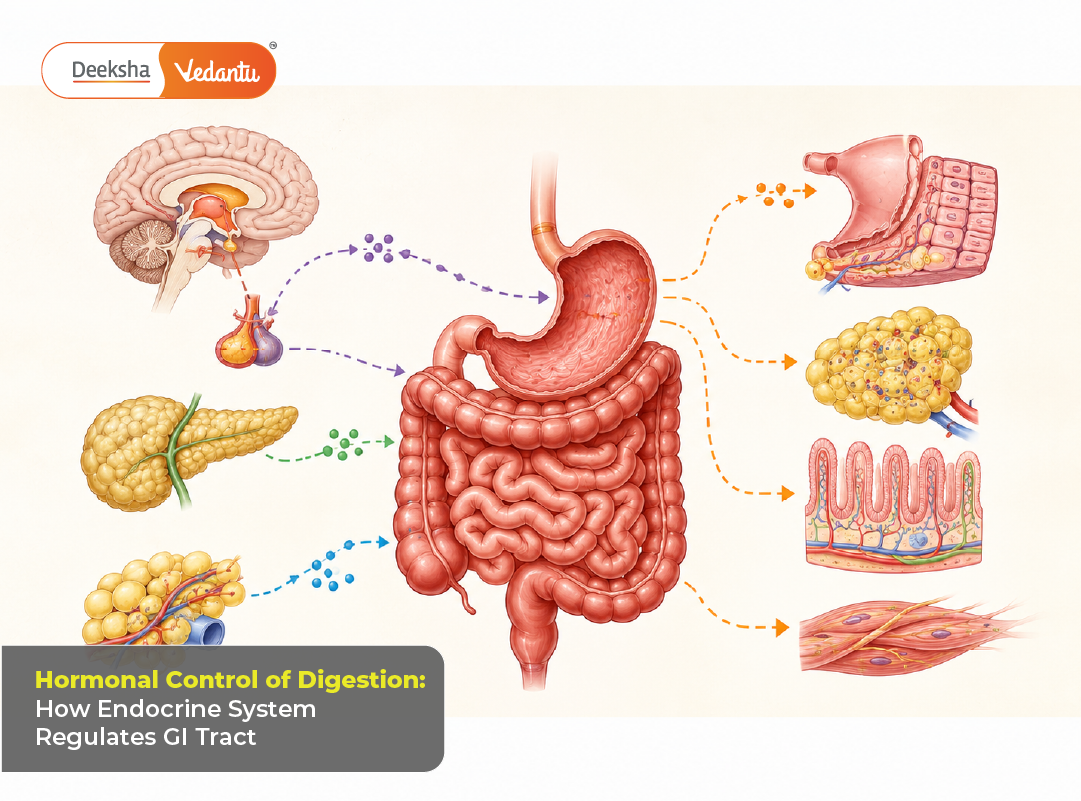


When NEET students revise digestion, they tend to focus almost entirely on enzymes – pepsin, trypsin, amylase – and treat the process as a purely mechanical and enzymatic pipeline. What gets consistently underweighted is that digestion is also a hormonally regulated process, with specific GI hormones timing exactly when acid is released, when the pancreas secretes, and when bile gets squeezed into the duodenum. NEET tests this hormonal layer directly, and it’s frequently the part students haven’t revised as carefully as the enzyme list.
Why Digestion Needs Hormonal Coordination at All
Purely reflex-driven digestion would be clumsy – the stomach can’t “know” food has arrived in the duodenum unless something tells it. GI hormones solve this coordination problem: they’re secreted by specialised cells embedded in the stomach and intestinal lining, travel through the bloodstream (making them true endocrine hormones, not local signals), and trigger specific responses in distant digestive organs. This is the same chemical-messenger logic covered more broadly in chemical coordination and integration, just applied specifically to the gut.
Gastrin: The Stomach’s Self-Regulating Signal
Source: G-cells in the stomach’s pyloric region
Trigger for release: Presence of food in the stomach, particularly partially digested proteins, along with vagal nerve stimulation
Target: Parietal cells in the stomach lining
Effect: Stimulates HCl secretion, increasing gastric acidity
Gastrin’s role connects directly to the acid-activation step covered in the human digestive system – it’s the hormonal trigger behind the strongly acidic environment (pH 1.5-2.5) that converts pepsinogen into active pepsin. NEET frequently tests gastrin through a stimulus-response question: what causes gastrin release, and what does increased gastrin ultimately cause downstream (more HCl, more pepsin activation).
A key conceptual trap: gastrin release is suppressed once stomach pH drops sufficiently low – a negative feedback loop preventing excessive acid secretion. This self-limiting mechanism is a frequently tested one-liner, since it demonstrates that even a single hormone’s regulation isn’t a simple on-switch.
Secretin: The First Hormone Ever Discovered
Source: S-cells in the duodenal mucosa
Trigger for release: Acidic chyme entering the duodenum from the stomach
Target: Pancreas (and liver)
Effect: Stimulates secretion of bicarbonate-rich pancreatic juice
Secretin holds a notable place in physiology history – it was the first hormone ever identified (by Bayliss and Starling in 1902), and its discovery essentially created the field of endocrinology as a distinct branch of physiology. NEET occasionally references this historical detail as a one-line fact.
Functionally, secretin is the direct hormonal counterpart to the pH-reversal point described in digestive system chapters – it’s the signal that triggers the pancreas to release the bicarbonate that neutralises stomach acid as it enters the duodenum, creating the alkaline environment pancreatic enzymes need to function. Without secretin’s timing, the duodenum would remain dangerously acidic for longer than necessary, and pancreatic enzymes like trypsin and pancreatic amylase would be released into an environment where they can’t function.
Cholecystokinin (CCK): The Fat and Protein Detector
Source: I-cells in the duodenal and jejunal mucosa
Trigger for release: Presence of fatty acids and amino acids (partially digested fats and proteins) in the duodenum
Target: Gallbladder and pancreas
Effect: Stimulates gallbladder contraction (releasing bile) and pancreatic enzyme secretion (especially lipase)
CCK is the hormone responsible for the well-known physiological link between eating a fatty meal and feeling a contraction-like sensation as bile gets released – it directly triggers the bile-release mechanism described in digestive system physiology, ensuring fat emulsification happens precisely when fat is present to be emulsified.
NEET sometimes tests CCK alongside secretin as a comparison question, since both originate in the duodenum and both target the pancreas, but respond to different triggers (acidity for secretin, fats/proteins for CCK) and produce different specific outputs (bicarbonate-rich fluid vs enzyme-rich fluid with bile release).
| Hormone | Source | Trigger | Main Target | Main Effect |
| Gastrin | Stomach (G-cells) | Food/protein in stomach | Parietal cells | ↑ HCl secretion |
| Secretin | Duodenum (S-cells) | Acidic chyme | Pancreas | ↑ Bicarbonate secretion |
| CCK | Duodenum (I-cells) | Fats/proteins in duodenum | Gallbladder, pancreas | Bile release, ↑ enzyme secretion |
This table is essentially the single most NEET-relevant summary in this entire topic – questions frequently give a trigger or an effect and ask you to identify the correct hormone.
The Phases of Gastric Secretion: Where Hormones Fit the Timeline
NEET sometimes frames hormonal digestion questions within the three classical phases of gastric secretion, and recognising which phase a hormone belongs to helps organise the sequence.
Cephalic phase – triggered by the sight, smell, or thought of food, mediated by neural signals (via the vagus nerve) before food even reaches the stomach. This phase is primarily neural, not hormonal, but it does stimulate some early gastrin release.
Gastric phase – begins once food physically enters the stomach, and this is where gastrin’s role is most dominant, directly stimulating acid secretion in response to stomach distension and protein content.
Intestinal phase – begins once chyme enters the duodenum, and this is where secretin and CCK take over, regulating pancreatic and gallbladder output in response to the chyme’s acidity and composition.
This phase-based framing helps resolve a common NEET confusion: gastrin dominates the gastric phase, while secretin and CCK dominate the intestinal phase – they aren’t competing signals but sequential ones, each responding to where the food currently is in the digestive tract.
Negative Feedback Across the GI Hormonal System
Just as the broader endocrine system relies on feedback loops (as seen in hormones in animals more generally), GI hormones operate on similar self-limiting logic. As chyme is neutralised and emptied from the duodenum, the stimuli for secretin and CCK release diminish, naturally reducing their secretion. This prevents continuous, unnecessary pancreatic and biliary output once digestion in that segment is essentially complete – a built-in efficiency mechanism NEET occasionally tests conceptually.
Solved NEET-Style Conceptual Question
A patient has chronically low secretin levels. Predict the most likely downstream digestive consequence.
Reduced secretin means reduced bicarbonate secretion from the pancreas, leaving duodenal chyme insufficiently neutralised. Since pancreatic enzymes like trypsin and lipase require an alkaline environment to function, digestion of proteins and fats in the small intestine would be impaired, even if the enzymes themselves are present in normal amounts – a useful illustration of why hormonal timing matters just as much as enzyme availability.
Practice Questions Styled After NEET
Q1. Which hormone is responsible for stimulating bicarbonate-rich pancreatic secretion?
(a) Gastrin (b) Secretin (c) CCK (d) Insulin)
Answer: (b)
Q2. Cholecystokinin is primarily released in response to:
(a) Acidic chyme (b) Fats and proteins in the duodenum (c) Food in the mouth (d) Low blood glucose)
Answer: (b)
Q3. Gastrin is secreted by which cells?
(a) S-cells (b) I-cells (c) G-cells (d) Beta cells)
Answer: (c)
Q4. The cephalic phase of gastric secretion is primarily mediated by:
(a) Secretin (b) Gastrin only (c) Neural signals via the vagus nerve (d) CCK)
Answer: (c)
Q5. Which hormone was historically the first to be discovered, establishing the field of endocrinology?
(a) Insulin (b) Gastrin (c) Secretin (d) CCK)
Answer: (c)
Why This Hormonal Layer Deserves Dedicated Revision Time
Most students lose marks on this topic not because the hormones are individually complex, but because the chapter is split across two different study sessions – digestion and endocrinology – and the connecting thread never gets revised explicitly. Treating GI hormones as a deliberate bridge between these two units, rather than a footnote in either one, is what converts a vague “I think gastrin does something with acid” into the precise trigger-target-effect recall NEET actually rewards.
For students preparing for a second NEET attempt, hormonal-digestive integration is exactly the kind of cross-chapter detail that’s easy to skip during a first read-through and easy to lose marks on later. Deeksha’s NEET repeater course builds physiology revision around exactly these connecting threads, ensuring that hormone-organ relationships across different chapters are drilled together rather than left as isolated facts to be recalled separately under exam pressure.











Get Social