
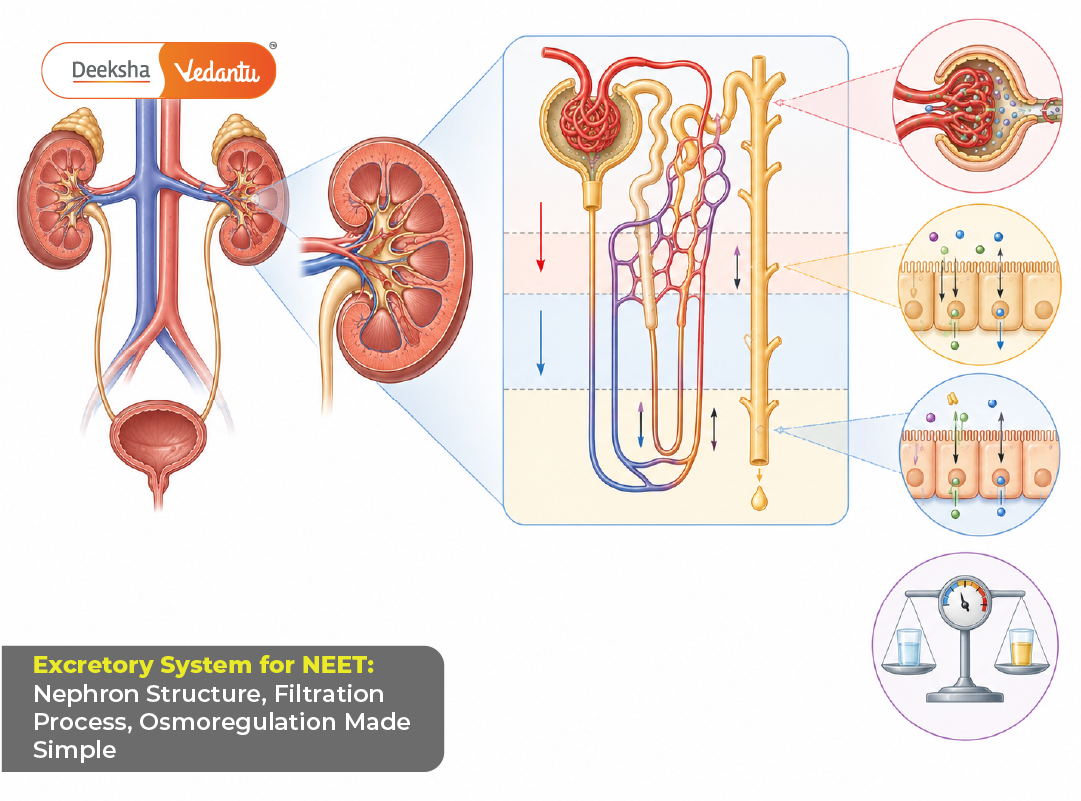


The excretory system is a chapter where NEET rewards precision in a very specific way – it tests the sequence of urine formation, the exact location of each transport event along the nephron, and the hormonal feedback loops that fine-tune water balance. Students who know “the kidney filters blood” in general terms but can’t trace what happens in the proximal tubule versus the loop of Henle versus the collecting duct consistently lose marks here. This guide walks through the nephron step by step, the way NEET actually examines it.
Why the Nephron Is the Real Exam Target
NEET rarely asks about the kidney as a whole organ – it asks about the nephron, the functional unit of the kidney, with around 1–1.5 million nephrons per kidney. Nearly every question in this chapter traces back to nephron anatomy, so building a clear mental map of its regions is the single highest-leverage thing you can do before attempting NEET-level questions.
Nephron Structure: Region by Region
A nephron consists of two main parts: the Malpighian (renal) corpuscle and the renal tubule.
Malpighian Corpuscle
Glomerulus – a tuft of capillaries formed by the afferent arteriole, where blood filtration begins. The afferent arteriole has a wider diameter than the efferent arteriole – this diameter difference creates the elevated hydrostatic pressure needed for filtration. NEET tests this diameter relationship directly and often as an assertion-reason question.
Bowman’s capsule – a double-walled cup surrounding the glomerulus, collecting the filtrate. Its inner wall is made of specialised cells called podocytes, which have foot-like processes (pedicels) creating filtration slits.
Renal Tubule
| Region | Key Function |
| Proximal Convoluted Tubule (PCT) | Reabsorbs ~70-80% of filtrate: glucose, amino acids, Na⁺, water |
| Loop of Henle (descending) | Permeable to water; impermeable to salt |
| Loop of Henle (ascending) | Impermeable to water; actively transports salt out |
| Distal Convoluted Tubule (DCT) | Reabsorbs Na⁺ (under aldosterone); secretes K⁺, H⁺ |
| Collecting Duct | Final water reabsorption (under ADH control); concentrates urine |
This table is essentially a map of every “where does X happen” question NEET can ask.
The Three-Step Process of Urine Formation
NEET structures this chapter around three sequential processes, and questions frequently ask you to identify which step a given event belongs to.
Step 1: Glomerular Filtration
Blood pressure forces water and small solutes (glucose, amino acids, salts, urea) out of the glomerular capillaries into Bowman’s capsule, forming the glomerular filtrate. Blood cells and large proteins are too big to pass through and remain in the blood.
Glomerular Filtration Rate (GFR) is the volume of filtrate formed per minute by both kidneys – normally 120–125 mL/minute, or roughly 180 litres per day. This number is one of NEET’s most frequently tested numericals, often paired with the fact that only about 1–1.5 litres of actual urine is produced daily – meaning over 99% of the filtrate is reabsorbed.
Filtration is regulated by the juxtaglomerular apparatus (JGA), a specialised sensory region near the afferent arteriole. When GFR falls, the JGA triggers the renin-angiotensin mechanism: renin converts angiotensinogen to angiotensin I, which is converted to angiotensin II (a powerful vasoconstrictor that also stimulates aldosterone release). This feedback loop is a guaranteed source of NEET questions and connects directly to blood pressure regulation covered in the circulatory system chapter.
Step 2: Reabsorption
Most of the useful filtrate is reabsorbed back into the blood through the peritubular capillaries surrounding the tubule. Reabsorption happens through both active transport (glucose, amino acids, Na⁺) and passive transport (water, urea, some ions).
Glucose and amino acids are 100% reabsorbed in the PCT under normal conditions – their presence in urine (glucosuria) signals that blood glucose levels exceeded the kidney’s reabsorption threshold, a hallmark of uncontrolled diabetes mellitus. NEET often frames this as a clinical-application question.
Step 3: Tubular Secretion
The final step adjusts the filtrate’s composition by actively secreting substances like H⁺, K⁺, and ammonia from the blood into the tubule, helping regulate blood pH and electrolyte balance. This step is what gives the kidney its role in maintaining acid-base homeostasis, working alongside the respiratory system’s buffering mechanisms.
The Loop of Henle: NEET’s Favourite Counter-Current Mechanism
The loop of Henle is where NEET tests conceptual depth rather than rote recall. Its function depends on a counter-current mechanism between the descending and ascending limbs, working alongside the surrounding vasa recta.
The descending limb is permeable to water but not to salt, so water moves out into the surrounding medullary interstitium, concentrating the filtrate as it descends. The ascending limb is impermeable to water but actively pumps Na⁺ and Cl⁻ out into the interstitium, diluting the filtrate as it ascends.
This creates an osmotic gradient in the medulla – increasingly concentrated from the cortex toward the inner medulla. This gradient is what allows the collecting duct, later, to reabsorb water efficiently and produce concentrated urine. Animals with longer loops of Henle (like desert rodents) can produce far more concentrated urine – a structure-function relationship NEET has tested in the context of animal adaptation to water scarcity.
Osmoregulation: The Hormonal Control System
Osmoregulation is the process of maintaining a stable internal water-salt balance, and NEET tests it primarily through two hormones.
Antidiuretic Hormone (ADH/Vasopressin)
Released by the posterior pituitary (synthesised in the hypothalamus), ADH increases the permeability of the collecting duct to water, allowing more water to be reabsorbed and producing concentrated urine.
When blood becomes too concentrated (high osmolarity) – detected by osmoreceptors in the hypothalamus – ADH secretion increases, water reabsorption increases, and urine becomes concentrated and reduced in volume.
When you drink excess water – blood osmolarity drops, ADH secretion is suppressed, less water is reabsorbed, and a large volume of dilute urine is produced.
This negative feedback loop is a near-certain NEET question, often presented as a scenario (“a person is dehydrated – what happens to ADH levels and urine concentration?”).
Aldosterone
Released by the adrenal cortex, aldosterone acts on the DCT to increase Na⁺ reabsorption (and consequently water, since water follows sodium osmotically) while promoting K⁺ secretion. It is triggered by the renin-angiotensin pathway when blood Na⁺ or blood pressure drops.
| Hormone | Source | Target | Effect |
| ADH | Posterior pituitary | Collecting duct | ↑ Water reabsorption |
| Aldosterone | Adrenal cortex | DCT | ↑ Na⁺ reabsorption |
Practice Questions Styled After NEET
Q1. The structure responsible for creating high pressure for filtration in the glomerulus is:
(a) Wider efferent arteriole (b) Wider afferent arteriole (c) Equal diameter arterioles (d) Bowman’s capsule)
Answer: (b)
Q2. Glucose is reabsorbed almost completely in which part of the nephron?
(a) Loop of Henle (b) DCT (c) PCT (d) Collecting duct)
Answer: (c)
Q3. ADH increases water permeability primarily at the:
(a) PCT (b) Glomerulus (c) Collecting duct (d) Bowman’s capsule)
Answer: (c)
Q4. The average glomerular filtration rate (GFR) in a healthy adult is approximately:
(a) 1.5 L/day (b) 180 L/day (c) 18 L/day (d) 1800 L/day)
Answer: (b)
Q5. Aldosterone primarily promotes reabsorption of:
(a) Glucose (b) Na⁺ (c) Urea (d) K⁺)
Answer: (b)
Linking the Excretory System to the Rest of NEET Biology
The excretory system rarely appears in isolation on the NEET paper. The renin-angiotensin pathway connects directly to blood pressure regulation in the circulatory system, while acid-base balance ties back to gas exchange in the respiratory system. Hormonal control by ADH and aldosterone overlaps with endocrine concepts tested alongside plant and animal hormone chapters, and active transport mechanisms in the PCT mirror the same membrane transport logic covered under cell organelles and the plasma membrane.
For repeaters, this chapter is often where the gap between “recognising terms” and “tracing a mechanism” becomes most visible – NEET’s scenario-based questions on dehydration, diabetes, or kidney function demand exactly that tracing ability. Deeksha’s NEET repeater course builds this kind of mechanism-first revision into its Biology modules, so chapters like this one move from familiar to fully exam-ready.








Get Social