
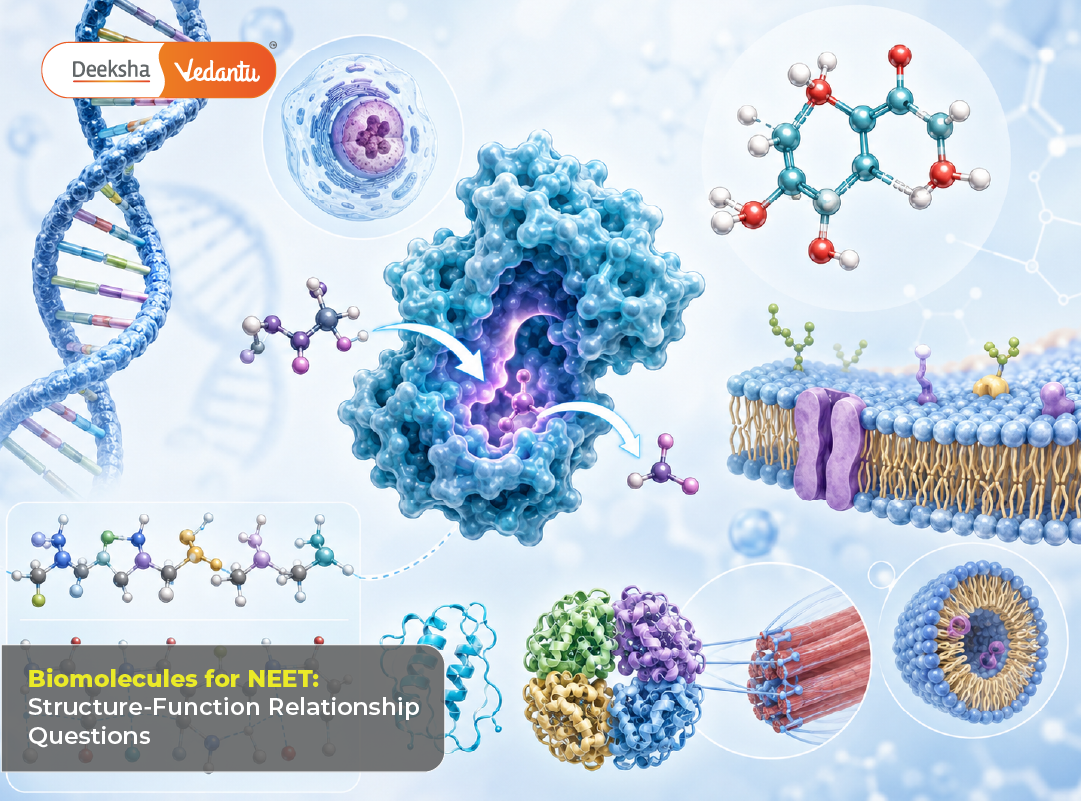


Open any NEET Biology paper from the last five years and you’ll find biomolecules hiding in plain sight – not just as a standalone chapter, but woven into questions on metabolism, genetics, and cell biology. The chapter “Biomolecules” from Class 12 Unit 4 consistently contributes 3-5 direct questions per paper, and several indirect ones through its connections to enzymes, DNA replication, and photosynthesis. What NEET tests here isn’t your ability to list biomolecules – it’s whether you understand why each molecule is built the way it is, and how that structure makes its function possible.
The Structure-Function Principle: Your Lens for This Chapter
Every question in this chapter becomes easier once you stop memorising structure and function as separate facts and start reading them as cause and effect. The alpha helix of a protein isn’t a random shape – it exists because of hydrogen bonding between specific amino acid residues, and that shape determines whether a protein can function as an enzyme, a hormone, or a structural component. The double helix of DNA isn’t aesthetic – it’s what makes accurate replication possible. Keep this lens active throughout your revision.
Carbohydrates: From Monosaccharides to Energy Storage Architecture
Carbohydrates follow the general formula (CH₂O)n and are classified by the number of sugar units they contain.
Monosaccharides are the building blocks. Glucose (C₆H₁₂O₆) exists in two ring forms – α-glucose and β-glucose – differing only in the orientation of the -OH group on carbon 1. This single structural difference has enormous functional consequences: α-glucose polymerises into starch (a storage molecule), while β-glucose polymerises into cellulose (a structural molecule in plant cell walls that humans cannot digest).
NEET loves this contrast. “Why can humans digest starch but not cellulose?” – The answer lies in the type of glycosidic bond: α-1,4-glycosidic linkage in starch (digestible by amylase) versus β-1,4-glycosidic linkage in cellulose (requires cellulase, which humans lack).
| Polymer | Monomer | Bond Type | Function |
| Starch (amylose + amylopectin) | α-glucose | α-1,4 (+ α-1,6 in branching) | Energy storage in plants |
| Glycogen | α-glucose | α-1,4 (+ α-1,6, highly branched) | Energy storage in animals |
| Cellulose | β-glucose | β-1,4 | Structural (plant cell walls) |
| Chitin | N-acetylglucosamine | β-1,4 | Structural (fungal walls, arthropod exoskeleton) |
Glycogen is more branched than amylopectin. More branching means more non-reducing ends available for rapid glucose release – a structure perfectly matched to the animal body’s need for quick energy mobilisation.
Proteins: Where Structure Gets Hierarchical
Proteins are polymers of amino acids joined by peptide bonds (formed by condensation between the -COOH of one amino acid and the -NH₂ of the next, with loss of water). With 20 standard amino acids and the possibility of thousands of residues in a single chain, proteins achieve an extraordinary range of functions – as enzymes, antibodies, hormones, transporters, and structural materials.
Protein structure is organised into four levels:
Primary structure – the linear sequence of amino acids. This is determined by the gene and dictates everything else. A single amino acid change can destroy function (as in sickle cell anemia, where glutamic acid is replaced by valine in haemoglobin).
Secondary structure – local folding patterns stabilised by hydrogen bonds between backbone -C=O and -NH groups. The two main forms are the α-helix (a right-handed coil) and the β-pleated sheet (lateral hydrogen bonds between strands). Structural proteins like keratin are predominantly α-helical; silk fibroin is predominantly β-sheet.
Tertiary structure – the overall 3D shape of a single polypeptide, stabilised by disulfide bonds, hydrophobic interactions, ionic bonds, and hydrogen bonds. This is the functional shape of most enzymes.
Quaternary structure – the arrangement of multiple polypeptide subunits. Haemoglobin (2α + 2β subunits) is the classic NEET example. Its cooperative oxygen binding – where binding of one O₂ makes the next subunit bind O₂ more readily – is a direct result of quaternary architecture.
NEET diagram tip: When a question shows a protein diagram with coil regions and arrow regions, identify α-helices (coils) and β-sheets (arrows) respectively.
Lipids: Amphipathic Architecture and Membrane Biology
Lipids are not polymers – they are a diverse group united by their hydrophobicity. For NEET, three types demand close attention.
Triglycerides (fats and oils) consist of glycerol + 3 fatty acids joined by ester bonds. Saturated fatty acids (no double bonds, straight chains) pack tightly → solid at room temperature (butter). Unsaturated fatty acids (one or more double bonds, kinked chains) cannot pack as tightly → liquid at room temperature (oils). This structural difference explains why saturated fats are associated with plaque formation in arteries.
Phospholipids are the structural basis of all biological membranes. They replace one fatty acid in triglycerides with a phosphate group, creating an amphipathic molecule – hydrophilic head, two hydrophobic tails. In an aqueous environment, phospholipids spontaneously arrange into a bilayer, with tails facing inward. This self-assembly is not driven by external force but by thermodynamic principles – one of the most elegant structure-function relationships in biology.
Sterols – particularly cholesterol – are embedded in animal cell membranes, where they modulate fluidity. At high temperatures, cholesterol restricts phospholipid movement (reducing fluidity); at low temperatures, it prevents tight packing (maintaining fluidity). Cholesterol is also the precursor for steroid hormones, bile salts, and Vitamin D.
Nucleic Acids: Information Storage in Structural Form
DNA and RNA are polynucleotides – each nucleotide consists of a nitrogenous base, a pentose sugar, and a phosphate group.
DNA uses deoxyribose sugar and the bases A, T, G, C. Its double helix structure (Watson-Crick model, 1953) has two antiparallel strands held by hydrogen bonds: A=T (2 H-bonds), G≡C (3 H-bonds). The stronger G-C pairing means organisms with high GC content have more thermally stable DNA – a real-world consequence of bond counting.
RNA uses ribose and replaces thymine with uracil. Unlike DNA, RNA is single-stranded, which allows it to fold back on itself forming hairpin loops – the structural basis of tRNA’s cloverleaf shape, which in turn allows it to carry both an anticodon and an amino acid simultaneously.
| Feature | DNA | RNA |
| Sugar | Deoxyribose | Ribose |
| Bases | A, T, G, C | A, U, G, C |
| Strands | Double | Single |
| Stability | More stable | Less stable |
| Function | Information storage | Protein synthesis |
The 2′ -OH group in ribose makes RNA more reactive and less stable than DNA – which is exactly why the long-term genetic blueprint is stored in DNA, not RNA. Structure again explains function.
Enzymes: Biomolecules That Enable Life’s Chemistry
Enzymes are globular proteins (except ribozymes, which are catalytic RNA molecules – a NEET favourite). Their active site has a precise 3D shape complementary to the substrate, explained by the lock and key model (Fischer) and the more accurate induced fit model (Koshland), where the enzyme changes shape slightly on substrate binding.
Key NEET distinctions:
Competitive inhibition – inhibitor structurally resembles the substrate and competes for the active site. Can be overcome by increasing substrate concentration.
Non-competitive inhibition – inhibitor binds at an allosteric site, changing the enzyme’s shape so the substrate can no longer bind effectively. Cannot be overcome by more substrate.
Cofactors vs Coenzymes: Cofactors are inorganic (e.g., Mg²⁺, Zn²⁺). Coenzymes are organic non-protein molecules (e.g., NAD⁺, FAD). Coenzymes that are tightly/permanently bound are called prosthetic groups.
Practice Questions Styled After NEET
Q1. Which bond connects amino acids in a protein?
(a) Glycosidic bond (b) Ester bond (c) Peptide bond (d) Phosphodiester bond
Answer: (c)
Q2. The secondary structure of a protein is maintained by:
(a) Disulfide bonds (b) Hydrogen bonds (c) Ionic bonds (d) Hydrophobic interactions
Answer: (b)
Q3. Cellulose differs from starch because:
(a) It has α-glucose monomers (b) It has β-1,4-glycosidic bonds (c) It is branched (d) It is water soluble
Answer: (b)
Q4. Which type of RNA carries the genetic code from nucleus to ribosome?
(a) tRNA (b) rRNA (c) hnRNA/mRNA (d) snRNA
Answer: (c)
Q5. An enzyme that is inhibited by the end product of the pathway it catalyses is an example of:
(a) Competitive inhibition (b) Feedback inhibition (c) Allosteric activation (d) Non-competitive activation
Answer: (b)
Connecting Biomolecules to the Broader NEET Paper
Biomolecules do not stay within their chapter boundaries in NEET. Carbohydrate metabolism connects to the Krebs cycle. Protein structure connects directly to epithelial tissue organisation and enzyme function. Nucleic acid structure is the foundation of inheritance patterns covered in Mendel’s laws. Lipid bilayers are central to understanding the cell organelles you studied in cell biology, particularly the membrane-bound organelles and how molecules enter and exit cells.
Students preparing for a second NEET attempt often discover that biomolecules was a chapter they “covered” the first time around but never truly built into a connected framework. The structure-function lens changes that – and once you read this chapter that way, the connections to every other Biology unit become visible and revision becomes significantly faster. Deeksha’s NEET repeater course approaches Biology in exactly this integrated way, ensuring no chapter exists in isolation when you sit the exam.








Get Social