
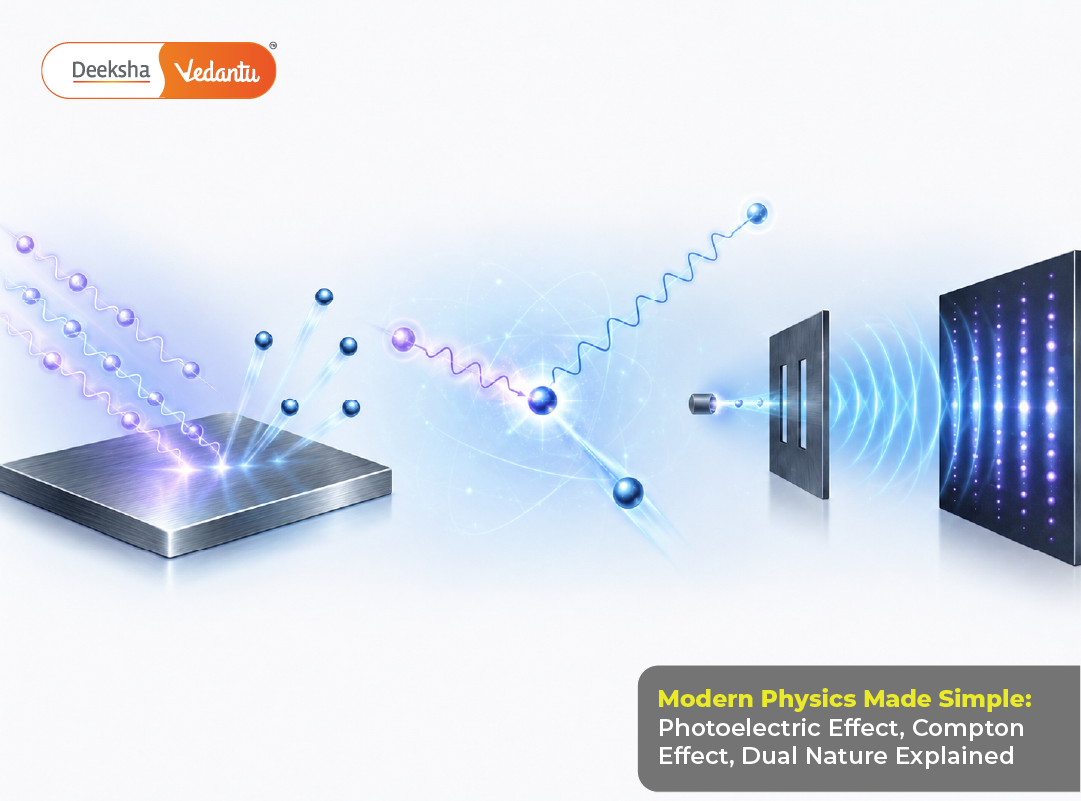


Modern physics is the chapter where NEET Physics shifts from “classical” mechanics into territory that initially feels counterintuitive – light behaving like particles, electrons behaving like waves, energy arriving in discrete packets rather than a continuous stream. The good news is that NEET tests this chapter through a small set of well-defined equations and graph interpretations. Master those, and modern physics becomes one of the most scoring sections in the paper.
Why Classical Physics Couldn’t Explain Light Anymore
By the late 1800s, light was firmly understood as a wave – diffraction and interference, the same wave optics principles that explain Young’s Double Slit Experiment, seemed to settle the matter. But certain experimental observations refused to fit that picture. The photoelectric effect was the first major crack, and explaining it required treating light as discrete energy packets rather than a continuous wave.
The Photoelectric Effect: Where Classical Theory Failed
When light of sufficiently high frequency strikes a metal surface, electrons are ejected – this is the photoelectric effect. Three experimental observations could not be explained by wave theory, and NEET tests all three directly.
Observation 1 – Instantaneous emission. Electrons are ejected the moment light strikes the surface, with no measurable time delay, regardless of intensity. Wave theory predicted a delay while energy “accumulated.”
Observation 2 – Threshold frequency. Below a certain minimum frequency (ν₀), no electrons are emitted no matter how intense the light is. Wave theory predicted that sufficiently intense light of any frequency should eventually eject electrons.
Observation 3 – Kinetic energy depends on frequency, not intensity. Increasing light intensity increases the number of photoelectrons, not their kinetic energy. Only increasing frequency increases kinetic energy. This was the most damaging observation for wave theory.
Einstein’s Photoelectric Equation: The Fix
Einstein proposed that light consists of discrete packets called photons, each carrying energy E = hν, where h is Planck’s constant (6.63 × 10⁻³⁴ J·s).
Einstein’s photoelectric equation:
hν = φ₀ + KEmax
where φ₀ is the work function (minimum energy needed to eject an electron from a given metal) and KEmax is the maximum kinetic energy of the emitted photoelectron.
Rearranged: KEmax = hν – φ₀ or KEmax = h(ν – ν₀)
This single equation explains all three problematic observations: emission is instantaneous because a single photon transfers its energy in one interaction (not gradually); threshold frequency exists because below ν₀, a single photon simply doesn’t carry enough energy to overcome φ₀; and kinetic energy depends only on photon frequency, while intensity (number of photons) only affects how many electrons get knocked out, not how energetically each one leaves.
Stopping potential (V₀): The minimum reverse voltage needed to stop even the fastest photoelectrons. eV₀ = KEmax = hν – φ₀
NEET frequently provides a graph of stopping potential versus frequency and asks you to extract the work function or Planck’s constant from the slope and intercept – the slope of this graph equals h/e, a numerical relationship worth memorising directly.
Solved NEET-Style Numerical: Photoelectric Effect
The work function of a metal is 2 eV. Light of wavelength 300 nm is incident on it. Find the maximum kinetic energy of the photoelectrons.
Energy of photon: E = hc/λ = (6.63 × 10⁻³⁴ × 3 × 10⁸) / (300 × 10⁻⁹)
E = 6.63 × 10⁻¹⁹ J ≈ 4.14 eV (using 1 eV = 1.6 × 10⁻¹⁹ J)
KEmax = E – φ₀ = 4.14 – 2 = 2.14 eV
The Compton Effect: Photons Behaving Like Particles in Collisions
While the photoelectric effect showed light’s particle nature in absorption, the Compton effect proved it in scattering. When X-rays collide with loosely bound electrons, the scattered X-rays have a longer wavelength than the incident ones – meaning the photon lost energy in the collision, exactly as a particle would in an elastic collision transferring momentum.
Compton shift formula:
Δλ = λ’ – λ = (h/m₀c)(1 – cosθ)
where θ is the scattering angle and h/m₀c is the Compton wavelength (≈ 2.43 × 10⁻¹² m for an electron).
NEET’s conceptual takeaway: the Compton effect cannot be explained by wave theory at all – it only makes sense if photons carry both energy (E = hν) and momentum (p = h/λ), behaving as particles in a billiard-ball-style collision with electrons. This is treated as definitive experimental proof of the particle nature of light, alongside the photoelectric effect.
Difference NEET often tests directly:
| Feature | Photoelectric Effect | Compton Effect |
| Process | Photon absorbed completely | Photon partially scattered |
| Wavelength change | Not relevant | Scattered wavelength increases |
| Electron involved | Bound electron in metal | Loosely bound/free electron |
| Evidence for | Particle nature of light | Particle nature + momentum of photons |
Dual Nature of Matter: de Broglie’s Reversal of the Idea
If light – traditionally a wave – could behave like a particle, Louis de Broglie proposed the reverse: particles of matter should also exhibit wave-like behaviour.
de Broglie wavelength:
λ = h/p = h/mv
This single equation is the most numerically tested formula in this chapter. NEET frequently asks for the de Broglie wavelength of an electron accelerated through a potential difference V:
λ = h/√(2meV)
For an electron specifically, this simplifies to a commonly memorised approximate relation: λ (in nm) ≈ √(1.5/V), where V is in volts – useful for quick estimation in MCQs.
Solved NEET-Style Numerical: de Broglie Wavelength
An electron is accelerated through a potential difference of 100 V. Find its de Broglie wavelength.
λ = h/√(2meV)
= 6.63 × 10⁻³⁴ / √(2 × 9.1 × 10⁻³¹ × 1.6 × 10⁻¹⁹ × 100)
= 6.63 × 10⁻³⁴ / √(2.912 × 10⁻⁴⁷)
= 6.63 × 10⁻³⁴ / 5.4 × 10⁻²⁴
≈ 1.22 × 10⁻¹⁰ m (1.22 Å)
This matching of electron wavelengths to X-ray-scale dimensions is why electron diffraction experiments (Davisson-Germer) were able to experimentally confirm de Broglie’s hypothesis – a historical detail NEET has tested as a one-liner.
Why This Connects Back to Atomic Structure
The dual nature of matter directly explains why electrons in atoms occupy specific, quantised orbits rather than spiralling into the nucleus – a problem unresolved by Rutherford’s atomic model. Bohr’s model, building on this wave-particle reasoning, proposed that electron orbits correspond to whole-number wavelengths – a concept developed further in the study of Bohr’s model and electronic structure. The logic of energy existing in discrete, quantised packets – rather than a continuous spectrum – is the same principle that governs electronic configuration and orbital filling in chemistry.
Practice Questions Styled After NEET
Q1. In the photoelectric effect, the kinetic energy of emitted electrons depends on:
(a) Intensity of light (b) Frequency of light (c) Distance from source (d) Angle of incidence
Answer: (b)
Q2. The Compton effect provides evidence for:
(a) Wave nature of light only (b) Particle nature of light, including momentum (c) Refraction of light (d) Polarisation of light
Answer: (b)
Q3. The de Broglie wavelength of a particle is inversely proportional to its:
(a) Charge (b) Momentum (c) Energy (d) Work function
Answer: (b)
Q4. If the frequency of incident light is below the threshold frequency, photoelectric emission:
(a) Occurs after a delay (b) Occurs with low kinetic energy (c) Does not occur at all (d) Occurs only at high intensity
Answer: (c)
Q5. The slope of the stopping potential vs frequency graph in the photoelectric effect equals:
(a) h (b) h/e (c) e/h (d) φ₀/e
Answer: (b)
Building Conceptual Continuity Into Modern Physics
Modern physics rewards students who treat each phenomenon as part of one continuous argument – light is a wave (interference, diffraction), light is also a particle (photoelectric effect, Compton effect), and matter, in turn, is also a wave (de Broglie). NEET’s questions are rarely about a single formula in isolation; they test whether you understand why each experiment forced a shift in how light and matter were understood, much like the conceptual jumps required when classifying ray versus wave optics problems in the preceding chapter.
The numerical method here also overlaps with electrical concepts elsewhere in the syllabus – accelerating a charge through a potential difference is the same logic used in electric potential and potential difference problems, just applied to a quantum context. For repeaters, modern physics is often a high-yield, low-time-investment chapter precisely because the formula set is small and the question patterns are predictable. Deeksha’s NEET repeater course treats this chapter as one of the priority “quick win” areas in the final revision cycle, given how consistently NEET draws from this small set of well-defined equations.








Get Social