
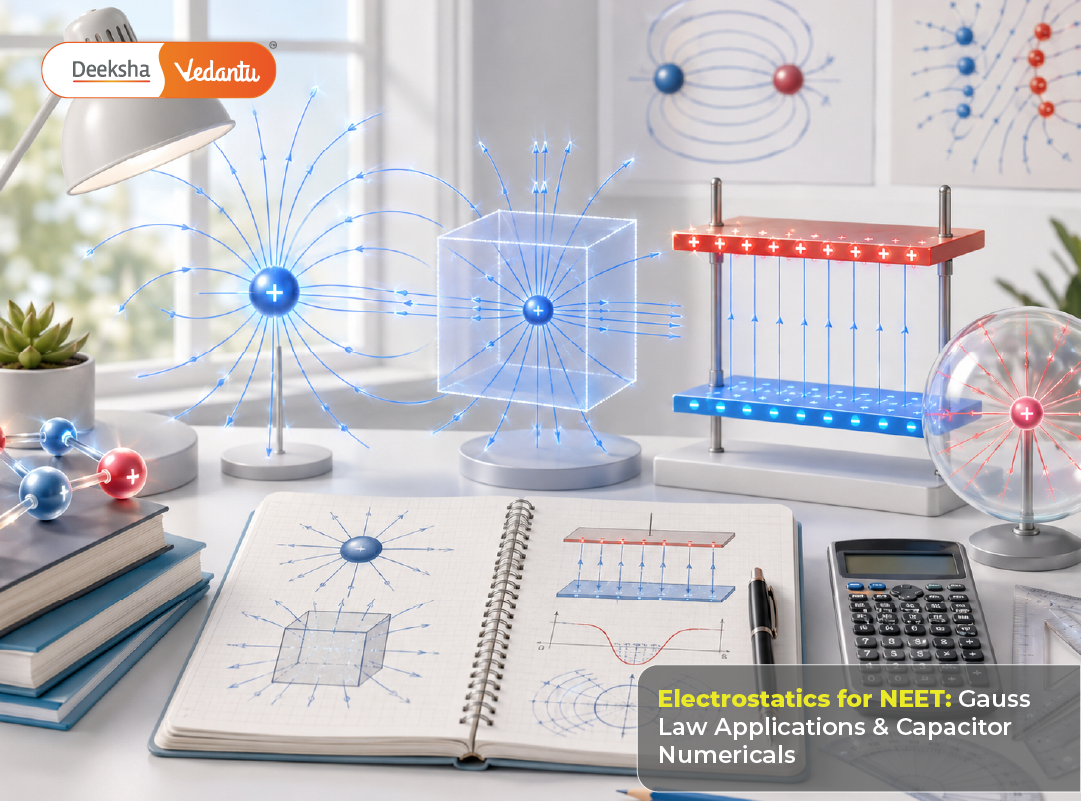


Electrostatics is one of those Physics chapters that NEET students either love or avoid. The theory looks deceptively manageable – charges, fields, potentials – until Gauss Law surfaces and the numerical section of the question paper suddenly feels hostile. This guide is built to fix that. Every core concept is tied to how NEET actually frames questions, and every numerical type is walked through with the exact method you need in the exam room.
Why Electrostatics Demands More Than Formula Memorisation
NEET consistently allocates 3-5 questions to electrostatics, and they rarely stay at the surface. A typical paper will include one Gauss Law application, one capacitor combination numerical, one energy/dielectric question, and at least one conceptual trap around electric field direction or potential gradient. The students who lose marks here aren’t those who don’t know the formulas – they’re those who don’t know when to apply which approach.
Understanding electrostatics also underpins other high-weightage chapters. The concept of work, energy and power directly feeds into electric potential energy calculations, while the logic of electric field lines connects naturally to how you’ll later interpret force in electromagnetic contexts.
Coulomb’s Law – The Starting Point
Coulomb’s Law gives the electrostatic force between two point charges:
F = kq₁q₂ / r²
where k = 1/4πε₀ ≈ 9 × 10⁹ N m² C⁻²
NEET uses this in two ways: direct substitution numericals (straightforward) and superposition-based problems where you find the net force on a charge due to multiple other charges. For superposition, always resolve into components and add vectorially – never add magnitudes directly.
Frequently tested trap: When a charge is placed at the centre of a square with identical charges at all four corners, the net force on the central charge is zero by symmetry. NEET has tested this pattern multiple times.
Electric Field – Direction Matters as Much as Magnitude
The electric field E at a point is the force experienced per unit positive test charge placed there:
E = F/q₀ = kq / r²
Direction: radially outward from a positive charge, radially inward toward a negative charge.
For a system of charges, use the principle of superposition: calculate E due to each charge individually, then add vectorially.
Conceptual NEET question type: “At which point between two equal and opposite charges is the electric field zero?” – The answer is: it is never zero between them (fields add, not cancel, in that region). Zero field exists only on the perpendicular bisector at specific conditions for unequal charges. This is a classic trap.
Gauss Law – The High-Value Section
Gauss Law states that the total electric flux through any closed surface (Gaussian surface) is equal to the net charge enclosed divided by ε₀:
Φ = Q_enclosed / ε₀
Or equivalently: ∮ E · dA = Q_enc / ε₀
The power of Gauss Law is that it lets you calculate electric fields for symmetric charge distributions without integrating over every tiny element. The key is choosing the right Gaussian surface.
Three Gauss Law Derivations NEET Tests Repeatedly
Electric Field Due to an Infinite Line Charge
For a linear charge density λ (charge per unit length), choose a cylindrical Gaussian surface of radius r and length L coaxial with the line charge.
Flux through curved surface: E × 2πrL
Charge enclosed: λL
Applying Gauss Law: E × 2πrL = λL / ε₀
E = λ / (2πε₀r)
Direction: radially outward (for positive λ). Note that E ∝ 1/r here, unlike the 1/r² dependence for a point charge.
Electric Field Due to an Infinite Plane Sheet of Charge
For a surface charge density σ, choose a cylindrical (pill-box) Gaussian surface straddling the sheet, with cross-sectional area A.
Flux: 2EA (flux through both flat faces; zero through curved side)
Charge enclosed: σA
E = σ / (2ε₀)
This is a constant – the field from an infinite sheet does not depend on distance from the sheet. NEET has tested this as an assertion-reason question asking whether the field varies with distance.
Electric Field Due to a Uniformly Charged Spherical Shell
This derivation has two cases:
| Location | Electric Field |
| Outside the shell (r > R) | E = Q / (4πε₀r²) – behaves like a point charge |
| Inside the shell (r < R) | E = 0 |
| On the surface (r = R) | E = Q / (4πε₀R²) – maximum value |
The fact that E = 0 inside a conducting shell is one of the most tested results in all of electrostatics. The proof rests on Gauss Law: a Gaussian surface inside the shell encloses zero charge, so E = 0.
NEET question: “A charge Q is placed at the centre of a metallic shell. What is the field inside the shell material?” – Zero, because free electrons redistribute to cancel the internal field.
Electric Potential and Its Relationship with Electric Field
Electric potential V at a distance r from a point charge Q:
V = kQ / r = Q / (4πε₀r)
The relationship between E and V is critical:
E = -dV/dr
This means the electric field points in the direction of decreasing potential – from high V to low V. Equipotential surfaces are always perpendicular to electric field lines.
NEET numerical type: Given V = 3x² + 4y, find E at point (1, 2).
Method: Eₓ = -∂V/∂x = -6x; Eᵧ = -∂V/∂y = -4
At (1, 2): E = -6î – 4ĵ, |E| = √(36 + 16) = √52 ≈ 7.2 N/C
Capacitors – The Numerical-Heavy Section
A capacitor stores electric charge and energy. Capacitance C is defined as:
C = Q / V
For a parallel plate capacitor: C = ε₀A / d
where A is the plate area and d is the separation between plates.
Capacitor Combinations
Series Combination
1/C_net = 1/C₁ + 1/C₂ + 1/C₃ …
- Same charge Q on each capacitor
- Voltage divides: V₁/V₂ = C₂/C₁ (inverse ratio)
- Net capacitance is always less than the smallest individual capacitance
Parallel Combination
C_net = C₁ + C₂ + C₃ …
- Same voltage across each capacitor
- Charge divides: Q₁/Q₂ = C₁/C₂ (direct ratio)
- Net capacitance is always greater than the largest individual capacitance
Effect of Dielectric on Capacitance
When a dielectric of dielectric constant K is inserted between the plates, filling the space completely:
C’ = KC
Since K > 1 for all dielectrics, capacitance always increases. But what happens to other quantities depends on whether the capacitor is connected to a battery or isolated:
| Condition | Q | V | E | C | Energy |
| Connected to battery (V constant) | Increases (KQ) | Same | Same | Increases (KC) | Increases |
| Isolated (Q constant) | Same | Decreases (V/K) | Decreases (E/K) | Increases (KC) | Decreases |
This table is a direct source of NEET questions. The energy decreasing in the isolated case surprises students – the extra energy goes into the work done in pulling the dielectric slab in.
Energy Stored in a Capacitor
U = ½ CV² = Q²/2C = ½ QV
Know all three forms. NEET will give you two of the three variables (Q, C, V) and ask for U.
Numerical:
A 4 μF capacitor is charged to 200 V. Find the energy stored.
U = ½ × 4 × 10⁻⁶ × (200)²
U = ½ × 4 × 10⁻⁶ × 40000
U = 0.08 J = 80 mJ
Solved NEET-Style Capacitor Numericals
Numerical 1 – Series-Parallel Combination
Three capacitors: C₁ = 2 μF, C₂ = 4 μF, C₃ = 4 μF. C₂ and C₃ are in parallel, and their combination is in series with C₁. Find net capacitance and charge on C₁ when connected to 12 V.
Step 1: C₂₃ = C₂ + C₃ = 4 + 4 = 8 μF (parallel)
Step 2: 1/C_net = 1/C₁ + 1/C₂₃ = 1/2 + 1/8 = 4/8 + 1/8 = 5/8
C_net = 8/5 = 1.6 μF
Step 3: Q = C_net × V = 1.6 × 10⁻⁶ × 12 = 19.2 μC
In series, Q is the same on C₁ and on the C₂₃ combination. So charge on C₁ = 19.2 μC.
Numerical 2 – Energy After Connecting Two Charged Capacitors
A 3 μF capacitor charged to 300 V is connected (positive to positive) to an uncharged 6 μF capacitor. Find the common potential and energy lost.
Initial charge: Q = 3 × 10⁻⁶ × 300 = 900 μC
Common potential: V = Q_total / C_total = 900/(3 + 6) = 100 V
Initial energy: U_i = ½ × 3 × 10⁻⁶ × (300)² = 135 mJ
Final energy: U_f = ½ × (3 + 6) × 10⁻⁶ × (100)² = 45 mJ
Energy lost = 135 – 45 = 90 mJ (dissipated as heat/radiation)
Practice Questions Styled After NEET
Q1. A charge of 8.85 × 10⁻¹² C is placed at the centre of a sphere of radius 5 cm. The electric flux through the sphere is:
(a) 1 N m² C⁻¹ (b) 0.1 N m² C⁻¹ (c) 10 N m² C⁻¹ (d) 100 N m² C⁻¹
Answer: (a) – Φ = Q/ε₀ = 8.85 × 10⁻¹² / 8.85 × 10⁻¹² = 1 N m² C⁻¹. Flux is independent of the size of the surface.
Q2. The capacitance of a parallel plate capacitor is 5 μF. If a dielectric of K = 3 is inserted and the plate separation is doubled simultaneously, the new capacitance is:
(a) 7.5 μF (b) 15 μF (c) 2.5 μF (d) 10 μF
Answer: (a) – C’ = K × ε₀A/2d = (3/2) × 5 = 7.5 μF
Q3. The electric field inside a hollow conducting sphere having a charge Q is:
(a) Q/4πε₀R² (b) Zero (c) Q/4πε₀r² (d) Infinite
Answer: (b)
Q4. Two capacitors of 6 μF and 3 μF are connected in series across 18 V. The charge on the 6 μF capacitor is:
(a) 36 μC (b) 108 μC (c) 18 μC (d) 54 μC
Answer: (a) – C_net = (6×3)/(6+3) = 2 μF; Q = 2 × 18 = 36 μC. In series, same charge on both.
Quick Reference: Key Formulas at a Glance
| Concept | Formula |
| Coulomb’s Law | F = kq₁q₂/r² |
| Electric Field (point charge) | E = kq/r² |
| Gauss Law | Φ = Q_enc/ε₀ |
| Field – infinite line charge | E = λ/2πε₀r |
| Field – infinite plane sheet | E = σ/2ε₀ |
| Field – outside spherical shell | E = Q/4πε₀r² |
| Parallel plate capacitance | C = ε₀A/d |
| With dielectric | C’ = Kε₀A/d |
| Energy stored | U = ½CV² |
Building a Physics Foundation That Holds Under NEET Pressure
Electrostatics doesn’t exist in isolation. The way field lines and potential relate to each other mirrors the logic you’ll need in chapters like thermodynamics and electromagnetic induction. Kirchhoff’s laws become far more intuitive once you’re comfortable with how potential drops across circuit elements – which is directly linked to capacitor and resistor behaviour. Even topics like the Wheatstone bridge and Zener diode circuits make more sense when your electrostatics foundation is clean.
The students who consistently score 140+ in NEET Physics tend to have one thing in common: they don’t treat chapters as isolated units. They build cumulative understanding – and electrostatics is where that cumulative chain begins.
If you’re preparing for a second NEET attempt and finding that Physics numericals are where marks are slipping, a structured programme that revisits these foundations systematically – rather than rushing to cover new material – tends to make the biggest difference. Deeksha’s NEET repeater course is built around exactly that kind of chapter-by-chapter numerical practice paired with concept consolidation.








Get Social