

Osmoregulation and thermoregulation are usually studied as two unrelated topics – one tucked inside the excretory system chapter, the other often skimmed briefly without a dedicated home in most syllabi breakdowns. But both are, at their core, the same biological problem solved twice: keeping an internal variable (water/salt balance, or body temperature) stable despite a constantly changing external environment. NEET occasionally tests this shared logic directly, and recognising the parallel structure makes both topics easier to retain.
The Shared Principle: Homeostasis Through Negative Feedback
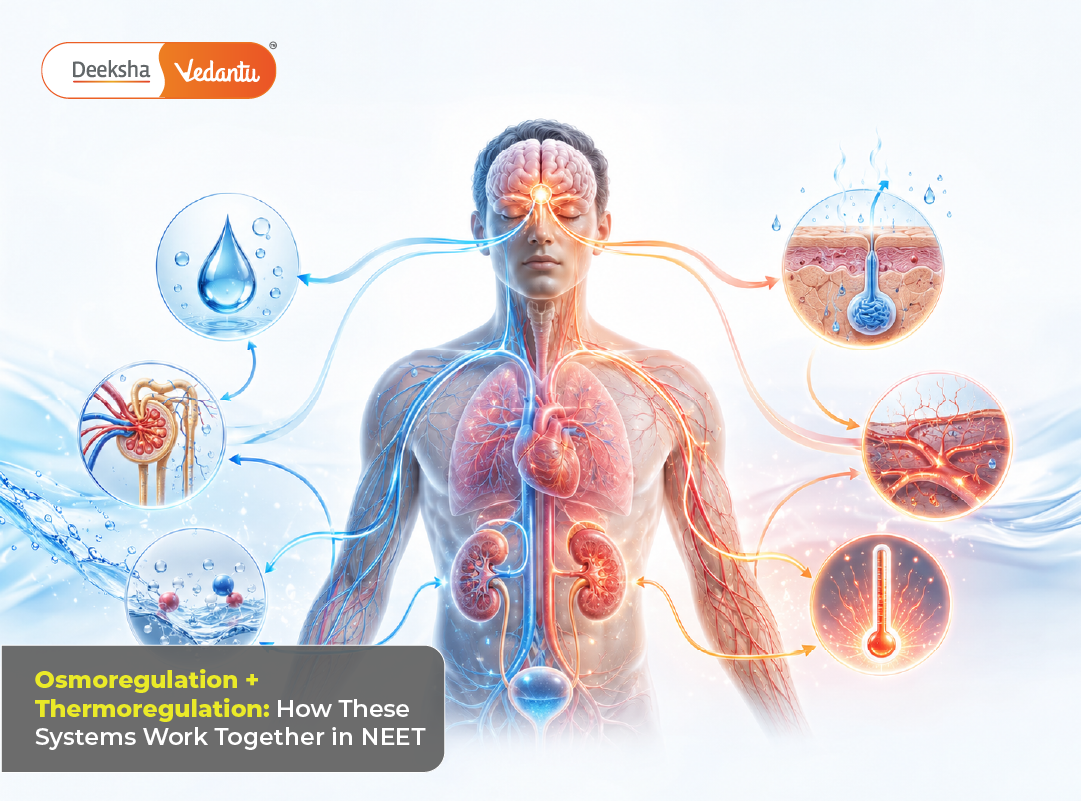
Both osmoregulation and thermoregulation are homeostatic mechanisms, meaning they work by detecting deviation from a set point and triggering a corrective response that pushes the variable back toward normal – classic negative feedback. The structural pattern is identical in both cases: a sensor detects the deviation, a control centre processes the signal and decides on a response, and an effector carries out the correction. Once you recognise this three-part structure, both osmoregulation and thermoregulation become variations on the same template rather than two separate systems to memorise independently.
Osmoregulation: Maintaining Water-Salt Balance
Osmoregulation is the process of maintaining a stable internal water and solute concentration, primarily managed by the kidneys and detailed extensively in the excretory products and their elimination unit.
Sensor: Osmoreceptors in the hypothalamus, which detect blood osmolarity (solute concentration).
Control centre: The hypothalamus, which processes the osmoreceptor signal and triggers the posterior pituitary to release ADH (antidiuretic hormone).
Effector: The kidney’s collecting duct, where ADH increases water permeability, allowing more water reabsorption and producing concentrated urine when the body needs to conserve water.
The full negative feedback loop: Blood becomes too concentrated (dehydration) → osmoreceptors detect rising osmolarity → hypothalamus signals increased ADH release → collecting duct reabsorbs more water → blood osmolarity falls back toward normal → reduced osmoreceptor signalling → ADH secretion decreases, completing the loop.
This loop is one of NEET’s most reliably tested physiology sequences, frequently presented as a scenario: “A person is severely dehydrated – what happens to ADH levels and urine concentration?” The correct chain of reasoning traces exactly the pathway above.
Thermoregulation: Maintaining Core Body Temperature
Thermoregulation maintains internal body temperature within a narrow range (around 37°C in humans) despite changing external temperatures, and follows the identical three-part structure.
Sensor: Thermoreceptors, located both centrally (in the hypothalamus itself, detecting blood temperature directly) and peripherally (in the skin, detecting external temperature).
Control centre: The hypothalamus, specifically containing both a heat-loss centre and a heat-gain (heat-conservation) centre, which compare incoming thermoreceptor signals against the body’s temperature set point.
Effectors: Multiple mechanisms depending on the direction of correction needed – sweat glands, blood vessels (vasodilation/vasoconstriction), skeletal muscles (shivering), and even behavioural responses (seeking shade, putting on a layer).
Responding to Excess Heat
When core temperature rises above the set point, the hypothalamus’s heat-loss centre activates: vasodilation of skin blood vessels increases blood flow to the skin surface, allowing heat to radiate away more efficiently, and sweat glands are stimulated to increase sweat production, which cools the body through evaporative heat loss.
Responding to Cold
When core temperature drops below the set point, the hypothalamus’s heat-conservation centre activates: vasoconstriction of skin blood vessels reduces blood flow to the surface, minimising heat loss, and shivering thermogenesis – involuntary, rapid skeletal muscle contractions – generates additional metabolic heat. In some contexts, non-shivering thermogenesis via brown adipose tissue also contributes, particularly relevant in infants and certain mammals.
| Feature | Osmoregulation | Thermoregulation |
| Variable controlled | Blood osmolarity (water/solute balance) | Core body temperature |
| Primary sensor | Osmoreceptors (hypothalamus) | Thermoreceptors (hypothalamus + skin) |
| Control centre | Hypothalamus → posterior pituitary (ADH) | Hypothalamus (heat-loss and heat-gain centres) |
| Main effector organ | Kidney (collecting duct) | Skin (vessels, sweat glands), skeletal muscle |
| Key hormone/signal | ADH | Indirect – primarily neural/muscular response, not a single dominant hormone |
This side-by-side table is the single most useful study tool for this combined topic, since NEET sometimes constructs questions that ask you to identify which system a given sensor or effector belongs to.
Why the Hypothalamus Is the Genuine Connecting Thread
Both systems converge on the same organ as their control centre – the hypothalamus – which makes sense given its broader role as the interface between the nervous and endocrine systems, the same dual role explored in chemical coordination and integration. This shared control centre is precisely why NEET occasionally combines these two topics: a single structure, the hypothalamus, is simultaneously running two independent negative feedback loops, each with its own sensors and effectors but a shared decision-making hub.
This connection also explains a clinically relevant detail NEET sometimes references: damage to specific hypothalamic regions can disrupt either osmoregulation or thermoregulation somewhat independently, depending on which specific nucleus is affected, since the two functions, while co-located in the same general structure, rely on distinct neural circuits within it.
A Conceptual Overlap Worth Noting: Sweating and Water Loss
Here’s where the two systems genuinely interact rather than merely sharing a control centre. Sweating, the primary thermoregulatory response to heat, simultaneously causes water and electrolyte loss – directly affecting osmoregulation. This means heavy sweating during heat exposure or intense exercise can trigger the osmoregulatory system into action almost immediately afterward, as rising blood osmolarity (from water loss via sweat) activates osmoreceptors and increases ADH release to conserve the body’s remaining water. NEET occasionally frames this interaction as an integrated scenario question: “Why does a person feel thirsty after intense exercise in hot weather?” The answer requires connecting both systems – thermoregulatory sweating causes water loss, which then triggers the osmoregulatory thirst and ADH response.
Solved NEET-Style Conceptual Question
A person exercises intensely in hot weather, sweating heavily. Trace the immediate effects on both thermoregulation and osmoregulation.
Thermoregulation: Rising core temperature activates the hypothalamic heat-loss centre → vasodilation and increased sweating occur to dissipate heat through evaporation.
Osmoregulation (triggered as a consequence): Sweating causes water loss, increasing blood osmolarity → osmoreceptors detect this rise → ADH secretion increases → kidneys reabsorb more water, producing more concentrated urine, conserving the body’s remaining fluid.
Both responses occur simultaneously, coordinated through the same hypothalamic structure, but addressing two distinct variables.
Practice Questions Styled After NEET
Q1. Which hormone directly regulates water reabsorption in the kidney’s collecting duct?
(a) Aldosterone (b) ADH (c) Insulin (d) Cortisol)
Answer: (b)
Q2. Vasodilation of skin blood vessels in response to heat is controlled by the:
(a) Adrenal medulla (b) Hypothalamus (c) Pancreas (d) Pituitary gland alone)
Answer: (b)
Q3. Shivering is an example of:
(a) Non-shivering thermogenesis (b) A behavioural response (c) Skeletal muscle-generated heat production (d) Hormonal heat production)
Answer: (c)
Q4. Both osmoregulation and thermoregulation share which common control structure?
(a) Medulla oblongata (b) Hypothalamus (c) Cerebellum (d) Pituitary gland alone)
Answer: (b)
Why Studying These Together Builds Stronger Recall
Treating osmoregulation and thermoregulation as two expressions of the same underlying homeostatic template – sensor, control centre, effector, negative feedback – rather than as unrelated facts to memorise separately, makes both topics significantly easier to retain and apply to scenario-based questions. This same homeostatic framework is worth carrying into related physiology revision, since recognising the sensor-centre-effector pattern also clarifies feedback loops elsewhere in the syllabus.
For repeaters, combined-topic questions like the sweating-and-thirst scenario above are exactly where a first attempt often falls short – not from missing content, but from never having practised connecting two chapters that were revised in separate sessions. Deeksha’s NEET repeater course deliberately builds these cross-system scenarios into revision, so recognising a combined homeostatic question becomes routine well before exam day rather than something to puzzle through under time pressure.





Get Social