
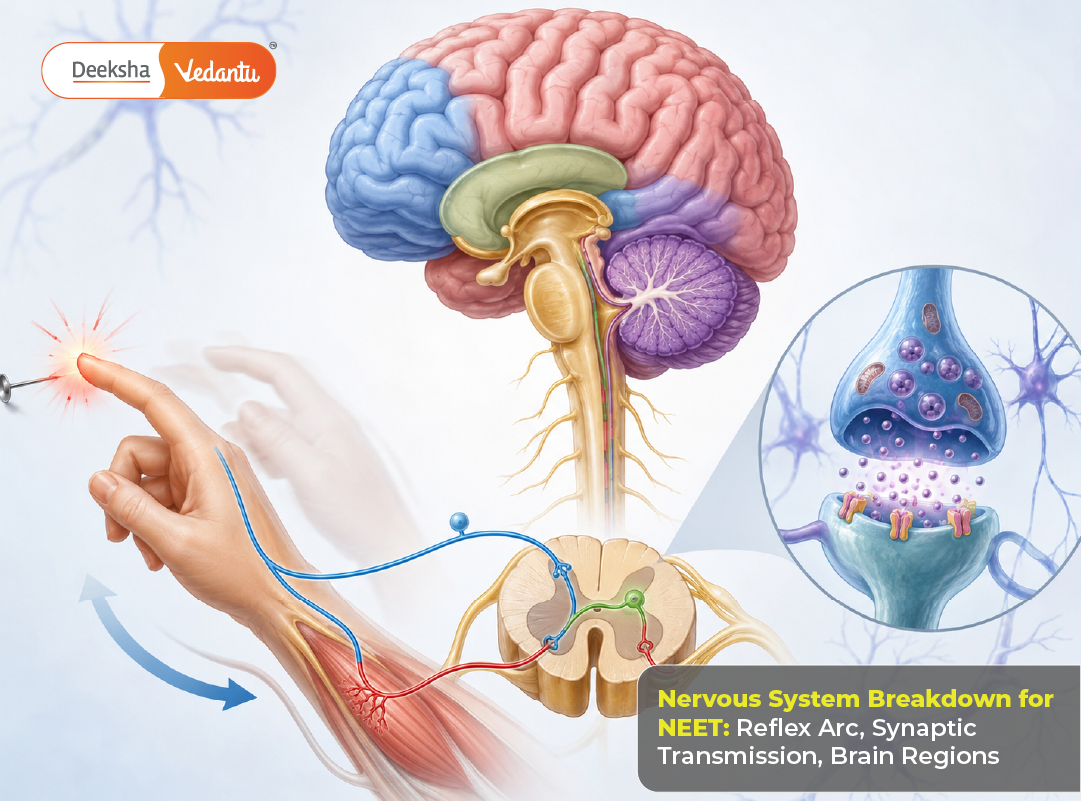


Ask any NEET Biology teacher which chapter produces the most avoidable mistakes, and the nervous system comes up consistently. Students recognise the vocabulary – neurons, synapse, cerebellum – but freeze when NEET asks them to trace a reflex arc component by component, identify a neurotransmitter by its function, or match a brain region to a specific behavioural deficit. This guide rebuilds the chapter from the ground up, with every concept tied to how the exam actually tests it.
The Neuron: Structure as a Blueprint for Function
Everything in the nervous system begins with the neuron, the structural and functional unit of the nervous system. A neuron has three distinct regions, each with a specific role:
Cell body (soma) – contains the nucleus and most metabolic machinery. Nissl granules (rough ER) in the soma are the site of protein synthesis for the entire neuron. Their absence in the axon is a distinguishing feature NEET has tested directly.
Dendrites – short, branched projections that receive signals from other neurons and carry them toward the cell body.
Axon – a single long projection that carries impulses away from the cell body toward the next neuron or effector. The axon is covered by a myelin sheath (in myelinated neurons) formed by Schwann cells in the PNS and oligodendrocytes in the CNS. The gaps between myelin segments are nodes of Ranvier, where saltatory conduction occurs – impulses jump from node to node, dramatically increasing conduction speed.
Classification of neurons by function:
| Type | Direction of Signal | Example |
| Sensory (afferent) | Receptor → CNS | Skin touch receptor to spinal cord |
| Motor (efferent) | CNS → Effector | Spinal cord to muscle |
| Interneuron (relay) | Within CNS | Connecting sensory and motor in spinal cord |
Resting Membrane Potential and Action Potential
A resting neuron maintains a potential difference of -70 mV across its membrane (inside negative relative to outside). This is maintained by the sodium-potassium pump (Na⁺-K⁺ ATPase), which actively transports 3 Na⁺ out and 2 K⁺ in per cycle, keeping the inside more negative.
When a stimulus exceeds the threshold, an action potential is generated:
Depolarisation – voltage-gated Na⁺ channels open; Na⁺ rushes in; membrane potential rises from -70 mV to approximately +35 mV.
Repolarisation – Na⁺ channels inactivate; voltage-gated K⁺ channels open; K⁺ rushes out; membrane potential falls back toward -70 mV.
Hyperpolarisation – K⁺ channels close slowly, causing a brief overshoot below -70 mV (the refractory period, during which no new action potential can be generated).
The action potential obeys the all-or-none law – it either fires fully or not at all. Signal strength is communicated by frequency of action potentials, not by their amplitude.
Synaptic Transmission: The Chemical Bridge Between Neurons
A synapse is the junction between two neurons (or between a neuron and an effector). The neuron sending the signal is the presynaptic neuron; the one receiving is the postsynaptic neuron. Between them lies the synaptic cleft (~20-40 nm wide).
The sequence of synaptic transmission is one of NEET’s most-tested processes:
- Action potential arrives at the axon terminal (synaptic knob)
- Voltage-gated Ca²⁺ channels open; Ca²⁺ flows into the terminal
- Ca²⁺ triggers synaptic vesicles to fuse with the presynaptic membrane
- Neurotransmitters are released into the synaptic cleft by exocytosis
- Neurotransmitters bind to receptor proteins on the postsynaptic membrane
- Ion channels open, generating a new potential in the postsynaptic neuron
- Neurotransmitters are degraded by enzymes or reabsorbed into the presynaptic terminal
Ca²⁺ is the trigger for neurotransmitter release – this is a high-frequency NEET one-liner. Without calcium influx, vesicle fusion does not occur.
| Neurotransmitter | Type | Effect | Clinical Link |
| Acetylcholine | Excitatory/Inhibitory | Muscle contraction, memory | Deficiency linked to Alzheimer’s |
| Dopamine | Excitatory | Reward, motor control | Deficiency linked to Parkinson’s |
| Serotonin | Inhibitory | Mood, sleep | Deficiency linked to depression |
| GABA | Inhibitory | Reduces neuronal activity | Target of anti-anxiety drugs |
| Norepinephrine | Excitatory | Alertness, fight-or-flight | Released with adrenaline |
These clinical associations have appeared in NEET as application-based questions. Know them – not as trivia, but as logical extensions of each neurotransmitter’s function.
Reflex Arc: The Shortest Neural Circuit
A reflex is a rapid, involuntary, stereotyped response to a stimulus. It does not require conscious brain involvement – the signal is processed entirely at the spinal cord level, making the response faster than any voluntary action.
The five components of a reflex arc in sequence:
Receptor → Afferent (sensory) neuron → Nerve centre (interneuron in spinal cord) → Efferent (motor) neuron → Effector
The classic example is the knee-jerk reflex (patellar reflex) – a monosynaptic reflex (only one synapse, between sensory and motor neuron) where tapping the patellar tendon causes an involuntary leg extension.
NEET diagram tip: When a spinal cord cross-section appears in the question, remember that the dorsal horn receives sensory input (sensory neurons enter from the back) and the ventral horn sends motor output (motor neurons exit from the front). Sensory neuron cell bodies are located in the dorsal root ganglion – outside the spinal cord. This structural detail is tested as a labelling question and also as an assertion-reason pair.
Cerebrospinal fluid (CSF) surrounds the brain and spinal cord, acting as a shock absorber and providing nutrients. It is produced by the choroid plexus in the ventricles of the brain – a detail NEET has included in one-liner questions.
Understanding the reflex arc also reinforces the human digestive system’s neural control – peristalsis, for instance, is coordinated by the enteric nervous system using similar reflex loops without conscious control.
Brain Regions: Function Mapped to Location
The human brain is divided into three major regions: forebrain, midbrain, and hindbrain.
Forebrain
Cerebrum – the largest part of the brain, divided into two hemispheres connected by the corpus callosum. The outer layer is the cerebral cortex (grey matter), responsible for conscious thought, voluntary movement, sensory perception, language, and memory. Different lobes handle different functions:
| Lobe | Location | Primary Function |
| Frontal | Front | Voluntary movement, decision-making, speech (Broca’s area) |
| Parietal | Top/back | Somatosensory processing, spatial awareness |
| Temporal | Sides | Hearing, language comprehension (Wernicke’s area) |
| Occipital | Back | Vision and visual processing |
Thalamus – the relay station for all sensory information (except smell) going to the cerebral cortex.
Hypothalamus – regulates body temperature, hunger, thirst, sleep, circadian rhythms, and controls the pituitary gland. Despite its small size, it is one of the most frequently tested brain structures in NEET because it links the nervous system to the endocrine system.
Midbrain
The midbrain connects the forebrain to the hindbrain and controls visual and auditory reflexes. The superior colliculi handle visual reflexes (like turning your head toward a sudden light); the inferior colliculi handle auditory reflexes. NEET has tested: “Which part of the brain controls the pupillary reflex?” – midbrain (superior colliculi).
Hindbrain
Cerebellum – coordinates voluntary muscle movements, maintains posture, balance, and muscle tone. Damage to the cerebellum causes ataxia (loss of coordination) – a clinical correlation NEET uses in applied questions.
Pons – contains relay centres for sleep, respiration, swallowing, and bladder control. Also connects the cerebellum to the rest of the brain.
Medulla oblongata – controls vital autonomic functions: heart rate, respiratory rate, blood pressure, vomiting, coughing, and sneezing. It is continuous with the spinal cord. The medullary cardiovascular centre mentioned in the circulatory system sits here – one of many connections between these two chapters.
Divisions of the Nervous System
| Division | Subdivision | Function |
| Central Nervous System (CNS) | Brain + Spinal cord | Processes and integrates all information |
| Peripheral Nervous System (PNS) | Somatic NS | Voluntary control of skeletal muscles |
| Autonomic NS – Sympathetic | Fight-or-flight: increases HR, dilates pupils | |
| Autonomic NS – Parasympathetic | Rest-and-digest: decreases HR, constricts pupils |
The sympathetic and parasympathetic systems are antagonistic – they oppose each other to maintain homeostasis. NEET frequently gives a physiological scenario (“heart rate increases after a sudden scare”) and asks which division is activated.
Practice Questions Styled After NEET
Q1. Nissl granules are absent in which part of the neuron?
(a) Dendrites (b) Cell body (c) Axon (d) Soma)
Answer: (c)
Q2. Which ion triggers the release of neurotransmitters from the synaptic knob?
(a) Na⁺ (b) K⁺ (c) Ca²⁺ (d) Cl⁻)
Answer: (c)
Q3. The knee-jerk reflex is an example of:
(a) Conditioned reflex (b) Monosynaptic reflex (c) Polysynaptic reflex (d) Cranial reflex)
Answer: (b)
Q4. Which part of the brain is responsible for maintaining posture and balance?
(a) Cerebrum (b) Hypothalamus (c) Medulla oblongata (d) Cerebellum)
Answer: (d)
Q5. Parkinson’s disease is associated with deficiency of:
(a) Acetylcholine (b) Serotonin (c) GABA (d) Dopamine)
Answer: (d)
Q6. The cell body of a sensory neuron in a spinal reflex arc is located in:
(a) Ventral horn of spinal cord (b) Dorsal root ganglion (c) Dorsal horn of spinal cord (d) Synaptic knob)
Answer: (b)
Cross-Chapter Connections That Earn Marks
The nervous system is the integration hub for all physiology in NEET. The human respiratory system is regulated by the medulla’s respiratory centre. The circulatory system’s heart rate is modulated by autonomic input to the SA node. Mitochondria are densely packed in neurons because the Na⁺-K⁺ pump is among the most energy-intensive processes in the body – consuming up to 20% of total ATP in the brain alone. Even cell organelles connect back here: the abundance of RER (Nissl granules) in the soma reflects the neuron’s enormous protein synthesis demands.
Students who lose marks in this chapter on a second NEET attempt typically haven’t revised the sequence of events – in action potentials, in synaptic transmission, in reflex arcs. The exam rewards the ability to trace a process step by step under time pressure. A structured programme that drills these sequences with timed practice is what converts familiarity into full marks. Deeksha’s NEET repeater course is built around precisely this kind of chapter-deep, process-focused revision.











Get Social