

In geometry, triangles are similar when they share the same shape, irrespective of their size. This happens when:

  1. Corresponding angles are equal.
  2. Corresponding sides are in the same ratio (proportion).

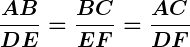
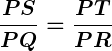
For example, if \boldsymbol, then:

\boldsymbol \displaystyle\boldsymbol

This concept is foundational in geometry and has practical applications in fields such as construction, navigation, and design.

Basic Proportionality Theorem (Thales' Theorem)

Statement

If a line is drawn parallel to one side of a triangle, intersecting the other two sides, the line divides those sides in the same ratio.

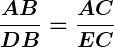
In \boldsymbol, if \boldsymbol, then:

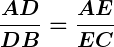
\displaystyle\boldsymbol

Understanding Thales' Theorem

Setup

  1. Draw any angle \boldsymbol and on one arm \boldsymbol, mark points \boldsymbol such that: \boldsymbol
  2. Draw another arm \boldsymbol and mark a point \boldsymbol on it.
  3. From \boldsymbol, draw \boldsymbol.

Observations

Measure \boldsymbol, \boldsymbol, \boldsymbol, and \boldsymbol.
You will find:

\displaystyle\boldsymbol{\frac = \frac}

This supports the Basic Proportionality Theorem.

Proof of Basic Proportionality Theorem

Given

In \boldsymbol, \boldsymbol intersects \boldsymbol and \boldsymbol at \boldsymbol and \boldsymbol.

To Prove

\displaystyle\boldsymbol{\frac = \frac}

Construction

  1. Draw \boldsymbol and \boldsymbol.

Proof

  1. Area of \boldsymbol is proportional to its base \boldsymbol:
    \displaystyle\boldsymbol
  2. Similarly, for \boldsymbol:
    \displaystyle\boldsymbol
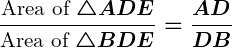
  3. Taking the ratio of areas:
    Area of \displaystyle\boldsymbol{\frac{\text{Area of } \triangle ADE}{\text{Area of } \triangle BDE} = \frac}
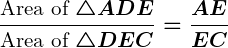
  4. Similarly, for \boldsymbol and \boldsymbol:
    Area of \displaystyle\boldsymbol{\frac{\text{Area of } \triangle ADE}{\text{Area of } \triangle DEC} = \frac}
  5. Thus, \displaystyle\boldsymbol{\frac = \frac}.

Converse of Basic Proportionality Theorem

Statement

If a line divides any two sides of a triangle in the same ratio, then the line is parallel to the third side.

Proof

  1. Suppose \displaystyle\boldsymbol{\frac = \frac}.
  2. Assume \boldsymbol is not parallel to \boldsymbol.
  3. Draw \boldsymbol \parallel BC}, and by the Basic Proportionality Theorem: \displaystyle\boldsymbol{\frac = \frac{AE'}{E'C}}
  4. But this contradicts \displaystyle\boldsymbol{\frac = \frac}. Hence, \boldsymbol.

Examples Based on Theorems

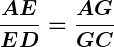
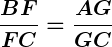
Example 1: Prove \displaystyle\boldsymbol{\frac = \frac = \frac}
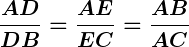
Solution:
From Thales' Theorem:

\displaystyle\boldsymbol​

Adding 1 to both sides:

\displaystyle\boldsymbol \displaystyle\boldsymbol​

Thus:

\displaystyle\boldsymbol

Example 2: Prove \displaystyle\boldsymbol in a trapezium.

Solution:
Join \boldsymbol, intersecting \boldsymbol at \boldsymbol.

  1. Using Thales' Theorem in \boldsymbol: \displaystyle\boldsymbol
  2. Similarly, in \boldsymbol: \displaystyle\boldsymbol

Thus:

\displaystyle\boldsymbol

Example 3: Prove \boldsymbol.

Solution:

  1. \boldsymbol, so by Thales' Theorem: \displaystyle\boldsymbol
  2. \boldsymbol (corresponding angles).

Thus, \boldsymbol.

Practice Problems

  1. In \boldsymbol, prove that \displaystyle\boldsymbol when \boldsymbol.
  2. Prove that the ratio of the areas of two similar triangles is equal to the square of the ratio of their corresponding sides.
  3. In \boldsymbol, \boldsymbol. If \boldsymbol cm, \boldsymbol cm, and \boldsymbol cm, find \boldsymbol.

Related Topics

Related Posts

[latest_pages_by_parent parent_id="65759" number="10"]
[latest_pages_by_parent parent_id="66155" number="10"]
[latest_pages_by_parent parent_id="66211" number="10"]
[latest_pages_by_parent parent_id="66213" number="10"]

Join Deeksha Vedantu

> PU + Competitive Exam CoachingPreferred Choice For Toppers25+ Years of Academic Excellence70k+ Success Stories

Related Pages

Latest Posts

  • Geometry Proofs: A Step-by-Step Method for Board-Style Answers

    Geometry Proofs: A Step-by-Step Method for Board-Style Answers

  • Word Problems in Algebra – A Framework for Translating English Into Equations

    Word Problems in Algebra – A Framework for Translating English Into Equations

  • Class 10 Science: The Diagram Questions You Cannot Afford to Skip Revising

    Class 10 Science: The Diagram Questions You Cannot Afford to Skip Revising

  • How to Self-Check Your Maths Numericals Without an Answer Key

    How to Self-Check Your Maths Numericals Without an Answer Key

  • Ray Diagram Practice: A Step-by-Step Method for Mirrors and Lenses

    Ray Diagram Practice: A Step-by-Step Method for Mirrors and Lenses

  • Trigonometry Numericals: A Practice Sequence From Easy to Board-Level

    Trigonometry Numericals: A Practice Sequence From Easy to Board-Level

  • Class 10 Science Numericals: Chapter-by-Chapter List of the Most Repeated Ones

    Class 10 Science Numericals: Chapter-by-Chapter List of the Most Repeated Ones

  • How to Practice Chemical Equation Balancing Until It’s Automatic

    How to Practice Chemical Equation Balancing Until It’s Automatic