
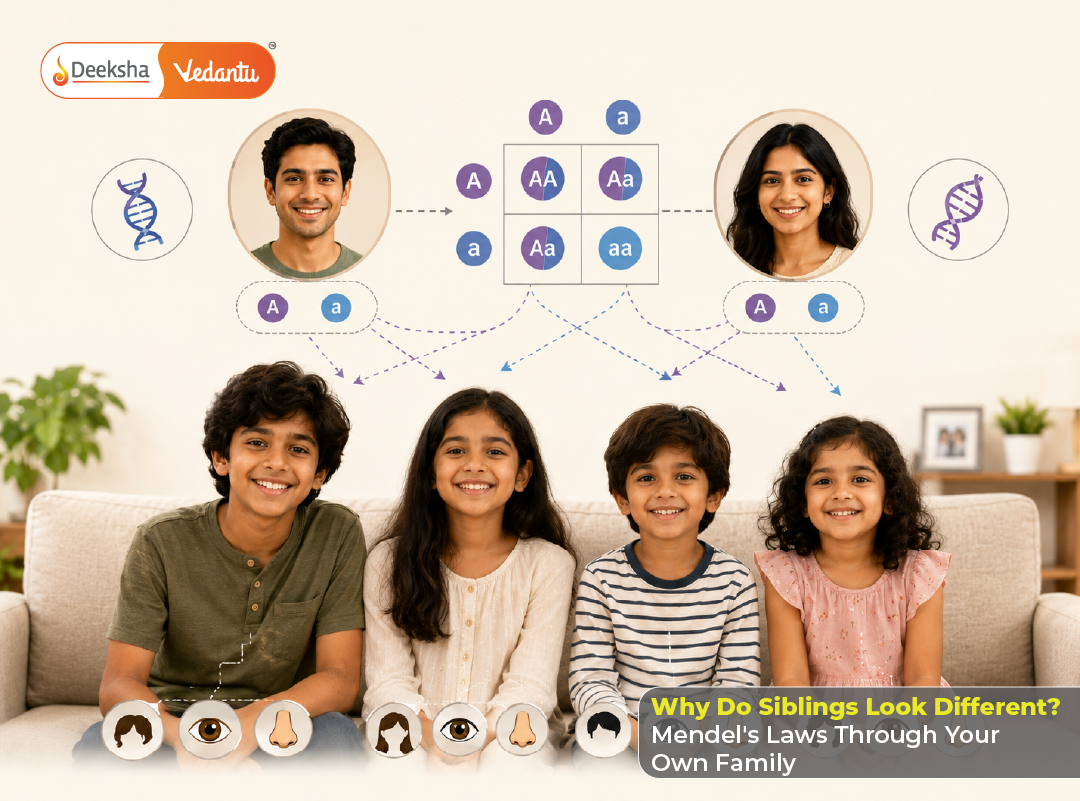


Two siblings, same parents, same house, same upbringing – and yet one has their mother’s curly hair while the other has their father’s straight hair. One is tall, the other noticeably shorter. If genetics were simply a matter of “children inherit their parents’ traits,” siblings should look like predictable blends of mom and dad, roughly the same each time. They don’t. And the reason they don’t is exactly what Gregor Mendel spent years in a monastery garden, breeding pea plants, quietly working out – long before anyone knew what a gene or a chromosome even was.
The Blending Theory That Mendel’s Peas Disproved
Before Mendel, the dominant assumption about inheritance was that offspring simply blended their parents’ traits together, the way mixing two paint colors produces a uniform intermediate shade. Under this theory, a tall parent and a short parent should reliably produce medium-height children, generation after generation, with no real variation.
Mendel’s pea plant experiments broke this assumption entirely. When he crossed a pure tall pea plant with a pure short pea plant, the very next generation wasn’t medium-height at all – every single offspring plant was tall, with no trace of shortness visible anywhere. The “short” trait hadn’t blended away or averaged out. It had simply gone quiet, hidden, while the tall trait showed up completely and exclusively. This single observation – an entire trait disappearing without a blend, then reappearing intact a generation later – is exactly what led Mendel to his first and most important insight.
Law of Dominance: Why One Trait “Wins” Without Erasing the Other
Mendel proposed that each parent contributes a distinct hereditary unit (what we now call an allele) for every trait, and when a plant inherits two different versions of that unit – one for tall, one for short – the two don’t blend. Instead, one version, called dominant, expresses itself completely, while the other, called recessive, stays present but silent, hidden by the dominant version’s presence.
This is the exact mechanism behind your siblings looking different despite sharing the same two parents. Each parent carries two alleles for a given trait – say, eye color – and those two alleles aren’t necessarily identical to each other, since each parent themselves inherited one allele from each of their own parents. A parent might carry one dominant “brown eye” allele and one recessive “blue eye” allele simultaneously, with brown visibly expressed while blue sits silently present, fully capable of being passed on regardless of which trait the parent themselves visibly displays.
Law of Segregation: Why Each Child Gets a Genuinely Random Half
Here’s where the real sibling variation begins. When a parent produces reproductive cells (sperm or egg), their two alleles for any given trait separate – segregate – from each other, so that each individual reproductive cell receives only one of the two alleles, never both. Which specific allele ends up in which specific cell is a matter of pure chance, decided independently every single time a new reproductive cell forms.
This means a parent carrying one brown-eye allele and one blue-eye allele doesn’t pass on some fixed, predetermined combination to every child – each child receives a fresh, independently random draw of just one of those two alleles from that parent, and a separate independent draw from the other parent. Two children from the same two parents can genuinely receive different combinations of alleles for the same trait, purely due to this segregation process happening freshly and randomly at each child’s conception – which is exactly why one sibling might display a trait neither parent visibly shows, having inherited two recessive alleles (one hidden in each parent) that happened to combine together in that one specific child.
Law of Independent Assortment: Why Height and Eye Color Don’t Travel Together
Mendel’s third major insight explains something else siblings demonstrate constantly: a child doesn’t inherit their traits as a single, linked bundle – height, eye color, hair texture, and every other trait are each inherited independently of one another, with the segregation of alleles for one trait having no bearing on how alleles for a completely different trait segregate.
This is exactly why a sibling can inherit their father’s height alongside their mother’s eye color, while another sibling inherits the reverse combination – tall with father’s eyes, or short with mother’s eyes – all four combinations being equally possible outcomes from the exact same two parents, precisely because height-related alleles and eye-color-related alleles assort into reproductive cells independently of each other. If traits were inherited as fixed, linked packages, siblings would tend to resemble one parent consistently across multiple traits simultaneously – but independent assortment is exactly why real siblings so often mix and match traits from both parents in ways that feel almost deliberately varied.
Putting the Three Laws Together, Through Your Own Family
| Mendel’s Law | What It Explains | Sibling Evidence |
| Law of Dominance | Why some traits “hide” in a parent without disappearing | A trait skipping a generation, then reappearing in a grandchild |
| Law of Segregation | Why each child gets a fresh, random allele draw | Siblings inheriting genuinely different trait combinations |
| Law of Independent Assortment | Why traits don’t travel together as fixed bundles | One sibling mixing father’s height with mother’s eyes, another sibling mixing the reverse |
Notice that all three laws are really answering the same underlying question from three different angles: why doesn’t inheritance simply average out into predictable sameness? Dominance explains why hidden traits don’t disappear entirely. Segregation explains why each child’s inheritance is a fresh random event rather than a fixed formula. Independent assortment explains why that randomness applies separately to each trait rather than as one linked package. Together, they’re the complete explanation for why two children raised in the exact same household, by the exact same parents, can end up looking like two entirely different combinations of the same genetic starting material.
Where This Fits Into Your Broader Preparation
Once this family-based intuition feels solid, the complete formal treatment – including Mendel’s actual pea plant cross ratios (the famous 3:1 phenotypic ratio) and the specific genotype notation NCERT expects – is covered on the Mendel’s laws of inheritance page, which extends directly from the family story above into the exact terminology your exam will test. The broader question of how variation enters a population in the first place, beyond just allele combinations within one family, is developed further on heredity traits and accumulation of variation during reproduction, both worth reading alongside this piece since they connect individual family inheritance to the larger evolutionary picture the same NCERT chapter builds toward.
For structured, board-exam-specific revision of this chapter, the CBSE Class 10 Science notes for Chapter 9: Heredity and Evolution is the natural next stop, and testing this understanding against real exam conditions through the MCQ questions on heredity and evolution will confirm how much of this family-based intuition has translated into exam-ready recall of Mendel’s specific terminology and ratios.
Frequently Asked Questions
If a trait is recessive in both parents, will it definitely show up in every child?
Yes – if both parents carry only the recessive allele for a trait (meaning neither has a dominant version to pass on), every child will inherit two recessive alleles and display that trait, since there’s no dominant allele available anywhere in the cross to mask it.
Can two children from the same parents have completely opposite combinations of every trait?
In principle, yes, though it becomes statistically less likely as more traits are considered together – since each trait segregates and assorts independently, the number of possible combinations grows rapidly with each additional trait being tracked.
Does Law of Independent Assortment apply to every pair of traits, without exception?
Mendel’s original law assumed this, but we now know some genes located very close together on the same chromosome tend to be inherited together more often than pure independent assortment would predict – a more advanced concept called gene linkage, generally introduced beyond the Class 10 syllabus level.
Siblings looking different was never a mystery requiring some separate explanation from what Mendel worked out in a monastery garden with pea plants – it’s the exact same three laws, playing out quietly at each child’s conception. A hidden trait resurfacing, a fresh random draw of alleles, traits mixing independently rather than traveling in fixed bundles – that’s not coincidence shaping your own family. That’s genetics, doing precisely what Mendel predicted it would.











Get Social