


What is Coordinate Geometry?
Coordinate Geometry, or analytic geometry, connects algebra and geometry by representing geometric shapes and problems using equations. Each point on a plane is represented by an ordered pair:

where:
 is the horizontal distance (abscissa).
 is the vertical distance (ordinate).
 is the horizontal distance (abscissa).
 is the vertical distance (ordinate).
Why Learn the Section Formula?
The section formula helps locate a point that divides a line segment joining two points in a given ratio. It is widely applicable in:
- Engineering and Design: To proportionally divide structures or objects.
- Navigation and Mapping: Locating intermediate points between destinations.
- Graphics and Animation: Rendering positions in 2D models.
- Physics: Analyzing motion along a straight line.
Section Formula
The section formula provides the coordinates of a point  dividing a line segment joining two points
  and
and  in the ratio
  :
:

Special Cases:
- Midpoint Formula:
When the dividing point divides the line segment into equal parts (
 ):
): 
- Centroid of a Triangle:
The point that divides each median of a triangle into a ratio of
  (vertex to midpoint):
- Distance Formula:
The distance between two points and is given by:
- External Division Formula:
When a point divides the line segment externally in the ratio  , the formula is:
- Slope of a Line:
The slope of a line passing through two points and is:
 ):
): 
 that divides each median of a triangle into a ratio of
  (vertex to midpoint):
 between two points

Section Formula
Definition:
The section formula helps determine the coordinates of a point that divides a line segment joining two points and in a given ratio . This formula is crucial for solving problems in geometry where proportional division of line segments is required.
Formula:
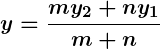
The coordinates of the point are given by:
Where:
- : Represents the coordinates of the dividing point.
- and : Are the coordinates of the endpoints of the line segment.
- : Denotes the ratio in which the point divides the line segment.
and  are positive constants.
Derivation of the Section Formula:
To derive the formula for the coordinates of a point that divides a line segment joining two points  and
and  in the ratio .
Step-by-Step Derivation
- Consider a Line Segment:
- Let
 and
and  be the endpoints of the line segment.
 - Let be the point dividing
 in the ratio .
- Let
- Proportionality:
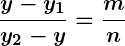
- The division ratio implies:

- This means that the distance
 is parts, and
  is parts.
- The division ratio implies:
- Use of Coordinates:
- In coordinate geometry, the distances along the x-axis and y-axis are proportional to the division ratio.
- Let the x-coordinate of
 be , and the y-coordinate be .
- Apply Proportionality Along the X-Axis:
- The position of along the x-axis is determined by the weighted average of
 and :
and : 
- Cross-multiply to get: n

- Expand and rearrange:


- Solve for :

- The position of
- Apply Proportionality Along the Y-Axis:
- Similarly, for the y-coordinate of :

- Cross-multiply and solve as done for :


- Solve for :

- Similarly, for the y-coordinate of
- Combine Results:
- The coordinates of are:
- The coordinates of
 in the ratio
 is
is  is
is  be
be  and
and  :
: 









Applications of the Section Formula:
- Internal Division:
- When the point lies between the two endpoints of the line segment, the section formula is applied as:
- When the point lies between the two endpoints of the line segment, the section formula is applied as:
- External Division:
- When the point divides the line segment externally, the formula becomes:
Here, to ensure valid results.
- When the point divides the line segment externally, the formula becomes:
- Special Cases:
- Midpoint Formula:
If, the formula simplifies to:
- Centroid of a Triangle:
When dividing the medians of a triangle in the ratio:
- Midpoint Formula:
- Distance Formula (for verifying calculations):
The distance between two points and is:
- Slope of a Line:
The slope of a line passing through two points and is:
Types of Division
Internal Division
Internal division occurs when the point lies between the two endpoints of a line segment and . This means that the point divides the line segment internally in a specified ratio .
- Formula for Internal Division:
- Explanation:
- and represent the weights of division, such that:
- The formula calculates the weighted average of the coordinates of and .
- Example: Find the coordinates of a point dividing the line segment joining
 and in the ratio .
- Using the internal division formula:

 .
.
- Using the internal division formula:
 .
.
 .
.External Division
External division occurs when the point lies outside the line segment, such that it divides the line segment and externally in a specified ratio . This type of division happens when the line segment is extended beyond one of the endpoints.
- Formula for External Division:

- Explanation:
- and still represent the weights of division, but the subtraction in the formula reflects the external division.
- For valid results, to ensure
 .
.
- Example: Find the coordinates of a point dividing the line segment joining and externally in the ratio
 .
.- Using the external division formula:

 .
.
- Using the external division formula:
 .
. and
and  externally in the ratio
  .
.
 .
.Comparison of Internal and External Division
| Aspect | Internal Division | External Division |
| Position of Point | Lies between the endpoints of the line segment. | Lies outside the endpoints, beyond the line segment. |
| Formula |  |  |
| Ratio Condition |  and and  are both positive. are both positive. |  for valid results. for valid results. |
Solved Examples
Example 1: Internal Division
Problem:
Find the point dividing a line segment joining  and
and  in the ratio
  .
.
Solution: Using the section formula for internal division:

Substitute:

 ,
, 


 ,
, 

Simplify:


Example 2: External Division
Problem:
Determine the coordinates of a point dividing a line segment joining  and
and  externally in the ratio
  .
.
Solution: Using the section formula for external division:

Substitute:

 ,
, 


 ,
, 

Simplify:

 Verifying Collinearity: Check if points" title="Rendered by QuickLaTeX.com" height="100" width="692" style="vertical-align: -6px;"/>\boldsymbol
 \boldsymbol
 \boldsymbol
 Find the slope between" title="Rendered by QuickLaTeX.com" height="72" width="692" style="vertical-align: -4px;"/>\boldsymbol
 \boldsymbol
 \displaystyle\boldsymbol
 Find the slope between" title="Rendered by QuickLaTeX.com" height="46" width="690" style="vertical-align: -4px;"/>\boldsymbol\boldsymbol\displaystyle\boldsymbol
 Since" title="Rendered by QuickLaTeX.com" height="46" width="690" style="vertical-align: -4px;"/>\boldsymbol
 Finding the Midpoint: Find the midpoint of a line segment joining" title="Rendered by QuickLaTeX.com" height="98" width="692" style="vertical-align: -4px;"/>\boldsymbol\boldsymbol
 Using the midpoint formula:" title="Rendered by QuickLaTeX.com" height="46" width="690" style="vertical-align: -4px;"/>\displaystyle\boldsymbol
 Substitute:" title="Rendered by QuickLaTeX.com" height="46" width="690" style="vertical-align: -4px;"/>\displaystyle\boldsymbol$










Get Social