
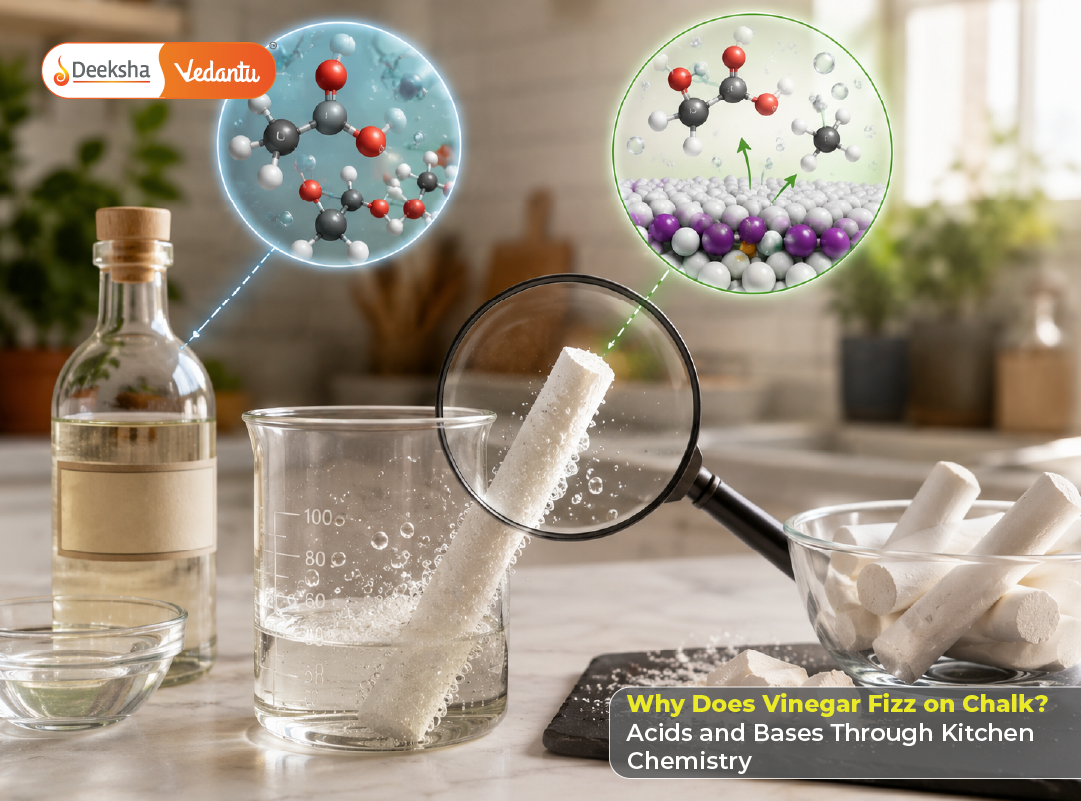


Pour a little vinegar onto a piece of chalk, and it starts hissing and bubbling almost immediately – a genuine chemical reaction happening right there on your kitchen counter, no lab equipment required. This isn’t a party trick. It’s the entire acids-and-bases chapter, playing out in real time, and understanding exactly what’s fizzing and why unlocks nearly every concept the chapter asks you to memorize.
What’s Actually Fizzing When Vinegar Meets Chalk
Chalk is mostly calcium carbonate (CaCO₃) – a base, in the broad chemical sense of the term. Vinegar is a dilute solution of acetic acid. When they meet, an acid-base reaction happens, and one of the products is carbon dioxide gas, which is exactly the bubbles you’re watching escape as fizz.
CaCO₃ + 2CH₃COOH → (CH₃COO)₂Ca + H₂O + CO₂↑
You don’t need to memorize this specific equation to get the underlying lesson: this reaction is a direct, visible demonstration that acids react with carbonates to release carbon dioxide – a rule the NCERT chapter states as a fact to memorize, but which your kitchen counter just demonstrated as an observable event. The gas escaping as bubbles is literally the reaction’s signature, which is exactly why “does it fizz with a carbonate” is one of the standard tests chemists use to confirm whether an unknown substance is actually acidic.
Why Lemon Juice Tastes Sour and Soap Tastes Bitter (If You’ve Ever Accidentally Tasted It)
Every acid you’ve ever eaten – lemon, vinegar, unripe mango, curd – shares that distinctive sour taste, and that’s not a coincidence. Sourness is one of the defining sensory properties of acids, caused specifically by the presence of hydrogen ions (H⁺) that acids release when dissolved in water. The more readily an acid releases these H⁺ ions, the more strongly acidic – and often the more intensely sour – it tastes.
Bases work in the opposite sensory direction: soap, chalk suspended in water, and baking soda solutions all share a distinctive bitter taste and a slippery, soapy feel between your fingers. That slippery texture is genuinely diagnostic – it comes from the base reacting with oils on your skin, forming a slippery soap-like substance in real time, which is exactly why soap itself (chemically, a base) feels the way it does when wet.
Worth noting immediately: NCERT specifically warns against testing pH by taste or touch in a lab setting, since many acids and bases are genuinely corrosive or toxic – the kitchen examples above work because vinegar, lemon juice, and everyday soap are dilute and safe, but this same method absolutely doesn’t generalize to lab chemicals.
The Cabbage Juice Trick That Turns Your Kitchen Into a Litmus Test
Here’s a genuinely useful home experiment: boil some red cabbage in water, and the resulting purple liquid works as a natural pH indicator, almost exactly like litmus in a chemistry lab. Add a splash of lemon juice or vinegar, and the purple liquid turns pink or red. Add a pinch of baking soda instead, and it turns blue or green.
This single kitchen demonstration is the entire concept behind litmus paper, made visible and repeatable at home: certain natural pigments change color depending on whether they’re in an acidic or basic environment, and this color change is precisely what makes indicators useful – they let you determine whether an unknown substance is acidic or basic without needing to taste or touch it. Red cabbage juice, turmeric, and litmus all work through the same underlying principle, just with different pigment molecules responding to H⁺ and OH⁻ ion concentrations differently.
Why Adding Water to Vinegar Makes It Taste Less Sour (Concentration vs. Strength)
Pour a small amount of vinegar into a large glass of water, and it tastes noticeably less sour than straight vinegar – an intuitive result, but one that hides an important chemical distinction NCERT specifically tests: the difference between a strong acid and a concentrated acid.
Vinegar is a weak acid – acetic acid doesn’t fully ionize into H⁺ ions in water, even in its undiluted form, which is a fixed chemical property of the acid itself. Diluting it with water doesn’t change whether it’s weak or strong; it only changes its concentration – how much of that weak acid is present per unit of water. This is exactly why a very dilute solution of a strong acid (like hydrochloric acid heavily diluted with water) can taste or react less intensely than concentrated vinegar, despite HCl being fundamentally the stronger acid of the two – strength describes how completely an acid ionizes, while concentration describes how much of it is dissolved, and the two are genuinely independent properties that NCERT frequently tests as a distinguishing pair. The full ionization-based explanation of this distinction is covered on the what do all acids and all bases have in common page.
The Baking Soda Trick for an Upset Stomach – Neutralization You’ve Actually Used
Excess stomach acid causing discomfort is commonly treated by drinking a small amount of baking soda (sodium bicarbonate) dissolved in water – an antacid, in chemical terms. This works through neutralization: the base (baking soda) reacts directly with the excess acid in your stomach, converting it into a neutral salt, water, and carbon dioxide, relieving the acidic irritation.
NaHCO₃ + HCl → NaCl + H₂O + CO₂↑
This is the exact same reaction category as the vinegar-and-chalk fizz from the opening example, just happening inside your stomach instead of on a countertop – an acid meeting a carbonate-based compound, releasing CO₂ as one of the products. Once you’ve noticed this pattern, neutralization stops being an abstract textbook term and becomes something you can point to as a genuinely useful, everyday chemical reaction you may have already relied on.
The Chapter, Traced Through Your Kitchen
| Kitchen Moment | NCERT Concept | Key Idea |
| Vinegar fizzing on chalk | Acid + carbonate → CO₂ | Fizzing is a diagnostic test for this reaction type |
| Lemon juice tasting sour | Acids release H⁺ ions | Sourness is linked directly to H⁺ concentration |
| Soap feeling slippery | Bases react with skin oils | Slipperiness is a sensory property of bases |
| Cabbage juice changing color | Indicators | Color change reveals acid vs. base without taste/touch |
| Diluted vinegar tasting milder | Concentration vs. strength | Weak/strong is fixed; concentration is variable |
| Baking soda for stomach acid | Neutralization | Acid + base → salt + water (+ CO₂ if a carbonate is involved) |
Where This Fits Into Your Broader Preparation
Once these kitchen-based intuitions feel solid, the complete formal treatment – including pH scale numerics and the specific reactions of acids with metals – is covered on the understanding the chemical properties of acids and bases page, and the broader salt-formation chemistry that neutralization leads into is developed further on more about salts. For structured revision built specifically around board exam requirements, the CBSE Class 10 Science notes for Chapter 2: Acids, Bases and Salts is the natural next stop, and practicing recall against real conditions through MCQ questions on acids, bases, and salts with answers will confirm how much of this kitchen-built intuition has actually translated into exam-ready recall.
Frequently Asked Questions
Is it safe to try the red cabbage indicator experiment at home?
Yes – boiling red cabbage and testing it against safe household substances like lemon juice, vinegar, or baking soda is a genuinely safe, commonly recommended home experiment, unlike testing with actual laboratory-grade acids or bases.
Why does vinegar fizz with chalk but not with something like table salt?
Fizzing specifically indicates a reaction producing carbon dioxide gas, which happens when an acid reacts with a carbonate compound like chalk (calcium carbonate) – table salt isn’t a carbonate, so no such gas-producing reaction occurs.
Is a stronger-tasting sour food always a stronger acid, chemically speaking?
Not necessarily – taste intensity is influenced by both the acid’s inherent strength (how completely it ionizes) and its concentration in the food, so a highly concentrated weak acid can taste more intensely sour than a dilute strong acid, even though the strong acid is chemically the more powerful one.
Acids and bases were never really a chapter that needed a laboratory to come alive – vinegar fizzing on chalk, soap’s slippery feel, and baking soda calming an upset stomach were quietly demonstrating this entire chapter long before you ever opened the textbook. Once you’ve noticed the chemistry sitting in your own kitchen, the formulas are just precise names for things you’d already witnessed.











Get Social