
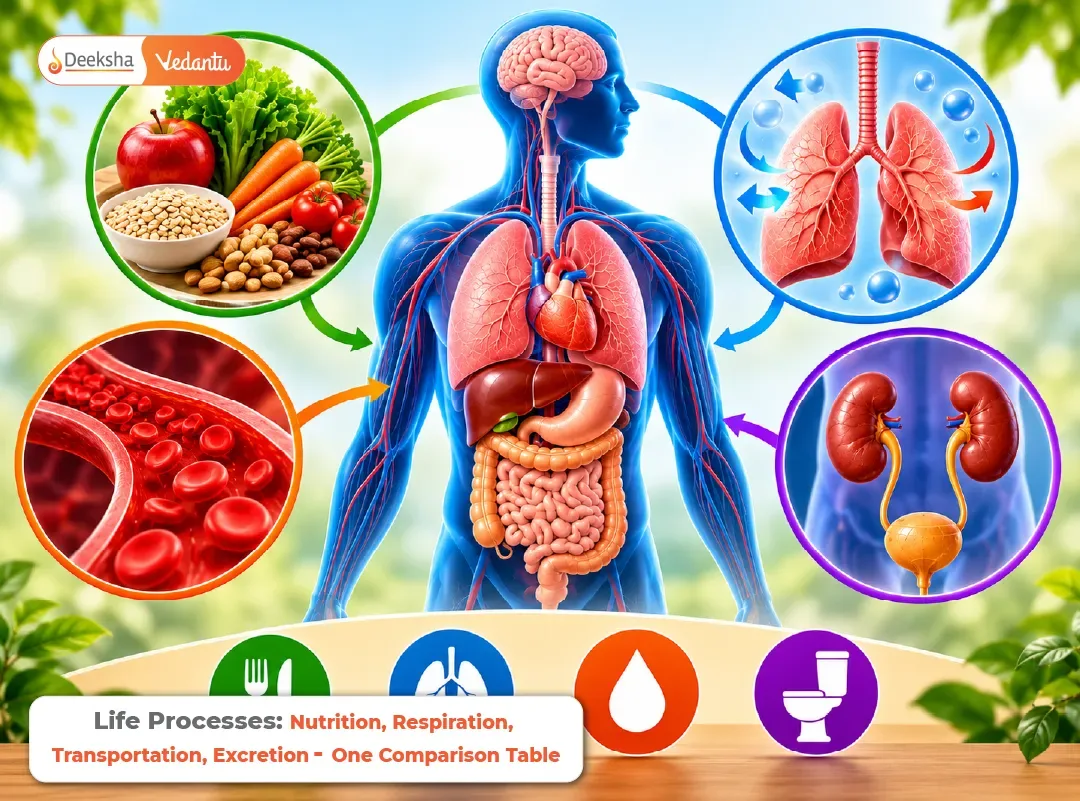
The life processes chapter feels long because it covers four big processes, each in humans and in plants, each with its own organs and its own diagrams. It is easier when you see that they are not four separate topics. They are four stages of one story: how a living body gets energy and materials, moves them around, and gets rid of what it does not need.
This guide follows a single mouthful of food through all four processes, then puts everything into comparison tables you can revise from in minutes.
Follow a Mouthful of Food
- Nutrition. You chew a piece of bread. Salivary amylase starts breaking the starch, and the food travels down the oesophagus into the stomach and then the small intestine, where it is fully digested into simple sugars, amino acids and fatty acids. These are absorbed into the blood.
- Transportation. The blood carries the glucose to every cell in the body.
- Respiration. Inside the cells, glucose is broken down with oxygen to release energy: glucose + oxygen → carbon dioxide + water + energy.
- Excretion. The waste products, such as carbon dioxide and urea, are carried by the blood to the lungs and the kidneys, and removed.
Each process depends on the one before it, which is why a question in one often needs facts from another.
The Four Processes in One Table
| Process | What it does | Main organs in humans | Key substances |
| Nutrition | Takes in and breaks down food to get energy and building materials | Alimentary canal, liver, pancreas | Enzymes (amylase, pepsin, trypsin, lipase), bile, HCl |
| Respiration | Releases energy from food inside cells | Lungs, with the nose, trachea, bronchi and alveoli | Oxygen, glucose, carbon dioxide, ATP, haemoglobin |
| Transportation | Moves materials around the body | Heart, blood vessels | Blood (plasma, red cells, white cells, platelets) and lymph |
| Excretion | Removes the waste made by the body | Kidneys, ureters, bladder, urethra, and the lungs and skin | Urea, uric acid, carbon dioxide, water |
Humans and Plants Compared
| Process | In humans | In plants |
| Nutrition | Heterotrophic. Food is eaten and digested by enzymes in the alimentary canal | Autotrophic. Food is made by photosynthesis: carbon dioxide + water, in the presence of sunlight and chlorophyll, gives carbohydrate and oxygen |
| Respiration | Gas exchange in the alveoli of the lungs, then aerobic respiration in the cells | Gas exchange by diffusion through stomata, lenticels and roots, with no special breathing organs |
| Transportation | Heart pumps blood in a double circulation through arteries, veins and capillaries | Xylem carries water and minerals upward. Phloem carries food from the leaves to all parts |
| Excretion | Kidneys filter blood and make urine through nephrons | No special organs. Gases leave through stomata, excess water by transpiration, and other wastes are stored in old leaves, bark and cell vacuoles, or lost as resins and gums |
A useful way to remember the plant column is that plants make less waste per unit of mass, they can store it safely, and they shed it when they drop leaves.
The Details Most Often Asked
Digestion, step by step
Mouth (salivary amylase) → oesophagus (peristalsis) → stomach (hydrochloric acid, pepsin and mucus) → small intestine (bile from the liver and enzymes from the pancreas and the intestinal wall, absorption through villi) → large intestine (absorbs water) → anus.
Two kinds of respiration
| Aerobic | Anaerobic | |
| Needs oxygen? | Yes | No |
| Where | Starts in the cytoplasm, completes in mitochondria | Cytoplasm |
| Products | Carbon dioxide, water and a large amount of energy | In yeast: ethanol, carbon dioxide and a little energy. In muscle: lactic acid and a little energy |
The kidney in three steps
A nephron filters blood at the glomerulus, takes back useful substances such as glucose and amino acids by selective reabsorption, and sends the rest on as urine, with the amount of water adjusted to what the body needs.
Diagrams to Practise
The chapter is full of diagrams, and these are the ones that come up repeatedly. Each has its own guide: the most commonly asked diagrams in life processes, a walkthrough of how the human heart pumps blood, the excretory system diagram labelling guide, and an explanation of why you breathe faster after running.
Why Each Process Needs the Others
The four life processes are not four separate jobs. If any one of them fails, the others follow, and seeing the chain of failure is the quickest way to understand how they connect.
| If this fails… | …this follows |
| Nutrition | No glucose reaches the cells, so respiration has no fuel and no energy is released |
| Respiration | No ATP is made, so the heart, muscles and kidneys cannot work |
| Transportation | Food and oxygen cannot reach the cells, and waste cannot leave them |
| Excretion | Waste such as urea builds up in the blood and harms the body |
This is also why a problem in one system soon shows up in the others.
Photosynthesis and Respiration: Two Sides of One Cycle
Students often mix up these two, because both involve gases, glucose and energy. They are close to opposites.
| Photosynthesis | Respiration | |
| Where | In chloroplasts of green plants | In the cells of all living organisms, mostly in mitochondria |
| Needs | Carbon dioxide, water, sunlight and chlorophyll | Glucose and (usually) oxygen |
| Gives | Glucose and oxygen | Carbon dioxide, water and energy |
| Energy | Stores light energy as chemical energy | Releases chemical energy as usable energy |
| When | Only in light | All the time, day and night |
Between them, the two processes keep the carbon and oxygen of the living world circulating. Plants use carbon dioxide and release oxygen, and every living thing, including the plant, uses oxygen and releases carbon dioxide.
Where a Chapati Goes
A plain chapati is a good way to trace the whole chapter in one example.
- Digestion. The starch in the chapati is broken down by amylase in the saliva and the pancreatic juice into glucose.
- Absorption. The villi of the small intestine absorb the glucose into the blood.
- Transport. The blood carries the glucose to every cell.
- Respiration. In the cells, the glucose is oxidised to release energy for movement, growth and keeping warm.
- Excretion. The carbon dioxide produced leaves through the lungs, and nitrogen-containing waste from proteins is removed as urea by the kidneys.
The fibre in the chapati is not digested and passes out as waste in the faeces, which is removal, but not excretion. Excretion strictly means the removal of metabolic waste, the waste made by the cells.
One Pore, Several Processes: The Stomata
The tiny pores on a leaf, the stomata, serve three of the plant’s life processes.
- Nutrition: carbon dioxide enters for photosynthesis.
- Respiration: oxygen enters and carbon dioxide leaves at night.
- Excretion and transport: water vapour leaves by transpiration, which also helps pull water up through the xylem.
The guard cells around each stoma open it when they swell with water and close it when they lose water. That is how the plant balances taking in gases against losing water, which is one of the cleverest trade-offs in the chapter.
Life Processes in Your Textbooks
Life Processes is Chapter 5 in the CBSE Class 10 Science textbook for 2026-27 and Chapter 6 in the Karnataka SSLC textbook, according to published listings. These chapter notes and the chapter MCQs with answers cover the full chapter. In Class 11 Biology, each process becomes its own chapter, such as breathing and exchange of gases, body fluids and circulation and excretory products and their elimination, which belong to the NEET Biology syllabus. Confirm the current portions with your own board and the latest NMC document.
Frequently Asked Questions
Q1. What are life processes?
Life processes are the basic functions that keep a living organism alive: nutrition, respiration, transportation and excretion.
Q2. What is the difference between breathing and respiration?
Breathing is the physical process of taking in oxygen and giving out carbon dioxide. Respiration is the chemical process inside cells that releases energy from food. Breathing supplies the oxygen that respiration uses.
Q3. How is transport in plants different from transport in humans?
Humans use a heart that pumps blood through vessels. Plants have no heart. Water and minerals rise through the xylem, and food moves through the phloem.
Q4. How do plants get rid of waste?
Plants release oxygen and carbon dioxide through stomata, lose water by transpiration, store wastes in old leaves, bark and cell vacuoles, and shed them when leaves fall. Some wastes leave as gums and resins.
Q5. Why do humans need double circulation?
In double circulation, blood passes through the heart twice in one complete round: once to the lungs to pick up oxygen and once to the body. This keeps oxygen-rich and oxygen-poor blood separate, so the body gets a steady, efficient supply of oxygen.
One Story, Four Chapters
Life processes are easier to learn when you keep the thread: food in, energy out, materials moved, waste removed. Put every fact in the chapter on that thread, and the tables become reminders and not things to memorise.




Get Social